Dr. Jitendra Singh visits ICGEB Trieste with Indian students
Synopsis
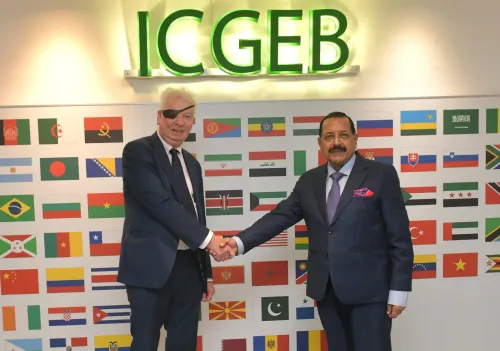
Union Science and Technology Minister Dr. Jitendra Singh visited the International Centre for Genetic Engineering and Biotechnology in Trieste, Italy, meeting Indian students and Director General Dr. Lawrence Banks, reaffirming India's four-decade founding partnership with the global research body.
Key Takeaways
Jitendra Singh visited ICGEB headquarters in Trieste, Italy on 16 November 2026 .
He was accompanied by a group of Indian students training at the institute.
Lawrence Banks , Director General of ICGEB, was also present at the meeting.
India has been a founding member of ICGEB since 1983 and hosts component laboratories in New Delhi .
India funds student fellowships that enable young Indian researchers to train at Trieste and other ICGEB centres.
The visit is part of India's broader pattern of high-level engagement with multilateral science bodies to support capacity building in the life sciences.
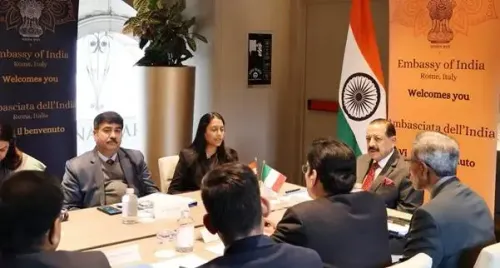
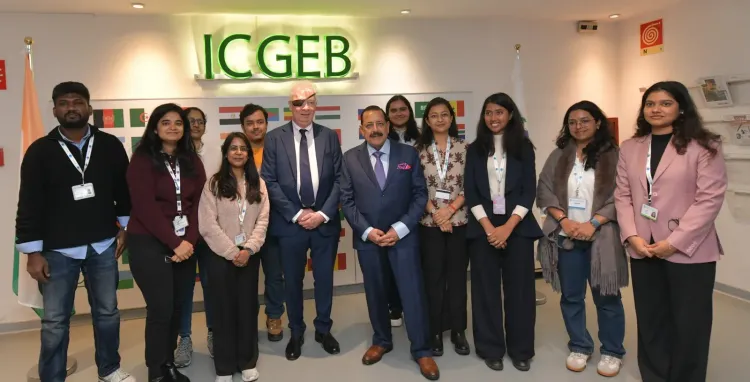
At the headquarters of one of the world's foremost multilateral biotechnology institutes, Union Science and Technology Minister Dr. Jitendra Singh met with a group of Indian students at the International Centre for Genetic Engineering and Biotechnology (ICGEB) in Trieste, Italy, on Monday, 16 November 2026 — a snapshot of the quiet but steady science diplomacy India runs through its founding partnership with the organisation.
The Minister shared an image from the visit, noting the presence of Dr. Lawrence Banks, Director General of ICGEB, alongside the Indian student group. The meeting underscores the human dimension of India's four-decade-old commitment to the institution — not just funding lines and policy agreements, but actual researchers and students moving through its laboratories.
India at ICGEB: a founding bond, four decades deep
India was among the founding members of ICGEB when it was established in 1983 under the auspices of the United Nations Industrial Development Organization (UNIDO). That relationship went further than a membership card: India subsequently set up its own ICGEB component laboratories in New Delhi under the Department of Biotechnology, making it one of only a handful of countries to host a full ICGEB node.
Successive Indian governments have sustained annual financial contributions to the organisation and supported student fellowships that allow young Indian life-science researchers to train at Trieste and other ICGEB centres. The students seen with Dr. Jitendra Singh are beneficiaries of precisely that pipeline — a living return on decades of institutional investment.
Dr. Lawrence Banks and ICGEB's global training mandate
Director General Dr. Lawrence Banks leads an organisation whose core mission sits at the intersection of cutting-edge genetic research and capacity building for developing nations. Under his stewardship, ICGEB has expanded its fellowship and training programmes, making the Trieste headquarters a destination for researchers from member states across Asia, Africa, and Latin America.
For Indian students in particular, a stint at Trieste offers exposure to world-class laboratory infrastructure and an international peer network — advantages that feed directly back into India's domestic biotechnology ecosystem, an industry the government has flagged as a high-priority growth sector.
Science diplomacy as soft power
Dr. Jitendra Singh is among the more internationally active science ministers in recent memory, regularly engaging with multilateral bodies, bilateral S&T committees, and global research organisations. A ministerial presence at ICGEB — standing alongside students, meeting the Director General — signals continuity of political will, the kind of assurance multilateral partners watch for before committing to expanded joint research calls or fellowship tranches.
India and Italy also maintain a broader bilateral science and technology cooperation framework, and visits like this one tend to complement the formal machinery of joint committee meetings that periodically set research priorities between the two countries.
The students in that Trieste photograph are both the story and the strategy — the clearest proof that India's science diplomacy is producing the one thing that outlasts any ministerial handshake: trained people.
Point of View
And periodic high-level visits help sustain the goodwill needed to negotiate expanded fellowships or joint research calls. The image of a minister standing with students — rather than just signing documents — also reflects a communications shift in how Indian science diplomacy is projected publicly. Watching whether this visit produces a concrete fellowship expansion or a new bilateral S&T agenda item will reveal whether the optics carry substantive follow-through.
NationPress
16 Nov 2026
Frequently Asked Questions
What is the ICGEB and what does India have to do with it?
The International Centre for Genetic Engineering and Biotechnology (ICGEB) is a multilateral research organisation founded in 1983 under UNIDO. India is a founding member and also hosts ICGEB component laboratories in New Delhi under the Department of Biotechnology.
Why did Dr. Jitendra Singh visit ICGEB in Trieste?
Dr. Jitendra Singh visited the ICGEB headquarters in Trieste, Italy, on 16 November 2026, meeting Indian students training there and Director General Dr. Lawrence Banks, as part of India's ongoing science diplomacy engagement with the institute.
Who is Dr. Lawrence Banks?
Dr. Lawrence Banks is the Director General of ICGEB, responsible for overseeing the organisation's global research and training programmes in genetic engineering and biotechnology across its member states.
Does India send students to train at ICGEB Trieste?
Yes. India has supported student fellowships that allow young Indian life-science researchers to train at ICGEB's Trieste headquarters and other centres, as part of its long-standing membership and financial contribution to the organisation.
Where is ICGEB headquartered?
ICGEB is headquartered in Trieste, Italy, where its main laboratories are located. It also has component laboratories in New Delhi, India, and Cape Town, South Africa.