Giriraj Singh hails Indian Railways as engine of new India
Synopsis
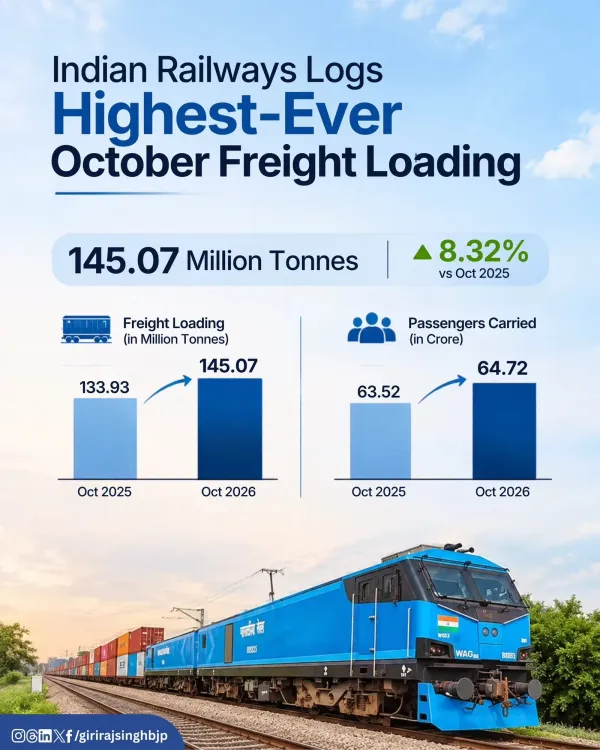
Union Textiles Minister Giriraj Singh on 17 November 2026 praised Indian Railways as a symbol of new India's progress, citing rising speed, capacity, and public trust, and linking the network's expansion to the country's broader economic momentum.
Key Takeaways
Giriraj Singh , Union Textiles Minister and Lok Sabha MP from Begusarai, Bihar , praised Indian Railways on 17 November 2026 .
He described the railway's growing speed, capacity, and public trust as a 'strong picture of new India's progress.' Indian Railways is one of the world's largest rail networks and a central pillar of India's National Infrastructure Pipeline .
The Dedicated Freight Corridor project, accelerated after 2014 , separates freight and passenger traffic to boost capacity and speed.
The post is part of a broader BJP ministerial pattern of framing infrastructure milestones within a unified national development narrative.
Parliamentary discussions on the next railway budget and high-speed corridor timelines will be the next tangible test of these claims.
India's national railway network is picking up speed — literally and symbolically — and Union Textiles Minister Giriraj Singh wants the country to notice. On Tuesday, 17 November 2026, the senior BJP leader took to X to frame Indian Railways not just as a transport system, but as the economic backbone of a resurgent nation.
Posting in Hindi, Singh wrote: 'भारतीय रेलवे की बढ़ती रफ्तार, क्षमता और लोगों का बढ़ता भरोसा नए भारत की प्रगति की मजबूत तस्वीर पेश करता है' — 'The growing speed, capacity, and rising trust in Indian Railways presents a strong picture of new India's progress.' He added that the railways are today giving 'new strength to the country's economic momentum while also shaping new dimensions of development.'
Why a Textiles Minister is talking about Railways
Singh's portfolio sits in textiles, not transport. But senior BJP ministers have long used infrastructure milestones as part of a unified government narrative — stitching together roads, rails, and economic corridors into a single story of transformation. For a Lok Sabha MP from Begusarai, Bihar, a state where rail connectivity is a lived daily reality for millions of constituents, the railway is never an abstract talking point.
Indian Railways is one of the largest rail networks in the world, and successive governments have invested heavily in modernisation — electrification, station redevelopment, and the flagship Dedicated Freight Corridors (DFC) project, which separates freight and passenger traffic to unlock higher speeds and capacity on both. The DFC initiative, initiated in the mid-2000s and significantly accelerated post-2014, has been positioned as the centrepiece of India's logistics efficiency drive under the National Infrastructure Pipeline.
Rail as the spine of India's economic story
The broader pattern here is deliberate. Indian Railways sits at the intersection of industrial supply chains, agricultural logistics, and mass passenger movement — meaning its performance is a direct proxy for economic velocity. When freight volumes rise, factories are feeding demand. When passenger numbers grow, so does consumer mobility and regional integration.
Singh's framing — 'new dimensions of development' alongside 'economic momentum' — echoes the government's consistent positioning of infrastructure investment as a multiplier, not just a cost. Parliamentary discussions on upcoming railway budget allocations and the rollout timelines of high-speed corridors will be the next concrete test of whether that narrative is backed by numbers.
The rails are moving. The question the next budget session will answer is exactly how fast.
Point of View
' the messaging seeks to convert capital expenditure into a voter-facing story of tangible progress. For a Bihar MP, rail connectivity also carries strong local resonance, giving the national message a regional grounding. Watch for similar amplification from ministers across portfolios as railway budget discussions approach Parliament.
NationPress
17 Nov 2026
Frequently Asked Questions
What did Giriraj Singh say about Indian Railways?
On 17 November 2026, Giriraj Singh posted on X saying that Indian Railways' growing speed, capacity, and rising public trust present a strong picture of new India's progress, and that the network is giving new strength to the country's economic momentum.
What is the Dedicated Freight Corridor in India?
The Dedicated Freight Corridor (DFC) is a major Indian Railways infrastructure project that separates freight and passenger traffic onto dedicated lines, increasing the speed and capacity of both. It was initiated in the mid-2000s and significantly accelerated after 2014.
Why is a Textiles Minister commenting on Indian Railways?
Senior BJP ministers frequently comment on infrastructure development as part of a unified government narrative linking all sectors to national growth. Giriraj Singh, as a Lok Sabha MP from Bihar — a state with deep rail dependency — also has a strong constituency interest in railway progress.
What is the National Infrastructure Pipeline?
The National Infrastructure Pipeline is India's long-term infrastructure investment programme covering roads, railways, ports, energy, and other sectors. Indian Railways is one of its largest components, with investments targeted at modernisation, electrification, and new high-speed corridors.
What comes next for Indian Railways development?
Parliamentary discussions on the upcoming railway budget and rollout timelines for high-speed rail corridors are the next key milestones to watch for concrete progress on the modernisation agenda.