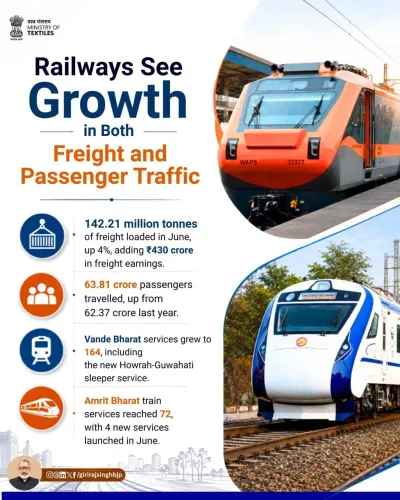
Giriraj Singh Highlights Indian Railways Digital Transformation
Synopsis
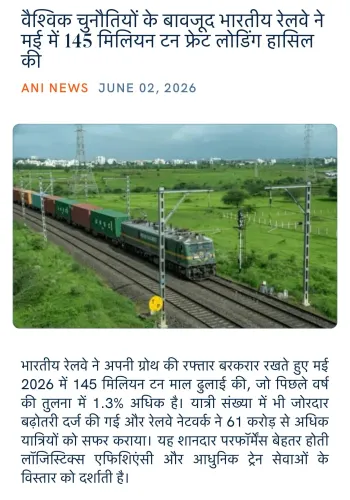
Union Textiles Minister Giriraj Singh amplified the story of Indian Railways' digital transformation on June 14, 2026, framing the network's evolution as a synergy of steel infrastructure and software innovation under the Digital India policy framework.
Key Takeaways
Giriraj Singh , Union Textiles Minister and BJP MP from Begusarai , shared content on Indian Railways' digital transformation on June 14, 2026 .
The post was shared via the NaMo App , framing the railways' evolution as a 'synergy of steel and software.' Indian Railways is the world's fourth-largest rail network and has been a flagship case for public-sector digital modernisation.
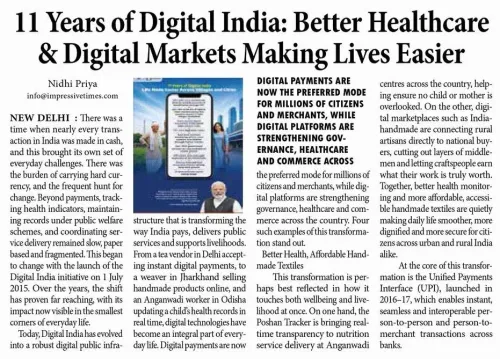
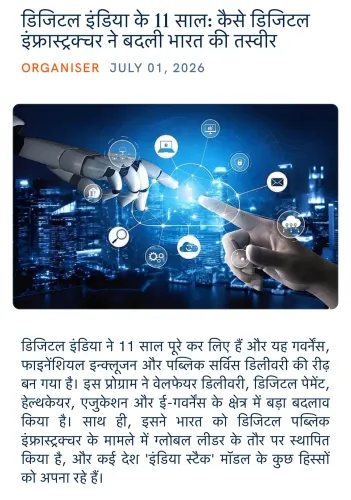
The Digital India programme, launched in 2015 , provided the policy foundation for integrating digital tools across railway operations.
UPI-based payments on the IRCTC platform were introduced in 2016 , modernising ticketing for millions of passengers.
The Rail Budget was merged with the Union Budget in 2017 , aligning railway investment with broader national infrastructure planning.
Union Textiles Minister Giriraj Singh on Sunday, June 14, 2026, shared a piece on the digital transformation of Indian Railways, highlighting the convergence of steel infrastructure and software-driven modernisation that has reshaped one of the world's largest rail networks. The post, shared via the NaMo App, drew attention to what the minister described as the 'synergy of steel and software' powering the railway system's ongoing evolution.
Context
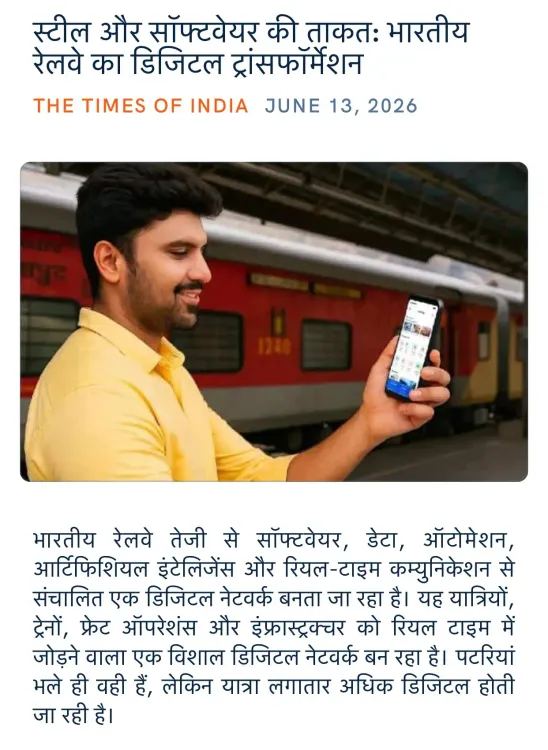
Indian Railways, the world's fourth-largest rail network, has over the past decade become a centrepiece of the government's push to marry legacy physical infrastructure with modern digital tools. Giriraj Singh's post — captioned 'स्टील और सॉफ्टवेयर की ताकत: भारतीय रेलवे का डिजिटल ट्रांसफॉर्मेशन' ('The strength of steel and software: Indian Railways' digital transformation') — amplifies a narrative that senior BJP leaders have consistently championed: that public-sector modernisation is a marker of governance delivery.
The minister shared the content through the NaMo App, a platform associated with Prime Minister Narendra Modi that BJP leaders and ministers regularly use to circulate policy-aligned content to party supporters and the wider public.
Policy Backdrop
The digital overhaul of Indian Railways is rooted in a series of deliberate policy decisions taken over the past decade. The Digital India programme, launched in 2015, set the framework for integrating digital infrastructure across government services, with transport emerging as an early and visible beneficiary.
IRCTC, the railways' ticketing and catering arm, integrated UPI-based payments starting 2016, dramatically simplifying ticket booking for hundreds of millions of passengers. The merger of the Rail Budget with the Union Budget in 2017 further aligned railway capital expenditure with the government's broader infrastructure planning, enabling larger, coordinated investments in both physical assets and digital systems.
These moves collectively positioned Indian Railways as a test case for how a vast, legacy public utility can be incrementally modernised without disrupting daily operations for its enormous passenger and freight base.
Stakeholders and Impact
The beneficiaries of this twin-track modernisation span a wide spectrum. Railway passengers — numbering in the tens of millions daily — have seen improvements in ticketing convenience, real-time train tracking, and digital grievance redressal. IT companies have found a large and growing client in the railways for software solutions ranging from operations management to passenger-facing applications.
Steel producers remain critical to the physical side of the equation: track-laying, rolling stock manufacturing, and station redevelopment all depend on sustained steel supply chains. The 'steel and software' framing that Giriraj Singh highlighted captures this dual dependency — neither strand alone is sufficient for a truly modernised network.
What's Next
Parliamentary discussions on railway modernisation budgets are expected to remain active, with attention focused on the rollout of further digital services, including integrated mobility platforms that could link rail with last-mile connectivity options. The government's stated ambition to expand high-speed and semi-high-speed corridors will require continued coordination between infrastructure investment and the digital systems that manage increasingly complex network operations.
As India positions its railway network as both a domestic growth engine and a model for developing-world infrastructure modernisation, the convergence of capital expenditure on steel and investment in software platforms is likely to remain a defining feature of railway policy in the years ahead.
Point of View
A coalition the ruling party has consistently tried to consolidate. Sharing via the NaMo App rather than a ministerial channel also underscores the party's strategy of using digital platforms to keep the base engaged with governance achievements. The broader arc here is one of the government positioning Indian Railways not merely as a utility, but as a proof point for 'New India' ambitions.
NationPress
13 Sept 2026
Frequently Asked Questions
What did Giriraj Singh post about Indian Railways?
Giriraj Singh shared content on June 14, 2026 highlighting Indian Railways' digital transformation, describing it as a synergy of steel infrastructure and software modernisation, via the NaMo App.
What is the digital transformation of Indian Railways?
Indian Railways' digital transformation refers to the integration of software-driven tools — including UPI-based ticketing on IRCTC, real-time tracking, and operations management systems — alongside physical infrastructure upgrades, under the Digital India policy framework.
When was Digital India launched and how does it relate to railways?
Digital India was launched in 2015 as a flagship government programme to expand digital infrastructure across public services; Indian Railways was an early and prominent beneficiary, with UPI-based ticketing introduced on IRCTC from 2016.
Why did the Rail Budget merge with the Union Budget?
The Rail Budget was merged with the Union Budget in 2017 to better align railway capital expenditure with the government's broader national infrastructure planning and fiscal priorities.
Who benefits from Indian Railways' digital modernisation?
The primary beneficiaries are railway passengers who gain easier ticketing and real-time information, IT companies that supply software solutions, and steel producers whose output underpins the physical infrastructure upgrades.