Giriraj Singh hails India's metro network expansion under Modi
Synopsis
Union Textiles Minister Giriraj Singh credited PM Narendra Modi's governance for India's sweeping metro rail expansion, calling it proof of commitment to modern infrastructure and public convenience in a post on 26 October 2026.
Key Takeaways
Giriraj Singh , Union Textiles Minister and BJP MP from Begusarai, Bihar , praised India's metro expansion on 26 October 2026 .
Singh described the expansion as proof of PM Narendra Modi 's commitment to modern infrastructure and public conveniences.
India's metro buildout has accelerated since 2014 , extending from tier-1 to tier-2 cities across the country.
The Metro Rail Policy of 2017 created a framework for central funding, requiring state governments to co-invest in new projects.
The Smart Cities Mission (2015) runs in parallel, embedding transit infrastructure within a broader urban modernisation agenda.
Senior BJP ministers routinely amplify infrastructure milestones as collective government achievements, reinforcing a unified political narrative.
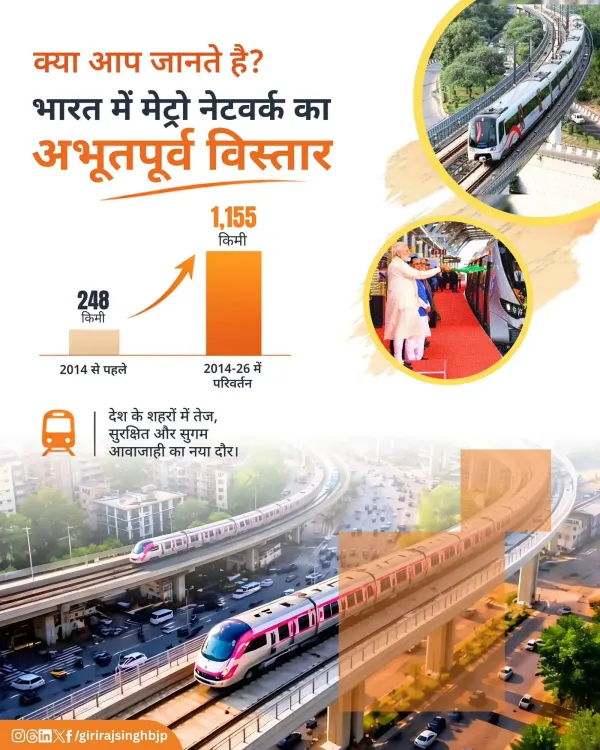
India's metro rail network has grown into one of the largest in the world, and Union Textiles Minister Giriraj Singh wants every commuter to know who gets the credit. On Monday, 26 October 2026, Singh took to X to describe the ongoing expansion of metro infrastructure as proof of Prime Minister Narendra Modi's commitment to modern public amenities.
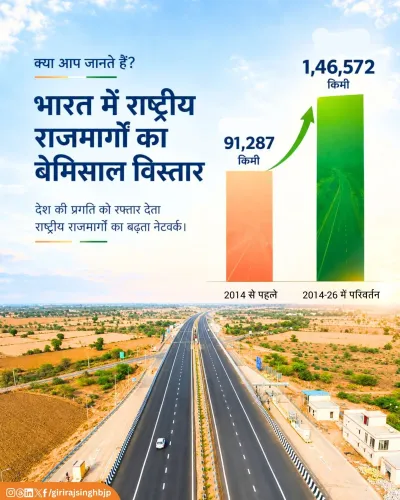
Singh wrote — translated from Hindi — that 'the unprecedented expansion of the metro network in India is proof of the Honourable Prime Minister Shri Narendra Modi's commitment to modern infrastructure and public conveniences.' The post was accompanied by an image, underscoring the visual scale of what the government frames as a generational infrastructure push.
From Delhi Metro to tier-2 cities: the arc of rail expansion
India's metro story did not begin with the current government — Delhi Metro laid the first tracks in the late 1990s — but the pace and geographic spread of approvals since 2014 represent a marked acceleration. Projects have been sanctioned and funded in cities far beyond the original handful of metros, with tier-2 and even smaller cities now on the network map. The Metro Rail Policy of 2017 formalised this push, creating a framework for how cities qualify for central funding and what share they must bear, nudging state governments to co-invest rather than wait for full central grants. The Smart Cities Mission, launched in 2015, runs parallel to the metro drive, bundling transit infrastructure into a broader urban modernisation agenda that covers everything from digital utilities to pedestrian corridors. Together, these schemes have given the government a coherent narrative: urban India is being rebuilt from the ground up, one corridor at a time.Why a Textiles Minister speaks for urban rail
Singh's portfolio is textiles, not transport — yet his post fits a recognisable pattern in BJP's communication strategy: senior ministers amplify marquee infrastructure milestones as a collective government achievement rather than leaving visibility solely to the ministries directly responsible. For Singh, who holds a Lok Sabha seat in Begusarai, Bihar, flagging urban infrastructure also carries a regional dimension: Bihar has been part of ongoing conversations about metro and rapid-transit connectivity in state capitals and large towns, making the message relevant to his own constituency base. For urban commuters — the most immediate stakeholders — the proof of any expansion lies in reduced travel time and affordable last-mile connectivity. Whether the network's growth translates into that on-the-ground experience remains the live question, one that upcoming Union Budget announcements and project completion timelines will keep answering.Point of View
Ensuring no single ministry monopolises credit. The Metro Rail Policy of 2017 and the Smart Cities Mission together give the government a durable two-pronged narrative on urban development that is difficult for opposition parties to challenge on substance alone. The real test, however, lies in delivery timelines and ridership numbers — metrics that will ultimately determine whether the metro story holds its political weight.
NationPress
26 Oct 2026
Frequently Asked Questions
What did Giriraj Singh say about India's metro expansion?
Giriraj Singh posted on X on 26 October 2026 saying that the unprecedented expansion of India's metro network is proof of PM Narendra Modi's commitment to modern infrastructure and public conveniences.
How has India's metro network grown since 2014?
Since 2014, metro rail projects have been approved and funded across a growing number of tier-1 and tier-2 cities, building on the foundation laid by Delhi Metro in the late 1990s and accelerating under the Metro Rail Policy of 2017.
What is the Metro Rail Policy of 2017?
The Metro Rail Policy of 2017 is a central government framework that sets out eligibility criteria for cities seeking metro funding and requires state governments to share a portion of project costs, enabling faster approvals across more cities.
What is the Smart Cities Mission and how does it relate to metro rail?
The Smart Cities Mission, launched in 2015, is a central scheme for holistic urban development that includes transit infrastructure as a key component, complementing dedicated metro rail projects in India's urban modernisation drive.
Why is a Textiles Minister commenting on metro infrastructure?
Senior BJP ministers frequently amplify marquee government schemes outside their own portfolios as part of a coordinated communication strategy that presents infrastructure milestones as collective achievements of the Modi government.