Giriraj Singh hails India Post's ₹15,373 cr revenue in FY26
Synopsis
Union Textiles Minister Giriraj Singh has credited the Digital India programme for India Post achieving ₹15,373 crore in revenue in FY26 — a figure he calls the highest in the department's 170-year history — saying the postal network is now fully digital and future-ready.
Key Takeaways
Giriraj Singh posted on 2 June 2026 attributing India Post's revenue growth to the Digital India programme.
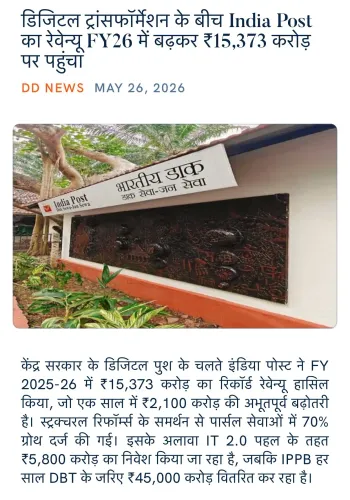
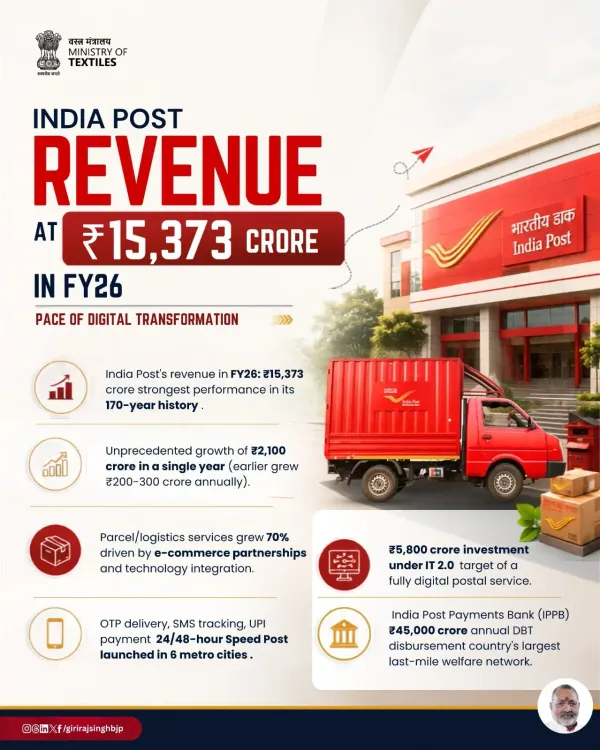
India Post reportedly recorded ₹15,373 crore in revenue in FY26 , described as the highest in its 170-year history .
India Post Payments Bank , incorporated in 2016 and rolled out nationwide by 2018 , expanded the department's revenue base beyond traditional mail.
The postal network now serves as a last-mile platform for e-commerce logistics , digital payments , and government benefit transfers .
Deeper integration with UPI , ONDC , and Aadhaar-linked services is being watched as the next phase of India Post's digital evolution.
Union Textiles Minister Giriraj Singh on Tuesday, 2 June 2026 credited the Digital India programme under Prime Minister Narendra Modi for what he described as a historic milestone: India Post recording a revenue of ₹15,373 crore in FY26, which he called the highest in the department's 170-year history.
Posting on X, Singh wrote — '170 साल के इतिहास में पहली बार India Post ने FY26 में ₹15,373 करोड़ का ऐतिहासिक रेवन्यू हासिल किया है!' ('For the first time in 170 years of history, India Post has achieved a historic revenue of ₹15,373 crore in FY26!') — adding that the national postal service is now fully digital and 'Future Ready'.
Context
India Post, established in 1854, operates one of the world's largest postal networks, with hundreds of thousands of post offices spread across urban centres and remote rural areas. For most of its existence the department was associated with physical mail, money orders, and savings accounts rather than digital commerce or high-margin logistics.
Singh's post frames the reported revenue figure as proof that a legacy public institution can be transformed through technology-led governance, a narrative the ruling dispensation has consistently used to highlight reform outcomes under the Digital India banner.
Policy Backdrop
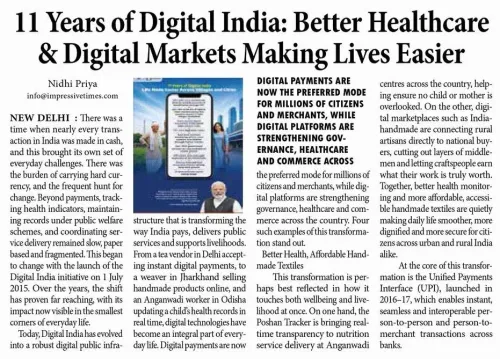
The Digital India programme was launched on 1 July 2015 to modernise government delivery mechanisms through digital infrastructure and e-governance. India Post Payments Bank (IPPB) was incorporated in 2016 and rolled out nationwide by 2018, extending formal financial services — savings, remittances, insurance — to millions of citizens through the existing postal network.
These moves positioned India Post not merely as a mail carrier but as a last-mile financial and logistics platform, allowing it to tap revenue streams from e-commerce parcel delivery, government-to-citizen benefit transfers, and digital payments. The broader Aatmanirbhar Bharat framework has similarly pushed legacy departments — railways, banking, telecom — to raise internal revenues and reduce fiscal dependence.
Stakeholders and Impact
Rural citizens are among the primary beneficiaries of India Post's digital pivot, gaining access to banking and government services through familiar neighbourhood post offices. The e-commerce sector has also leaned on the postal network for last-mile delivery in tier-2, tier-3, and rural markets where private couriers have limited reach.
For postal employees — one of the largest workforces in the central government — digitisation has meant retraining and role expansion, moving from envelope sorting to handling digital transactions and parcel logistics. The revenue growth, if sustained, could also strengthen the case for further investment in staff and infrastructure.
What's Next
Analysts and parliamentary committees are likely to scrutinise the Department of Posts' annual report for a detailed breakdown of the ₹15,373 crore figure — separating contributions from postal savings, logistics, payments banking, and government disbursements. Questions around deeper integration of India Post with UPI, ONDC, and Aadhaar-linked services are expected to feature in upcoming parliamentary sessions.
If the revenue trajectory holds, India Post's transformation could serve as a template for other legacy public utilities weighing the costs and benefits of large-scale digital overhauls.
Point of View
Using a striking revenue number to reinforce the BJP's core narrative that Digital India has delivered tangible results in unexpected corners of the state apparatus. By anchoring the claim to 170 years of institutional history, the framing maximises the contrast between pre-2014 stagnation and post-2015 transformation — a rhetorical pattern the party deploys consistently across sectors. The timing, ahead of what could be a budget or policy cycle, suggests an effort to build public and investor confidence in legacy public-sector digitisation. Whether the ₹15,373 crore figure withstands detailed parliamentary or audit scrutiny will determine how durable this narrative proves.
NationPress
16 Oct 2026
Frequently Asked Questions
What is India Post's revenue in FY26?
Union Textiles Minister Giriraj Singh has claimed that India Post recorded a revenue of ₹15,373 crore in FY26, which he described as the highest in the department's 170-year history. The figure has not yet been independently verified from official annual reports.
What is the Digital India programme?
Digital India is a flagship central government programme launched on 1 July 2015 to modernise public service delivery through digital infrastructure, e-governance, and internet connectivity, covering departments from postal services to banking.
What is India Post Payments Bank?
India Post Payments Bank (IPPB) is a payments bank incorporated in 2016 and rolled out nationwide by 2018, using India Post's vast network of post offices to offer savings accounts, remittances, and insurance to citizens, particularly in rural areas.
Why is India Post's revenue growth significant?
India Post was historically a low-revenue legacy department focused on physical mail. Its reported shift to high revenues reflects diversification into e-commerce logistics, digital payments, and government benefit disbursements, making it a model for public-sector modernisation.
Who is Giriraj Singh?
Giriraj Singh is a senior BJP leader, Union Minister of Textiles, and Lok Sabha MP from Begusarai, Bihar. He is known for his vocal support of government schemes and frequently uses social media to amplify governance milestones.