India Post revenue hits record ₹15,373 crore in FY26, parcel segment up 70%

Synopsis
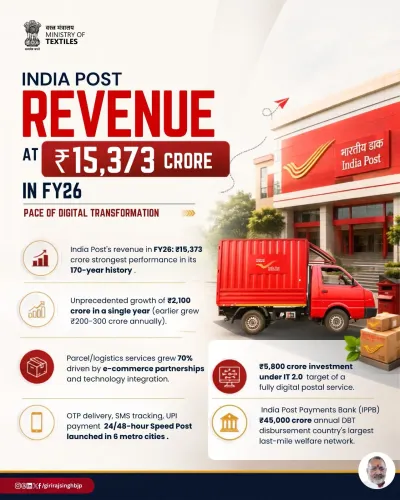
India Post's revenue crossed ₹15,373 crore in FY26 — its highest ever — with a single-year jump nearly 10 times the historical average. The turnaround is being driven by a 70% surge in parcels, OTP-based delivery, e-commerce tie-ups, and a ₹5,800 crore technology overhaul that could push parcel revenue alone to ₹10,000 crore.
Key Takeaways
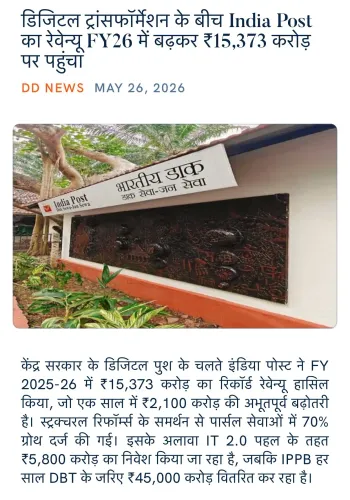
India Post recorded an all-time high revenue of ₹15,373 crore in FY2025–26 .
Single-year revenue addition of ₹2,100 crore is nearly 10 times the historical annual average of ₹200–300 crore .
Parcel and logistics segment grew 70% , aided by OTP delivery, UPI payments, and e-commerce B2B tie-ups.
A ₹5,800 crore investment under the Advanced Postal Technology (APT) initiative is powering the digital overhaul.
India Post Payments Bank (IPPB) distributes approximately ₹45,000 crore annually in DBT welfare transfers.
3.8 crore girl children are enrolled under the Sukanya Samriddhi Scheme as of FY26.
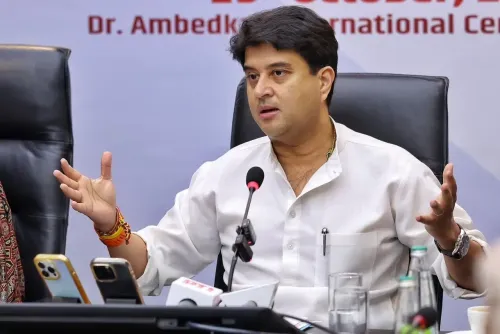
India Post recorded an all-time high revenue of ₹15,373 crore in financial year 2025–26, driven by a 70% surge in its parcel and logistics segment, Union Minister of State for Communications and Rural Development Chandra Sekhar Pemmasani said in an interview. The single-year jump of ₹2,100 crore is nearly 10 times the department's historical annual growth average.
Scale of the Revenue Leap
India Post's revenue stood at approximately ₹11,500 crore in 2016, growing at an average of ₹200–300 crore per year over the intervening decade. The ₹2,100 crore addition in a single year marks a structural break from that trajectory, according to the minister. This is the department's strongest annual performance on record.
What Drove the Parcel Surge
Minister Pemmasani attributed the parcel boom to technology integration and expanded e-commerce tie-ups. 'When the current leadership assumed charge, total parcel revenue stood at approximately ₹600 crore. With the introduction of OTP-based delivery, SMS tracking, UPI and digital payment acceptance, and B2B tie-ups with major e-commerce platforms, parcel services alone are estimated to have the potential to generate up to ₹10,000 crore in revenue,' he said.
Route rationalisation has enabled faster deliveries. After extensive piloting, India Post launched 24-hour and 48-hour Speed Post delivery services across six metro cities.
The ₹5,800 Crore Technology Overhaul
A centrepiece of India Post's modernisation is the ₹5,800 crore investment under the Advanced Postal Technology (APT) initiative, part of the broader IT 2.0 programme. The vision, as outlined by the minister, is fully digital end-to-end services — enabling citizens to purchase savings instruments and insurance policies such as PLI and RPLI through a browser, download digital certificates instantly, and receive matured policy amounts directly into their bank accounts, without visiting a post office.
Security architecture under IT 2.0 includes facial recognition for system access, e-KYC, Aadhaar linking, and full compliance with national cloud security protocols.
Financial Inclusion and Welfare Delivery
Through India Post Payments Bank (IPPB), the department currently distributes approximately ₹45,000 crore annually via Direct Benefit Transfer (DBT), making it one of the largest last-mile welfare delivery channels in the country. Postal savings accounts, which offer an interest rate of 4% — significantly above the approximately 2.5% offered by leading commercial banks — are expected to see wider adoption through the digital accessibility push.
The department is also implementing the Sukanya Samriddhi Scheme in saturation mode, with 3.8 crore girl children currently enrolled.
Workforce and Infrastructure Upgrades
India Post has launched a capacity-building and behavioural transformation programme across its workforce, with training sessions conducted for every 100 employees, focusing on customer interaction, service delivery, and sales skills. Urban post offices are being revamped with an investment of ₹60–70 lakh per facility, featuring digital counters, streamlined Aadhaar updation services, and shared workspaces. With technology investments maturing and e-commerce volumes rising, India Post is positioning itself as a serious logistics competitor in the years ahead.
Point of View
But the more consequential number is the ₹10,000 crore parcel potential the minister cited — because it signals a direct challenge to private logistics players like Delhivery and Ecom Express on last-mile reach. The department's structural advantage is its 1.6 lakh-plus post office network, which no private player can replicate at cost. The risk is execution: past government technology programmes have struggled with adoption at the field level, and the ₹5,800 crore APT investment will only deliver if postmasters and delivery staff actually use the tools. The DBT and Sukanya Samriddhi numbers also deserve scrutiny — India Post is quietly becoming a welfare infrastructure backbone, and that role carries accountability that revenue headlines alone do not capture.
NationPress
26 Sept 2026
Frequently Asked Questions
What is India Post's revenue for FY2025–26?
India Post recorded an all-time high revenue of ₹15,373 crore in FY2025–26, a jump of ₹2,100 crore over the previous year — nearly 10 times the historical annual growth average of ₹200–300 crore.
Why did India Post's parcel revenue grow so sharply?
The parcel and logistics segment grew 70% in FY26, driven by OTP-based delivery, SMS tracking, UPI and digital payment acceptance, and B2B partnerships with major e-commerce platforms. Route rationalisation also enabled faster deliveries, including 24-hour and 48-hour Speed Post services in six metro cities.
What is the Advanced Postal Technology (APT) initiative?
APT is a ₹5,800 crore technology investment under India Post's IT 2.0 programme, aimed at enabling fully digital end-to-end postal services. It includes facial recognition for system access, e-KYC, Aadhaar linking, and cloud security compliance.
How much does India Post distribute through Direct Benefit Transfer?
Through India Post Payments Bank (IPPB), India Post distributes approximately ₹45,000 crore annually via Direct Benefit Transfer (DBT), making it one of the country's largest last-mile welfare delivery channels.
How does India Post's savings account interest rate compare with banks?
India Post's postal savings accounts offer an interest rate of 4%, which is significantly higher than the approximately 2.5% offered by leading commercial banks, giving the department a competitive edge in retail savings mobilisation.