Giriraj Singh hits back at '13 crore voter deletion' claim

Synopsis
Union Textiles Minister Giriraj Singh on 1 November 2026 called the opposition's claim of 13 crore deleted voter names a fabricated statistic, saying the Election Commission found no evidence when it sought proof, and attributed the electoral loss to voters rejecting corruption.
Key Takeaways
Giriraj Singh rejected opposition claims of 13 crore voter names being deleted from electoral rolls as a 'fabricated number.' He stated that the Election Commission of India asked the opposition for evidence of deletions and received none.
Singh attributed the electoral outcome to voters consciously rejecting 'the corrupt and the thieves' — not to any manipulation.
The post continues a recurring pattern of post-election disputes over voter-roll integrity in India.
No formal, verified complaint establishing the 13 crore deletion figure has been documented at the time of writing.
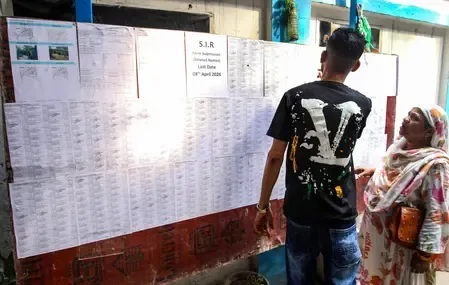
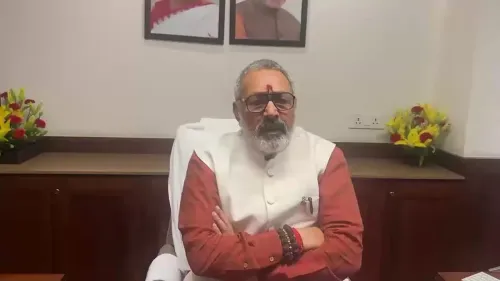
Every election loss needs an explanation — and Union Textiles Minister Giriraj Singh says the opposition has found a dangerously misleading one. On Sunday, 1 November 2026, the senior BJP leader and Lok Sabha MP from Begusarai, Bihar, fired back at opposition allegations of mass voter-list manipulation, calling the circulating figure of 13 crore deleted names a 'fabricated statistic' designed to obscure electoral defeat.
Posting in Hindi, Giriraj Singh wrote: 'लोकतंत्र का अपमान करना और मतदाताओं के विवेक को कम आंकना विपक्ष की फितरत बन चुका है' — 'Insulting democracy and underestimating the wisdom of voters has become the nature of the opposition.' He added that when the Election Commission of India demanded evidence of names being struck off voter rolls, the opposition had no answer to offer.
The '13 crore' number and what Singh says about it
The figure at the heart of the row — 13 crore voters allegedly removed from electoral rolls — has been circulating as opposition ammunition in the post-election period. Singh dismissed it as a 'mangharat ankada' (fabricated number), lobbed to draw a curtain over what he framed as a straightforward verdict against corruption. 'No 'vote theft' has taken place in the country,' he wrote bluntly. 'The country's aware public has simply stopped voting for the corrupt and the thieves.'
His intervention sharpens a recurring fault line in Indian electoral politics: when results disappoint, do they reflect manipulation or mandate? The Election Commission, a constitutional body that maintains voter rolls and supervises the entire electoral machinery, has consistently required documented complaints before acting on allegations of mass deletions — a bar, Singh argues, the opposition has repeatedly failed to clear.
A familiar post-election playbook — and why it matters this time
Post-election allegations of voter-list irregularities are not new to Indian politics. Opposition parties across the spectrum have raised concerns about electronic voting machines and roll revisions after unexpected defeats. What gives this round particular visibility is the scale of the claim: 13 crore is a number large enough — if true — to have materially altered outcomes across multiple constituencies. Singh's counter is pointed: produce the proof, or the allegation is noise.
The Election Commission's standard protocol is to investigate formal, evidence-backed complaints. Until any such complaint clears that threshold, the official position remains that electoral rolls were maintained in accordance with established procedure.
Whether the opposition produces documentary evidence — or whether this exchange fades into the routine static of post-poll politics — will determine how long the '13 crore' number stays in circulation.
Point of View
Pivot immediately to the evidentiary bar and frame any unsubstantiated allegation as an insult to the electorate. By invoking the Election Commission's own demand for proof, Singh puts the credibility burden squarely on the opposition rather than the process. The '13 crore' figure, if it persists without documentation, risks becoming the kind of claim that energises a base while eroding credibility with swing voters. The episode underscores how electoral legitimacy — not just policy — is now a primary theatre of political contestation in India.
NationPress
1 Nov 2026
Frequently Asked Questions
What is the '13 crore voter deletion' claim Giriraj Singh is responding to?
Opposition parties have alleged that approximately 13 crore names were removed from voter rolls, potentially affecting election results. Giriraj Singh has called this figure fabricated and says the opposition provided no evidence when the Election Commission asked for proof.
What did the Election Commission say about the voter deletion allegations?
According to Giriraj Singh's post, the Election Commission of India asked the opposition for documented evidence of names being struck off voter rolls, and no such evidence was produced. The Commission has not independently commented in this specific exchange.
Why is Giriraj Singh commenting on this issue?
Giriraj Singh is a senior BJP leader and Union Minister. He was responding to opposition claims circulating after election results, defending the integrity of the electoral process and attacking what he called a narrative designed to cover up a legitimate defeat.
Has India seen voter list deletion allegations after elections before?
Yes. Post-election allegations about voter roll irregularities and electronic voting machine tampering have appeared repeatedly in Indian politics after various state and national elections, typically raised by whichever party performed below expectations.
What would happen if the opposition filed a formal complaint with the Election Commission?
The Election Commission of India is constitutionally mandated to investigate formal, evidence-backed complaints about electoral irregularities. If credible documentary evidence were submitted, the Commission would be obliged to investigate and publish its findings.