Giriraj Singh invokes Maa Baglamukhi against 'anti-Sanatan' forces
Synopsis
Union Textiles Minister Giriraj Singh invoked Maa Baglamukhi on 24 October 2026, declaring divine retribution certain for those conspiring against Sanatan Dharma and India's honour — a sharp piece of cultural-political messaging consistent with BJP's Hindutva communication register.
Key Takeaways
Union Textiles Minister Giriraj Singh posted a Hindi invocation on 24 October 2026 calling upon Maa Baglamukhi to deliver reckoning against those he described as conspiring against Sanatan Dharma.
Singh characterised the goddess as a force that destroys 'wicked intellect and crooked intent,' closing with 'Victory to Dharma, victory to the nation.' No specific individual, event, or legislation was named as the trigger for the post.
Maa Baglamukhi is one of the ten Mahavidyas, revered in the Shakta tradition specifically as a deity who paralyses enemies and silences falsehood.
The post is consistent with a broader BJP pattern of using devotional social-media content to reinforce civilisational and cultural-political framing.
No immediate policy or parliamentary follow-up is linked to the statement.
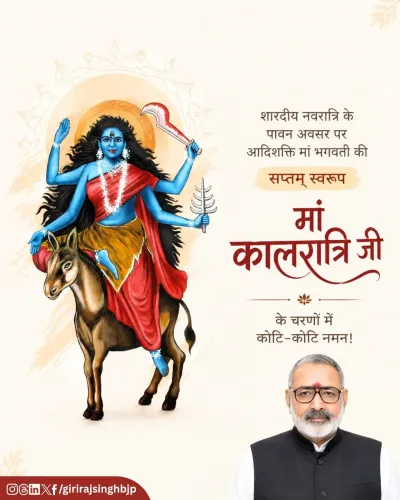
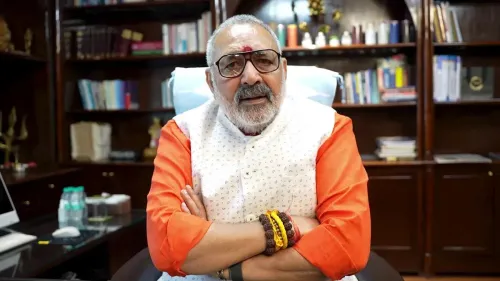
A sharp religious invocation from a senior Union Cabinet minister landed on social media on Saturday, 24 October 2026, as Union Textiles Minister Giriraj Singh called upon the goddess Baglamukhi to deliver the final reckoning against those he described as working to dishonour India and conspire against Sanatan Dharma.
Posting in Hindi, Singh declared: 'Bharat ke samman ko aaghaat pahunchaane waali soch aur Sanatan virodhī shadyantra rachne waalon ka ant Maa Baglamukhi ki kripa se tay hai' — 'The end of those who wound India's honour and weave conspiracies against Sanatan Dharma is certain by the grace of Maa Baglamukhi.' He added that the goddess is a force that destroys 'wicked intellect and crooked intent,' closing with the rallying cry: 'Victory to Dharma, victory to the nation.'
Maa Baglamukhi and her place in Hindu political symbolism
Maa Baglamukhi is one of the ten Mahavidyas in the Shakta tradition, revered specifically as a deity who paralyses enemies and silences those who speak falsehood or bear ill intent. Her invocation in political discourse is not incidental — she is the goddess associated with the power to immobilise adversaries, making her a recurring symbol in the BJP's cultural-political vocabulary when framing ideological battles.
The post carries no reference to a specific event, legislation, or individual. The research background confirms that no verifiable trigger for this particular message could be identified. What it does reflect is a well-established pattern: senior BJP figures periodically using devotional social-media posts to reinforce a civilisational framing of political contest — dharma versus its opponents, national honour versus those who undermine it.
Cultural-political messaging as a consistent BJP register
Giriraj Singh, the Lok Sabha MP from Begusarai, Bihar, is among the BJP's most vocal voices on Hindu cultural identity. His social-media presence has long blended ministerial communication with assertive Hindutva-inflected commentary. This post sits squarely in that tradition — devotional in form, combative in subtext.
For the BJP's core base, the language of divine justice — where the goddess herself guarantees the defeat of those who harm India's honour — functions as both reassurance and mobilisation. It requires no specific target to carry political weight. The enemy is unnamed; the outcome is declared inevitable. That is precisely the rhetorical structure such posts are designed to project.
No immediate policy action or parliamentary follow-up is linked to the statement. The post is best read as cultural-political signalling — a minister reinforcing ideological solidarity through the language of faith at a moment when no specific legislative trigger has been publicly identified.
When a Cabinet minister frames a political contest as one already decided by divine grace, the message to supporters is unmistakable: the battle is righteous, and its conclusion is written.
Point of View
Which preserves deniability while energising a base. It fits a longer BJP arc of embedding cultural-nationalist messaging within religious idiom, particularly around elections and moments of perceived ideological contest. The choice of Baglamukhi — the goddess of silencing and paralysis — rather than a more generic deity is deliberate and sophisticated. For the BJP's core constituency, the post functions as a declaration of civilisational confidence dressed in the language of prayer.
NationPress
24 Oct 2026
Frequently Asked Questions
What did Giriraj Singh post about Sanatan Dharma?
On 24 October 2026, Giriraj Singh posted in Hindi invoking Maa Baglamukhi, declaring that the end of those who wound India's honour and conspire against Sanatan Dharma is certain by the goddess's grace.
Who is Maa Baglamukhi and why is she politically significant?
Maa Baglamukhi is one of the ten Mahavidyas in the Shakta tradition, worshipped as a deity who paralyses enemies and destroys falsehood. BJP leaders have invoked her symbolically when framing ideological or civilisational battles.
What does 'anti-Sanatan conspiracy' mean in Indian politics?
In BJP political discourse, references to 'anti-Sanatan' forces typically describe groups or ideologies seen as hostile to Hindu cultural and religious traditions. The term is used broadly without always specifying a concrete target.
Is Giriraj Singh's post linked to any specific policy or event?
No specific policy, legislation, or verifiable event has been publicly identified as the trigger for this post. It is consistent with periodic cultural-political messaging by senior BJP leaders on social media.
Who is Giriraj Singh?
Giriraj Singh is India's Union Minister of Textiles and a senior BJP leader. He is a Lok Sabha MP from Begusarai, Bihar, and is known for assertive commentary on Hindu cultural identity alongside his ministerial role.