Giriraj Singh invokes Kalnemi to target unnamed opponents

Synopsis
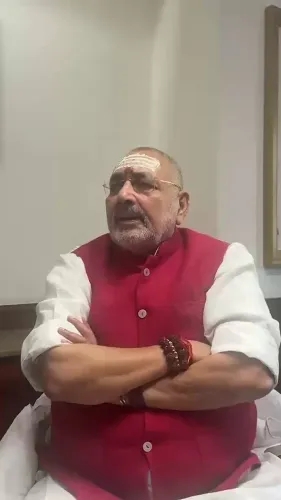
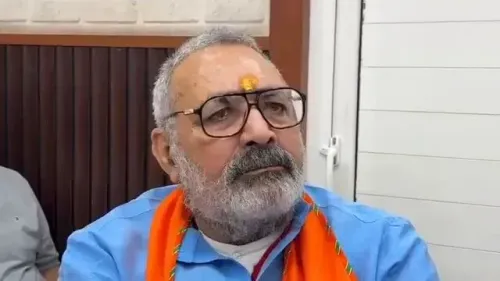
Union Textiles Minister Giriraj Singh invoked the Ramayana's Kalnemi episode on 24 September 2026 to accuse unnamed political opponents of masquerading as righteous figures while serving a destructive agenda — a sharp but target-unnamed salvo on X.
Key Takeaways
Union Textiles Minister Giriraj Singh posted on X on 24 September 2026 using a Ramayana allegory to attack unnamed opponents.
He cited the demon Kalnemi , who disguised himself as a sage to obstruct Hanuman's mission to retrieve the Sanjeevani herb for Lakshmana.
Singh accused the unnamed target of chanting Ram's name while secretly working against the public interest — 'doing Ravana's bidding'.
No individual or political party was named in the post, keeping the target deliberately ambiguous.
The BJP has a long tradition of deploying Ramayana episodes as political metaphors, and this post follows that established pattern.
Possible opposition responses or clarification from the minister on the intended reference remain to be watched.
A mythology lesson with a political edge: Union Textiles Minister Giriraj Singh on Thursday, 24 September 2026 reached into the Ramayana to brand unnamed adversaries as shape-shifting deceivers — the kind who chant Ram's name while secretly serving Ravana's agenda.
In a post on X, the senior BJP leader recalled the episode of Kalnemi — the demon dispatched by Ravana who disguised himself as a sage precisely when Hanuman was racing to fetch the life-saving Sanjeevani herb for a mortally wounded Lakshmana. Singh's message was pointed: 'Ram-naam japte hue woh Ravan ka kaam kar raha tha' — ('He chanted Ram's name all the while doing Ravana's bidding'). The parallel, he insisted, is playing out today.
The Kalnemi framework: a demon in a saint's robe
Singh did not name the individual or group he was targeting. But the allegory left little to the imagination: someone is performing piety — new costumes, new personas — while working against the public good. 'The public is well acquainted with both your face and your character,' he wrote, addressing the unnamed party directly. The warning carries an almost theatrical finality: everyone knows how the Kalnemi story ends.
BJP's long tradition of Ramayana rhetoric
This is not the first time BJP leaders have reached for Valmiki's epic to frame a political opponent. The party has a well-worn tradition of casting rivals in demonic or deceptive roles drawn from the Ramayana and Mahabharata — a rhetorical strategy that lands powerfully with a wide cross-section of Indian voters for whom these narratives are lived cultural memory, not distant mythology. What makes Singh's formulation sharper than usual is the specificity of the Kalnemi episode: the demon is not a straightforward villain but a counterfeit saint — making the accusation one of hypocrisy and infiltration rather than mere opposition.
No name, maximum pressure
The deliberate vagueness is itself a political move. By leaving the target unnamed, Singh maximises interpretive range — multiple opponents, in multiple contexts, can feel the arrow is aimed at them. It also insulates the post from the need for direct evidence. The minister's constituents in Begusarai, Bihar, and beyond are left to fill in the blank, which they inevitably will — loudly, and in every direction. Whether opposition figures respond with a counter-narrative or let the allegory pass unanswered may determine how far this particular round of mythological combat travels.
Point of View
Forcing multiple opponents to wonder if the arrow is theirs. Set against a backdrop of approaching state-level political cycles in Bihar, the post reads less as a theological observation and more as a pre-emptive character indictment — one that invites the targeted party to self-identify by responding.
NationPress
24 Sept 2026
Frequently Asked Questions
What is the Kalnemi story Giriraj Singh referred to?
Kalnemi is a demon in the Ramayana whom Ravana sent to kill Hanuman while he was searching for the Sanjeevani herb. Kalnemi disguised himself as a holy sage to deceive Hanuman, making him a symbol of treachery hidden behind a pious facade. Singh used this episode to accuse unnamed opponents of similar hypocrisy.
Who did Giriraj Singh target in his Kalnemi post?
Singh did not name any individual or party in the post. The target remains unidentified, which is a deliberate rhetorical choice that broadens the accusation's range and forces multiple potential targets to respond or stay silent.
Why do BJP leaders frequently use Ramayana references in political speech?
The Ramayana is deeply embedded in Indian cultural memory and resonates across caste, class, and regional lines. BJP leaders use its moral framework — dharma versus adharma, genuine devotion versus deception — to frame political contests in terms voters find instantly recognisable and emotionally compelling.
What is Giriraj Singh's political position?
Giriraj Singh is a senior BJP leader, Union Minister of Textiles in the Government of India, and a Lok Sabha MP from Begusarai in Bihar. He is known for making sharp, assertive political statements, often directed at opposition parties.
What could be the significance of this post in Bihar politics?
Bihar has been a persistent political battleground and Singh, as the sitting MP from Begusarai, regularly uses social media to shape narratives there. While no specific event was cited, a character-attack allegory of this intensity often signals the start of a more sustained political offensive or responds to a developing local or national controversy.