Giriraj Singh: Ram and Shiv are one, not to be divided
Synopsis
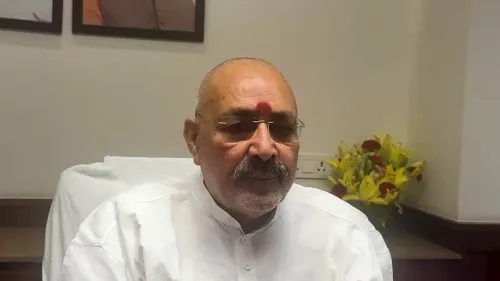
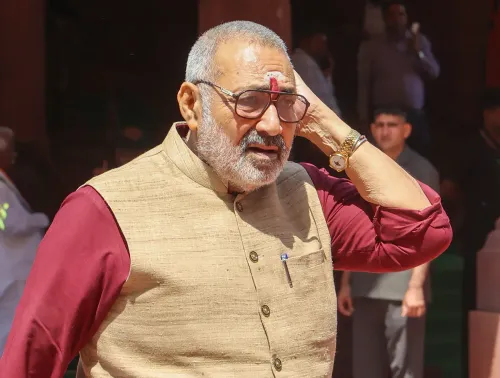
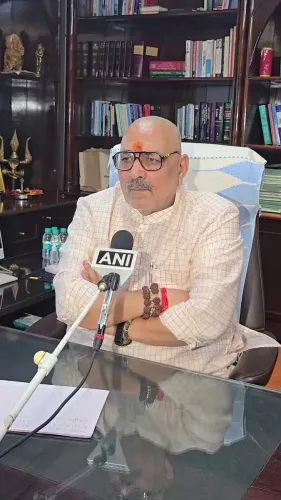
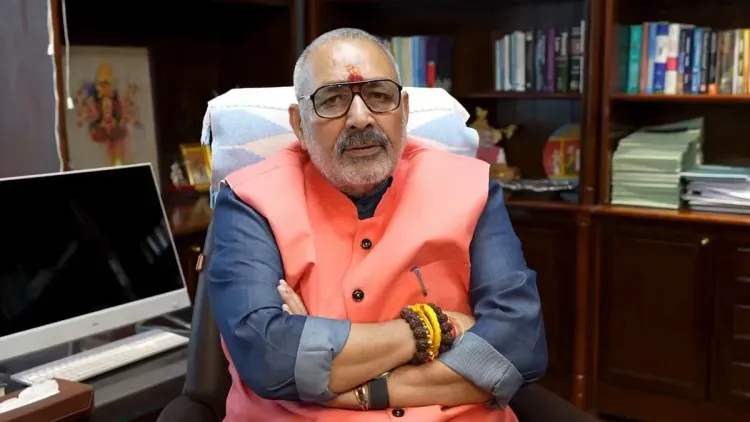
Union Textiles Minister Giriraj Singh accused unnamed political rivals of dividing Ram and Shiva for vote-bank appeasement, asserting in a post that the two deities are one — blending theological tradition with pointed political critique.
Key Takeaways
Giriraj Singh posted on September 29, 2026 accusing rivals of stoking religious and caste divisions for appeasement.
He charged that political opponents had gone so far as to attempt to divide Lord Ram and Lord Shiva — two of Hinduism's most revered deities.
Singh used the word tushtikaran (appeasement) and described such thinking as sankeerṇ soch (narrow mindset) unworthy of trust.
He closed with the theological assertion: 'Shiv and Ram are one.
Ram is in Shiv, Shiv is in Ram,' drawing on the Ramcharitmanas tradition of mutual devotion.
As Lok Sabha MP from Begusarai, Bihar , the message carries particular weight in a state where caste and religious identity dominate electoral politics.
When a Union Minister invokes two of Hinduism's most revered deities to call out what he sees as deliberate religious wedge-driving, the charge lands with weight. Union Textiles Minister Giriraj Singh fired a sharp political broadside on Tuesday, September 29, 2026, accusing unnamed political rivals of stoking divisions in the name of caste and religion — and, he argued, taking that calculus so far as to pit Lord Ram against Lord Shiva.
In his post, Singh wrote: 'धर्म और जाति के नाम पर लड़वाते-लड़वाते इन्होंने तो भगवान तक को नहीं छोड़ा' — 'In their drive to pit people against each other in the name of religion and caste, they have not even spared God.' He accused his targets of sinking so low in pursuit of appeasement that they had effectively attempted to divide Sri Ram and Bholenath — the popular epithets for Lord Shiva. His closing line was a theological assertion as much as a political one: 'Shiv and Ram are one. Ram is in Shiv, Shiv is in Ram.'
The appeasement charge — and who it is aimed at
Singh did not name any individual or party, but the language — tushtikaran (appeasement) and 'sankeerṇ soch' (narrow mindset) — is vocabulary that senior BJP leaders have consistently directed at opposition parties they accuse of practising vote-bank politics along religious and caste lines. The accusation that rivals have tried to split the devotional bases of Ram and Shiva suggests a specific political flashpoint: the idea that some actors have sought to mobilise Shaivite and Vaishnavite communities separately for electoral gain.
What makes the charge pointed is its framing. Rather than a standard political attack, Singh anchors it in theology, quoting the deep Indic tradition that treats the Ram-Shiva relationship as non-dual. In the Ramcharitmanas, Tulsidas depicts Ram and Shiva as mutual devotees of each other — a theological loop that makes the notion of dividing them, Singh implies, not merely politically cynical but culturally absurd.
A pattern in BJP's cultural messaging
BJP leaders have long used the oneness of Ram and Shiva as a counter-narrative to what they describe as opposition attempts to fragment the Hindu votebank. The argument runs that identity politics aimed at separating communities — by caste sub-group or by the deity they hold dearest — is corrosive both socially and electorally, and that asserting the unity of the tradition is a form of resistance to that fragmentation. Singh's post fits squarely in that line of messaging.
As a Lok Sabha MP from Begusarai, Bihar — a state where both caste arithmetic and religious identity shape every election cycle — Singh's intervention carries a specific regional resonance. Bihar heads toward politically sensitive terrain with local and state-level mobilisation constant; a message about religious unity over divisive politics reads differently on the Gangetic plain than it might elsewhere.
What the broadside signals
The absence of a named target is itself a rhetorical choice: it casts the criticism wide, inviting audiences to fill in the blank with whoever they believe fits the description. Singh's final couplet — 'Shiv and Ram are one' — functions as both a theological reminder and a political rallying point, a closing line designed to be shared, cited, and chanted rather than debated clause by clause.
In a political climate where religious symbolism moves fast and far on social media, a sitting Union Minister declaring that any attempt to separate Ram and Shiva is a mark of 'narrow mindset' is a signal the opposition will need to answer — whether they choose to or not.
Point of View
Which is a harder frame for opponents to escape. In Bihar especially, where caste and sub-caste mobilisation is granular and constant, the message does double duty: it signals to a broad Hindu voter base that the BJP holds the tradition whole, while putting rivals on the defensive about whether their coalition-building crosses into divisiveness. The unnamed-target choice is deliberate — it widens the blast radius while forcing the accused to identify themselves.
NationPress
29 Sept 2026
Frequently Asked Questions
What did Giriraj Singh say about Ram and Shiva?
Giriraj Singh posted that political rivals had attempted to divide Lord Ram and Lord Shiva for appeasement politics, and asserted that 'Shiv and Ram are one — Ram is in Shiv, Shiv is in Ram.'
Who is Giriraj Singh targeting in his post?
Singh did not name any individual or party, but used terms like 'appeasement' and 'narrow mindset' — language BJP leaders have historically directed at opposition parties accused of caste and religion-based vote-bank politics.
What is tushtikaran and why does Giriraj Singh use the term?
Tushtikaran is the Hindi word for appeasement. BJP leaders use it to describe what they characterise as opposition efforts to win votes by making concessions to specific religious or caste groups, often at the cost of broader social harmony.
What is the theological basis for saying Ram and Shiva are one?
The tradition of Ram-Shiva non-duality is rooted in texts like the Ramcharitmanas, where Tulsidas depicts Ram and Shiva as mutual devotees — each worshipping the other — making any notion of a rivalry between their followers theologically unfounded.
Why is Giriraj Singh's statement significant for Bihar politics?
As a Lok Sabha MP from Begusarai, Bihar — a state where caste arithmetic and religious identity heavily shape elections — Singh's call for Hindu unity over divisive politics carries direct electoral messaging for a key battleground state.