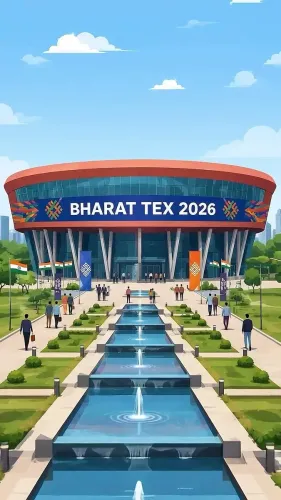
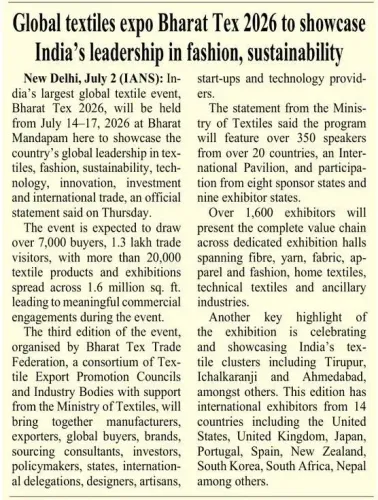
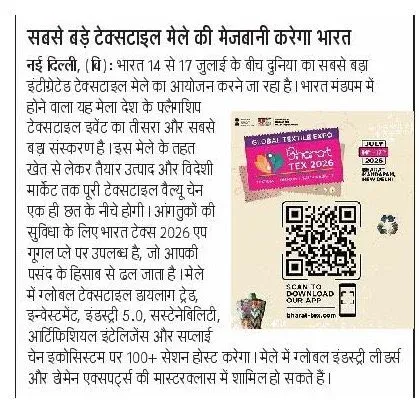
Giriraj Singh Launches Bharat Tex 2026 to Boost India's Textile Sector
Synopsis
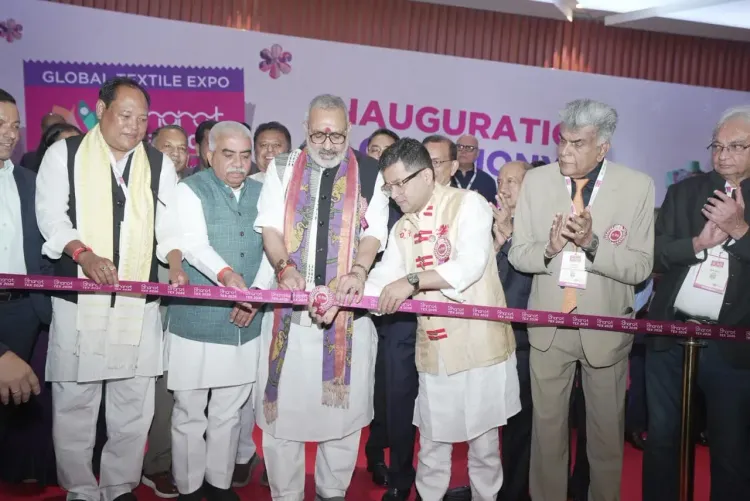
Union Textiles Minister Giriraj Singh launched Bharat Tex 2026 on 14 July, framing the flagship trade fair as a catalyst to unite India's textile heritage, modern innovation, and global partnerships under the Viksit Bharat vision.
Key Takeaways
Bharat Tex 2026 was inaugurated on 14 July 2026 by Union Textiles Minister Giriraj Singh .
The event aims to unify India's textile heritage, modern innovation, and international partnerships on a single platform.
The launch is positioned under the government's Viksit Bharat and Atmanirbhar Bharat frameworks.
The PLI scheme for man-made fibre apparel and technical textiles, approved in 2021 , forms a key policy pillar supporting the sector.
Key stakeholders include textile exporters and handloom weavers , both central to India's textile economy.
New incentives, textile park projects, or trade agreements announced alongside the event will be closely tracked.
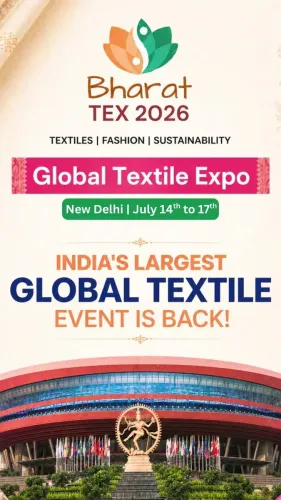
Union Textiles Minister Giriraj Singh on Tuesday, 14 July 2026, announced the launch of Bharat Tex 2026, describing the event as a landmark step toward strengthening India's position in global textile trade by uniting the country's rich textile heritage, modern innovation, and international partnerships under one platform.
Posting on X, the minister wrote: 'भारत टेक्स 2026 का शुभारंभ आज नई ऊर्जा, नए विश्वास और बड़े संकल्प के साथ हुआ' — 'Bharat Tex 2026 has been inaugurated today with new energy, new confidence, and great resolve.' He added that the event would help make India 'stronger and more leading in the global textile sector.'
Context
Bharat Tex is India's flagship international textile trade fair, conceived to serve as a single, unified showcase for the country's entire textile value chain — from raw fibre and yarn to finished garments and technical textiles. The 2026 edition was inaugurated with an emphasis on three pillars: preserving India's textile heritage, accelerating modern innovation, and deepening global partnerships. Minister Singh's post, tagged with #BharatTex2026, #Textiles, and #ViksitBharat, signals the event's alignment with the government's broader Viksit Bharat (Developed India) vision.
Policy Backdrop
The launch builds on a sustained policy push by successive central governments to raise India's share in global textile trade. A key pillar of this effort is the Production Linked Incentive (PLI) scheme for man-made fibre apparel and technical textiles, approved in 2021, which was designed to expand domestic manufacturing capacity and drive exports. The Ministry of Textiles has consistently sought to link India's traditional strengths — in cotton, silk, and handlooms — with modern value chains and foreign direct investment.
This heritage-plus-innovation approach mirrors parallel efforts across other labour-intensive sectors under the Atmanirbhar Bharat and Viksit Bharat frameworks, reflecting a cross-sector governmental philosophy of self-reliance anchored in global competitiveness.
Stakeholders and Impact
The textile sector is one of India's largest employers, supporting millions of workers across segments ranging from handloom weavers in rural clusters to large-scale textile exporters in manufacturing hubs. An event like Bharat Tex 2026 provides exporters a platform to connect with international buyers, while also spotlighting artisanal and handloom communities whose products carry significant cultural and economic value.
Global trade partnerships forged or reinforced at such events can translate into long-term export orders, technology transfers, and investment commitments — outcomes that directly affect employment and income across the textile supply chain.
What's Next
Observers will watch closely for any new incentives, textile park projects, or bilateral trade agreements announced in conjunction with Bharat Tex 2026. The government's performance at subsequent international textile fairs will also be a key indicator of whether the momentum generated by this launch translates into measurable gains in India's global market share. If Bharat Tex 2026 succeeds in attracting significant international participation and investment commitments, it could serve as a template for positioning India as the world's preferred textile sourcing destination in the coming decade.
Point of View
The ministry is tying a sector-specific initiative to the ruling party's overarching developmental brand. The emphasis on 'heritage plus innovation' is a politically astute framing that appeals simultaneously to artisan communities and to modern industry. Whether the event delivers concrete trade outcomes — new export orders, FDI commitments, or policy announcements — will determine if it registers as a substantive policy milestone or a high-profile showcase.
NationPress
14 Jul 2026
Frequently Asked Questions
What is Bharat Tex 2026?
Bharat Tex 2026 is India's flagship international textile trade fair, inaugurated on 14 July 2026, designed to showcase the country's full textile value chain and attract global buyers, investors, and partners.
Who inaugurated Bharat Tex 2026?
Union Textiles Minister Giriraj Singh announced the inauguration of Bharat Tex 2026 on 14 July 2026, describing it as a major step for India's global textile ambitions.
What is the significance of Bharat Tex 2026 for Indian textile exporters?
Bharat Tex 2026 gives Indian textile exporters a platform to connect with international buyers and showcase products, potentially leading to long-term export orders and investment commitments.
What is the PLI scheme for textiles in India?
The Production Linked Incentive (PLI) scheme for man-made fibre apparel and technical textiles was approved in 2021 to expand India's domestic manufacturing capacity and boost textile exports.
How does Bharat Tex 2026 relate to Viksit Bharat?
The government has positioned Bharat Tex 2026 under the Viksit Bharat (Developed India) framework, using the event to advance its goal of making India a stronger and more prominent player in global textile trade.