Giriraj Singh lays foundation for ROB at LC 7B in Begusarai
Synopsis
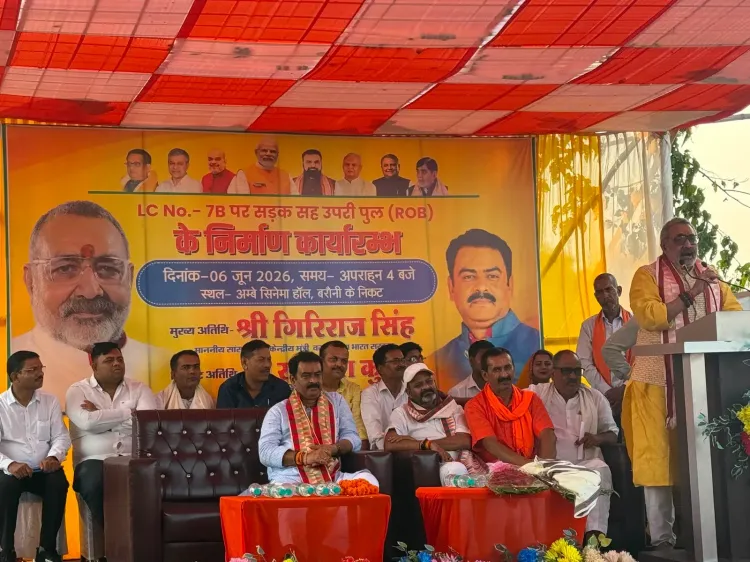
Union Textiles Minister Giriraj Singh on June 6, 2026 laid the foundation stone for a Road Over Bridge at Level Crossing No. 7B in Begusarai, Bihar. Construction of the first pillar began the same day. The project aims to ease traffic congestion at the railway crossing and improve connectivity for farmers, traders, students, and residents.
Key Takeaways
Union Textiles Minister Giriraj Singh laid the foundation stone for an ROB at LC No.
7B in Begusarai, Bihar on June 6, 2026 .
Construction of the project's first pillar commenced on the same day as the foundation-stone ceremony.
The ROB will eliminate a railway level crossing that currently causes traffic jams and poses safety risks.
Beneficiaries identified include farmers, traders, students, and ordinary citizens of Begusarai.
The project is framed as part of broader efforts to boost industrial connectivity in Begusarai, a district with significant refinery and manufacturing presence.
Completion timeline and funding details for the project have not yet been publicly disclosed.
Union Textiles Minister Giriraj Singh on Saturday, June 6, 2026, laid the foundation stone for a Road Over Bridge (ROB) at Level Crossing (LC) No. 7B in Begusarai, Bihar, marking the start of construction of the project's first pillar. The minister, who represents Begusarai as a Lok Sabha MP, described the initiative as a significant step toward the district's development, improved connectivity, and industrial growth.
Context
Posting on X, Giriraj Singh announced: 'आज LC संख्या-7B पर सड़क सह उपरी पुल (ROB) के निर्माण कार्य का शिलान्यास किया' ('Today, I laid the foundation stone for the construction of a Road-cum-Over Bridge at LC No. 7B'). He added that the ROB would bring relief from traffic congestion at the railway level crossing and make commuting safer and more convenient for farmers, traders, students, and ordinary citizens.
Level crossings are points where roads and railway tracks intersect at the same grade. They are a persistent source of traffic bottlenecks and accident risk, particularly in densely populated districts like Begusarai where freight and passenger movement is heavy.
Policy Backdrop
Indian Railways has, over the past decade, pursued an active programme of replacing manned level crossings with Road Over Bridges and Road Under Bridges (RUBs) as part of its safety and capacity enhancement agenda. Multiple such projects were sanctioned in Bihar during the 2010s, reflecting the state's status as a priority zone for rail-road separation works.
The broader push aligns with the central government's emphasis on upgrading connectivity infrastructure in eastern India, where growing industrial and agricultural traffic has increased pressure on existing road-rail intersections. Begusarai — home to a major oil refinery and several industrial units — sits at the centre of this demand, making ROB projects in the district particularly consequential for supply-chain efficiency.
Stakeholders and Impact
The ROB at LC 7B is expected to directly benefit the four groups Giriraj Singh named: farmers transporting produce to markets, traders moving goods through the district, students commuting to educational institutions, and daily-wage workers and residents who rely on the crossing. Elimination of the level crossing wait will reduce fuel loss, commute time, and the risk of accidents at an unmanned or manned gate.
For Begusarai's industrial corridor, smoother road access across the railway line can ease logistics for factories and warehouses that depend on timely freight movement. Local civic bodies and the district administration are among the stakeholders who stand to benefit from reduced traffic management burden once the bridge is operational.
What's Next
With the first pillar's construction now under way, attention will shift to the project's completion timeline and the funding structure — details that have not yet been placed in the public domain. Further announcements on additional railway or highway projects for Begusarai are expected as the minister continues constituency-level development outreach. The pace of construction and coordination between the state government, Indian Railways, and the district administration will determine how quickly commuters see relief at the crossing.
Point of View
Who has held Begusarai for successive terms, projects that address everyday pain points — traffic jams, accident risk — carry direct political resonance with a broad cross-section of voters. The ROB also slots into the central government's wider push to modernise rail-road infrastructure in Bihar, a state that has received elevated infrastructure attention as part of coalition management priorities. The key question going forward is whether execution matches the announcement, given the historically mixed completion record of ROB projects in the state.
NationPress
16 Sept 2026
Frequently Asked Questions
What is the ROB being built at LC 7B in Begusarai?
It is a Road Over Bridge (ROB) — a flyover that carries road traffic over a railway track — being constructed at Level Crossing No. 7B in Begusarai, Bihar. The foundation stone was laid by Union Textiles Minister Giriraj Singh on June 6, 2026.
Who laid the foundation stone of the Begusarai ROB?
Union Textiles Minister and Begusarai Lok Sabha MP Giriraj Singh laid the foundation stone and inaugurated construction of the first pillar on June 6, 2026.
How will the Begusarai ROB help local residents?
Once complete, the ROB will eliminate traffic jams caused by the railway level crossing gate, making commuting safer and faster for farmers, traders, students, and daily commuters in the area.
What is Indian Railways' policy on level crossings?
Indian Railways has been replacing manned level crossings with Road Over Bridges and Road Under Bridges as part of a national safety and capacity programme, with several such projects sanctioned in Bihar over the past decade.
When will the Begusarai LC 7B ROB be completed?
The completion timeline has not been officially announced yet. Construction of the first pillar began on June 6, 2026, and further project details are awaited from the authorities.