Giriraj Singh leads 'Loktantra Bachao' march in Begusarai
Synopsis
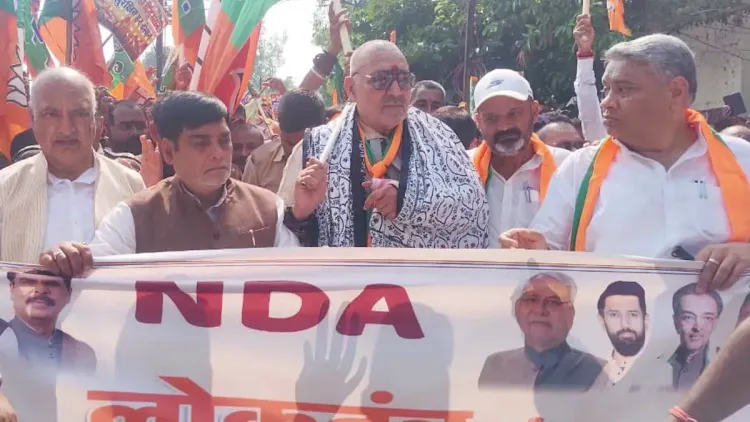
Union Textiles Minister Giriraj Singh led a 'Loktantra Bachao, Arajkata Hatao' padyatra across Begusarai on November 2, 2026, declaring overwhelming public support for BJP and framing the march as a battle cry against opposition anarchy and misleading agendas.
Key Takeaways
The padyatra ran from Gandhi Stadium through Kachahari Road and Ambedkar Chowk to Traffic Chowk in Begusarai, Bihar .
Union Textiles Minister Giriraj Singh personally led and participated in the march on November 2, 2026 .
Singh described the event as a shankhanad — a battle cry — against what he called opposition anarchy.
The march was branded 'Loktantra Bachao, Arajkata Hatao' (Save Democracy, Remove Anarchy).
Singh asserted that 'India wants a strong nation and rapid development under BJP leadership, not the opposition's misleading agenda.' The event follows a broader BJP pattern of high-visibility constituency mobilisation in competitive Bihar.
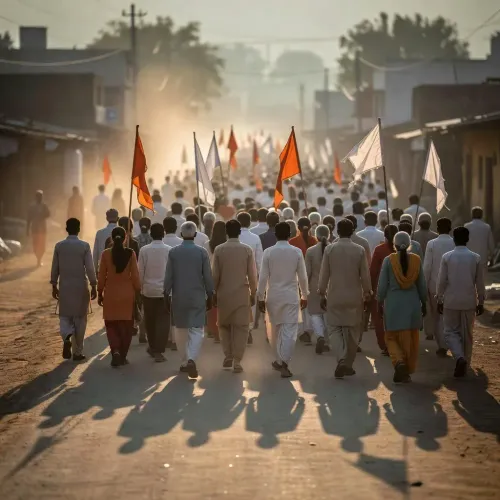
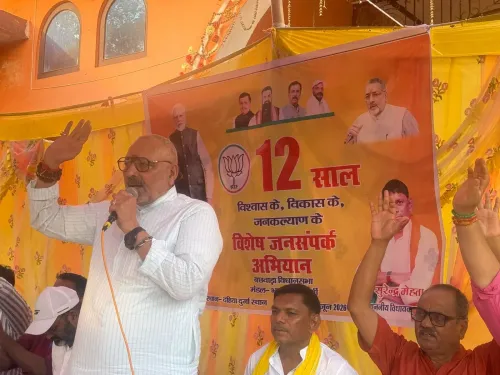
A mass padyatra wound through the streets of Begusarai on Monday, November 2, 2026 — from Gandhi Stadium along Kachahari Road, past Ambedkar Chowk, all the way to Traffic Chowk — as Union Textiles Minister Giriraj Singh led what he called a declaration of war against opposition 'anarchy'.
Posting on X after the march, Singh described the event as an historic 'Loktantra Bachao, Arajkata Hatao' (Save Democracy, Remove Anarchy) padyatra and declared it a 'shankhanad' — a conch-shell battle cry — against what he termed the opposition's anarchic politics. 'Let the opposition see clearly that the people's overwhelming support is with the BJP,' he wrote. 'India does not want the opposition's misleading agenda and anarchy — it wants a strong nation and rapid development under BJP leadership.'
A march by design: BJP's street-level playbook in Bihar
The choice of Begusarai is deliberate. Giriraj Singh has represented the constituency in the Lok Sabha and has long used it as a laboratory for high-visibility political mobilisation. Ruling-party leaders across India routinely stage public marches in home constituencies to project grassroots strength, assert dominance in the local narrative, and pre-empt opposition momentum. In Bihar — a state defined by fiercely competitive, multi-cornered political contests — such demonstrations carry particular weight. The route itself was a statement. Threading through Gandhi Stadium, a civic landmark, to the commercially and symbolically busy Traffic Chowk, the padyatra was designed to maximise visibility and participation across different neighbourhoods of the city.The 'anarchy' frame and what it signals
Singh's language — 'arajkata' (anarchy), 'bhramak agenda' (misleading agenda) — follows a well-worn BJP messaging template that contrasts its own development record against opposition disruption. The framing sharpens ahead of any election cycle, positioning the party as the stable, constructive force and the opposition as a destabilising one. The invocation of 'loktantra' (democracy) adds a constitutional weight to what is, at its core, a mobilisation exercise. Bihar's political landscape remains one of the most watched in India — its voter arithmetic, caste dynamics, and coalition mathematics regularly shape national calculations. A senior Union Minister taking to the streets personally, rather than sending a local functionary, signals that the BJP is treating the ground-level contest in this constituency with serious intent. Whether the opposition — whose response is yet to emerge — can mount a counter-narrative in Begusarai will be the next chapter to watch.Point of View
Rather than delegating to local party units, underscores how seriously the BJP is treating ground-level competition in Begusarai. The 'Loktantra Bachao' branding is a calculated pivot — by framing the opposition as a threat to democracy itself, the BJP elevates a local mobilisation event into a national ideological argument. Bihar's outsized electoral importance means such displays are rarely just local theatre; they often set the tone for state-level and coalition messaging. The opposition's counter-move, or lack thereof, will reveal the balance of political confidence in this bellwether constituency.
NationPress
2 Nov 2026
Frequently Asked Questions
What is the 'Loktantra Bachao, Arajkata Hatao' padyatra in Begusarai?
It is a public march organised by BJP in Begusarai on November 2, 2026, led by Union Textiles Minister Giriraj Singh, aimed at asserting popular support for the BJP and opposing what the party describes as the opposition's anarchy and misleading agenda.
What route did the Begusarai padyatra take?
The march began at Gandhi Stadium, proceeded along Kachahari Road, passed through Ambedkar Chowk, and concluded at Traffic Chowk in Begusarai.
Why did Giriraj Singh hold this march in Begusarai?
Begusarai is Giriraj Singh's Lok Sabha constituency, and BJP leaders regularly organise high-visibility marches in home constituencies to project grassroots strength and counter opposition messaging, especially in electorally competitive Bihar.
What did Giriraj Singh say about the opposition?
Singh stated that the opposition should 'clearly see' that public support is overwhelmingly with BJP, and that India needs 'a strong nation and rapid development under BJP leadership,' not the opposition's 'misleading agenda and anarchy.'
What does 'shankhanad' mean in the context of Giriraj Singh's march?
'Shankhanad' literally means the blowing of a conch shell, a traditional Indian symbol of a momentous call to action or battle cry. Singh used the term to describe the march as a decisive declaration against opposition politics.