Giriraj Singh marks 11 years of Digital India, cites 1.02 bn internet connections
Synopsis
Union Textiles Minister Giriraj Singh marked Digital India's eleventh anniversary on 1 July 2026, sharing data showing internet connections have reached 1.02 billion — up from roughly 250 million at the programme's 2015 launch — as the government highlights a decade of digital infrastructure expansion.
Key Takeaways
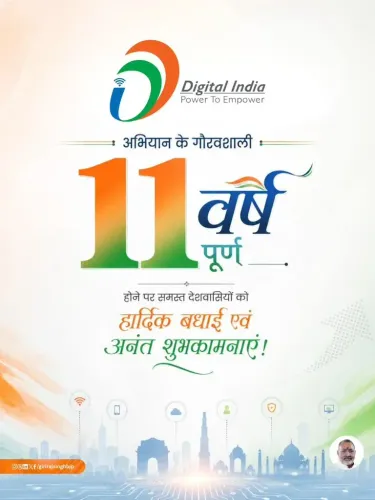
Digital India completed 11 years on 1 July 2026 , having been launched by Prime Minister Narendra Modi on 1 July 2015 .
Internet connections in India have reportedly reached 1.02 billion , roughly quadrupling since the programme's launch.
Union Textiles Minister Giriraj Singh amplified the milestone via the NaMo App , reflecting cross-portfolio BJP communication on the anniversary.
The growth spans mobile broadband , BharatNet rural fibre, and allied digital public infrastructure including Aadhaar and UPI .
Upcoming policy milestones include further 5G spectrum auctions and implementation of the Digital Personal Data Protection Act .
Rural India remains the critical frontier for the next phase of connectivity and digital literacy expansion.
Union Textiles Minister Giriraj Singh on Wednesday, 1 July 2026 shared a milestone marking 11 years of the Digital India programme, highlighting that internet connections in the country have grown to 1.02 billion — a figure he described as emblematic of the initiative's transformative reach since its launch in July 2015.
Context
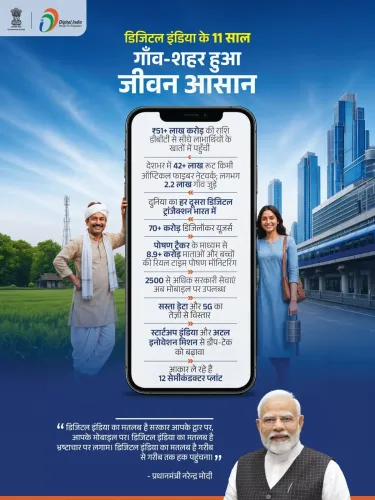
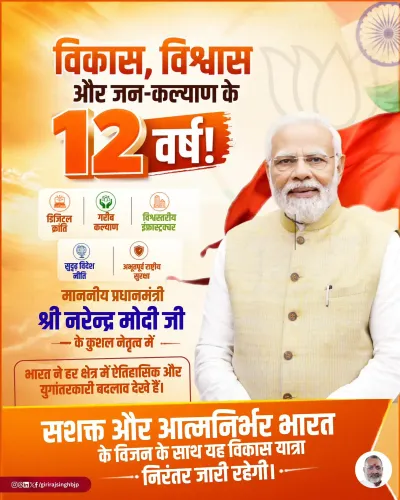
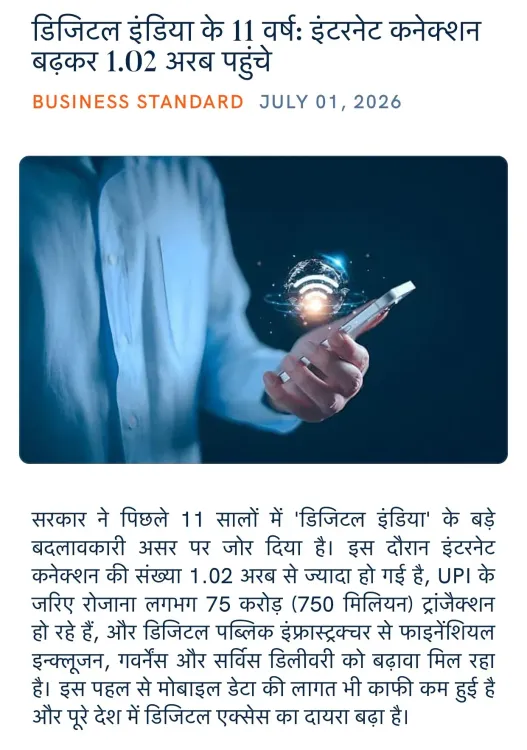
The post, shared via the NaMo App, carried the headline 'डिजिटल इंडिया के 11 वर्ष: इंटरनेट कनेक्शन बढ़कर 1.02 अरब पहुंचे' — translating to '11 years of Digital India: Internet connections rise to 1.02 billion.' 1 July 2026 marks the eleventh anniversary of the flagship programme, which Prime Minister Narendra Modi formally launched on 1 July 2015 with the stated goal of creating a digitally empowered society and transforming India into a knowledge economy.
The NaMo App, through which the post was shared, serves as an official platform for government updates and BJP communication, underlining the political salience attached to the Digital India anniversary across the ruling party's leadership.
Policy Backdrop
The Digital India programme was conceived as an umbrella initiative spanning digital infrastructure expansion, e-governance delivery and broadband connectivity to underserved regions. Over its eleven-year run, the programme has intersected with allied pillars of India's digital public infrastructure — including Aadhaar-linked identity services and the Unified Payments Interface (UPI), which together form the backbone of the government's India Stack architecture.
The quadrupling of internet connections — from roughly 250 million at the time of the programme's launch to the cited 1.02 billion — reflects a combination of aggressive mobile broadband rollout, competitive data pricing triggered by market disruption after 2016, and government-led schemes to extend last-mile connectivity to rural and remote areas. The expansion of 5G networks, spectrum auctions and the BharatNet optical fibre project have each contributed to this trajectory.
Stakeholders and Impact
The most direct beneficiaries of the connectivity surge are rural households and first-time internet users, for whom digital access has unlocked government welfare delivery, digital payments, telemedicine and online education. With over 1 billion active internet connections, India now ranks among the world's largest connected populations, a fact the government has consistently cited in multilateral forums on digital governance.
For the BJP and the Modi government, the Digital India anniversary serves as a high-visibility opportunity to consolidate a technology-progress narrative ahead of ongoing state electoral cycles. Senior ministers across portfolios — not only those with a direct technology brief — routinely amplify such milestones, signalling the programme's cross-cutting political significance.
What's Next
The government's near-term digital agenda includes further 5G spectrum auctions, deeper penetration of BharatNet into gram panchayats, and the operationalisation of the Digital Personal Data Protection Act — a framework that will govern how the data of India's billion-plus connected users is collected, stored and processed. Each of these steps will test whether the infrastructure gains of the past eleven years translate into robust, rights-respecting digital governance.
As internet penetration approaches saturation in urban markets, the next phase of Digital India's growth story will increasingly be written in rural India, where connectivity quality, digital literacy and last-mile device access remain the defining challenges.
Point of View
With ministers well beyond the IT ministry — including Giriraj Singh from Textiles — amplifying the milestone, signalling how deeply the technology-progress narrative is woven into the BJP's broader political identity. Reaching the symbolic threshold of one billion internet connections gives the ruling party a powerful, concrete data point to anchor its development story. At the same time, the shift from raw connectivity numbers to questions of data rights, platform accountability and digital literacy will define whether the programme's second decade matches the ambition of its first. The imminent implementation of the Digital Personal Data Protection Act will be an early test of that maturity.
NationPress
1 Jul 2026
Frequently Asked Questions
What is Digital India and when was it launched?
Digital India is a flagship government programme launched by Prime Minister Narendra Modi on 1 July 2015 to expand digital infrastructure, promote e-governance and improve internet access across the country, particularly in rural and underserved areas.
How many internet connections does India have in 2026?
According to the figure shared by Union Textiles Minister Giriraj Singh on the programme's eleventh anniversary, India's internet connections have reached 1.02 billion , roughly four times the number at the time of Digital India's launch in 2015.
Why did Giriraj Singh post about Digital India if he is the Textiles Minister?
Giriraj Singh is a senior BJP leader and Lok Sabha MP from Begusarai, Bihar . It is common for ministers across portfolios to amplify flagship government programme milestones through party communication channels such as the NaMo App , reflecting a coordinated political messaging strategy.
What is the NaMo App?
The NaMo App is an official platform associated with Prime Minister Narendra Modi and the BJP , used to disseminate government updates, policy milestones and party communications to supporters and the public.
What are the next steps for Digital India after 11 years?
Key upcoming milestones include further 5G spectrum auctions , expanded BharatNet rural fibre connectivity and the operationalisation of the Digital Personal Data Protection Act , which will regulate how data belonging to India's billion-plus internet users is handled.