Giriraj Singh hails yoga as global movement on Int'l Yoga Day
Synopsis
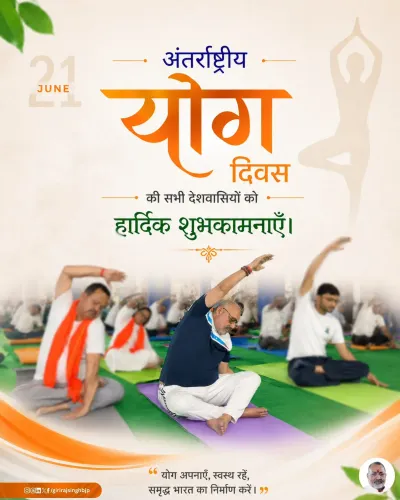
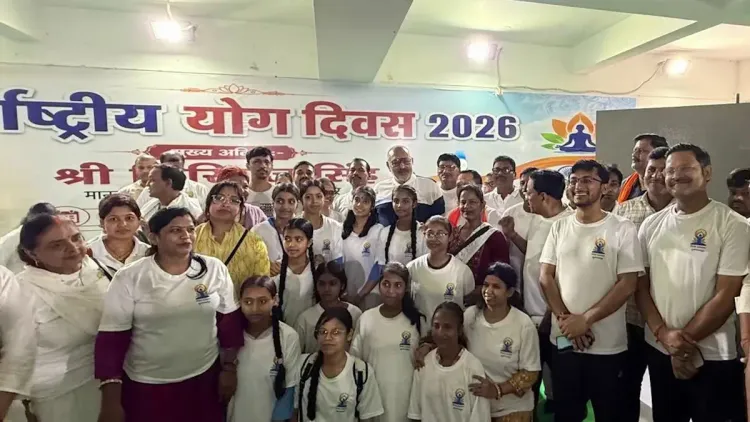
Union Textiles Minister Giriraj Singh marked International Yoga Day on 21 June 2026 by crediting PM Modi's UN initiative for elevating yoga into a global people's movement, linking the practice to India's ancient philosophy of universal well-being.
Key Takeaways
Giriraj Singh posted on 21 June 2026 marking International Yoga Day , crediting PM Modi for yoga's global spread.
Singh described yoga as a 'global people's movement' ( vaishvik jan-andolan ) transcending India's ancient heritage.
He invoked the Sanskrit principle Sarve Bhavantu Sukhinah — 'may all beings be happy' — as yoga's guiding philosophy.
PM Modi proposed International Yoga Day at the UN General Assembly in September 2014 ; the resolution was adopted by acclamation in December 2014 .
India has used the annual observance as a tool of cultural diplomacy and soft power through the Ministry of AYUSH .
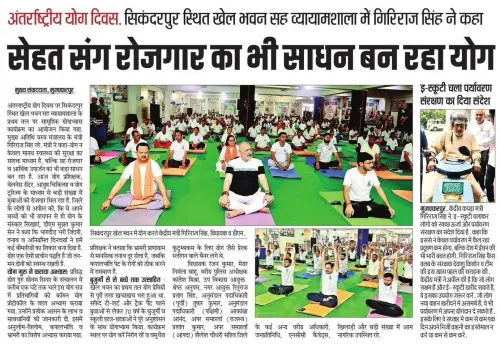
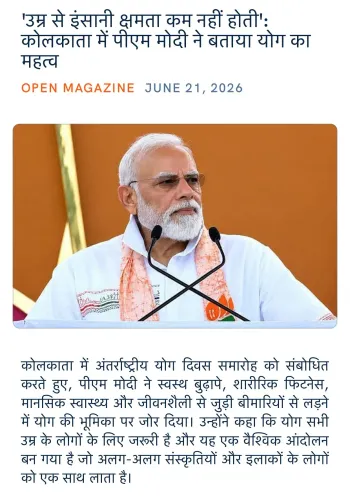
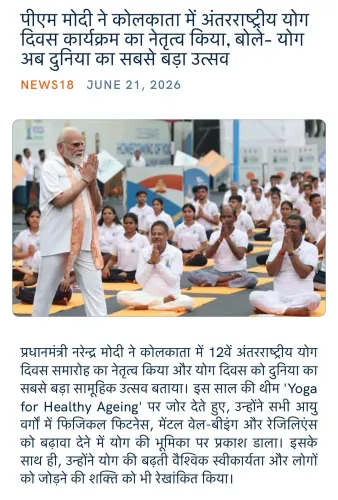
Union Textiles Minister Giriraj Singh on Sunday, 21 June 2026, credited Prime Minister Narendra Modi's sustained efforts for transforming yoga from India's ancient heritage into a worldwide people's movement, posting his message on the occasion of International Yoga Day. The minister invoked the Sanskrit principle Sarve Bhavantu Sukhinah (may all beings be happy) to frame yoga as a vehicle of India's civilisational philosophy reaching every corner of the globe.
Context
In his post, Singh wrote that through Modi's continuous efforts, yoga has moved beyond India's ancient heritage to become a 'global people's movement' (vaishvik jan-andolan). He described crores of people adopting yoga as the foundation of a healthy body, a calm mind, and a balanced life. The post was accompanied by a video and was shared on the morning of International Yoga Day.
Singh added that through yoga, India's philosophy of 'Sarve Bhavantu Sukhinah' — 'may all be happy' — is being realised across the world, positioning the practice as a form of universal well-being rather than a purely physical discipline.
Policy Backdrop
The origins of International Yoga Day trace directly to India's diplomatic initiative. In September 2014, Prime Minister Modi proposed at the United Nations General Assembly that 21 June be designated as an international day for yoga. The UN adopted the resolution by acclamation in December 2014, making it one of the fastest resolutions of its kind to receive such broad support.
Since then, India has used the annual observance to advance cultural diplomacy and soft power, linking the country's ancient traditions to contemporary global wellness discourse. The Ministry of AYUSH has been the nodal body for coordinating mass yoga events, outreach programmes, and integration of yoga into public health messaging both domestically and through Indian missions abroad.
Stakeholders and Impact
The global yoga community — spanning practitioners, wellness organisations, and public health bodies across continents — is the primary audience for India's International Yoga Day outreach. Domestically, the AYUSH ministry's programmes have sought to embed yoga in school curricula and preventive health frameworks, broadening its reach beyond urban practitioners.
India's framing of yoga as a universal, non-sectarian practice has enabled wide international participation, with events held in countries across Asia, Europe, the Americas, and Africa. Senior ministers and BJP leaders routinely mark the occasion with public messaging that reinforces both the cultural and diplomatic dimensions of the initiative.
What's Next
Attention will now turn to the scale and reach of this year's International Yoga Day events coordinated by the AYUSH ministry, including any flagship mass yoga sessions at prominent national or international venues. Announcements on deeper integration of yoga into school health programmes or new bilateral wellness partnerships could follow in the days ahead, as the government looks to build on the day's global visibility.
Point of View
The message serves a dual purpose: domestic political messaging and international image-building around India's civilisational identity. The invocation of Sarve Bhavantu Sukhinah is a deliberate choice, framing yoga as a universalist, non-sectarian offering — a framing that has helped sustain broad international buy-in for the UN observance. This pattern of senior ministers amplifying the yoga diplomacy narrative on 21 June has become a fixture of India's cultural outreach calendar.
NationPress
20 Sept 2026
Frequently Asked Questions
When is International Yoga Day and who proposed it?
International Yoga Day is observed every year on 21 June . It was proposed by Prime Minister Narendra Modi at the UN General Assembly in September 2014 and adopted by the UN in December 2014 .
What did Giriraj Singh say on International Yoga Day 2026?
Union Textiles Minister Giriraj Singh credited PM Modi's sustained efforts for transforming yoga from India's ancient heritage into a worldwide people's movement, and invoked the Sanskrit phrase Sarve Bhavantu Sukhinah — 'may all be happy' — to describe yoga's global mission.
What is the meaning of 'Sarve Bhavantu Sukhinah'?
Sarve Bhavantu Sukhinah is a Sanskrit invocation meaning 'may all beings be happy.' It is drawn from ancient Indian scriptures and is frequently cited as expressing yoga's universal philosophy of well-being.
Which ministry oversees International Yoga Day events in India?
The Ministry of AYUSH (Ayurveda, Yoga and Naturopathy, Unani, Siddha and Homeopathy) is the nodal government body coordinating International Yoga Day events, outreach programmes, and yoga integration in public health initiatives across India.
Why does India celebrate International Yoga Day?
India celebrates International Yoga Day on 21 June to promote yoga as a tool of public health and cultural diplomacy, building on the country's initiative that led to the UN's adoption of the observance in 2014 . It also serves as a platform to highlight India's ancient wellness traditions on a global stage.