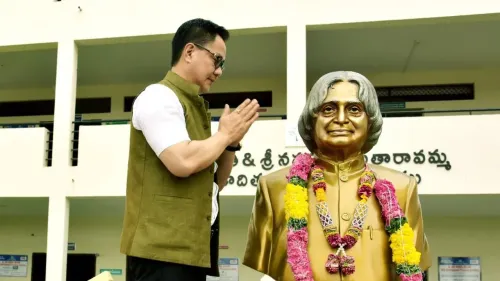
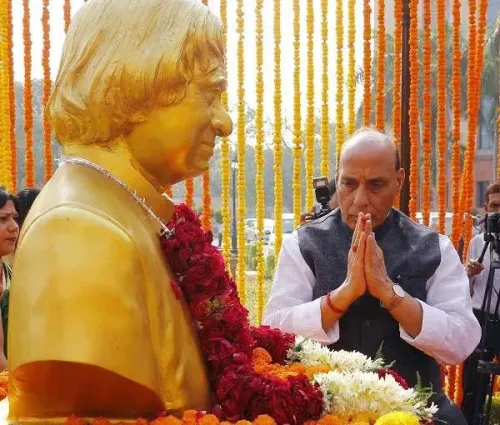
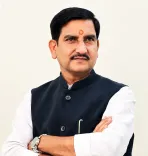
Giriraj Singh pays tribute to APJ Abdul Kalam on birth anniversary
Synopsis
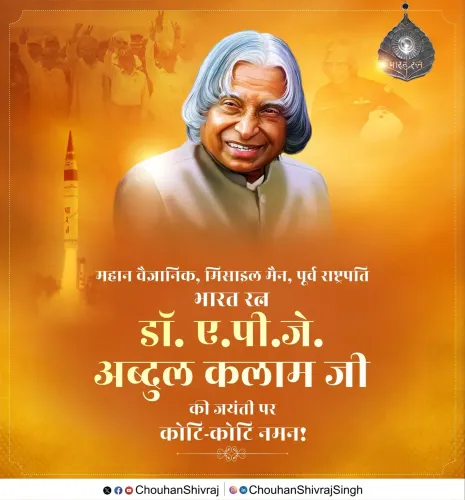
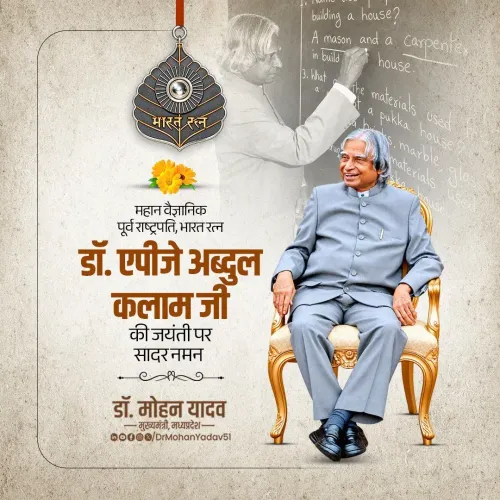
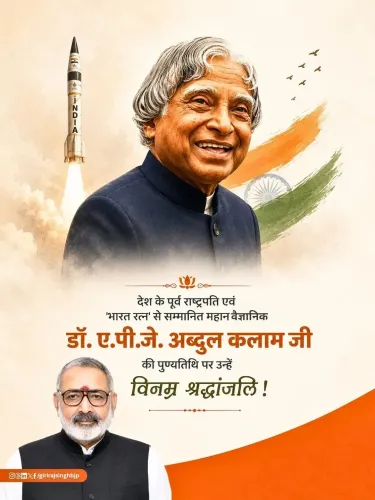
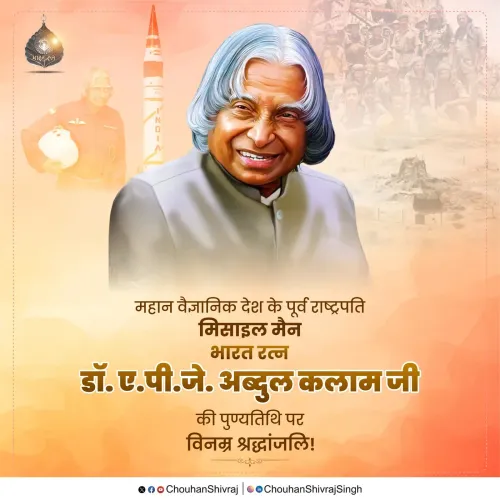
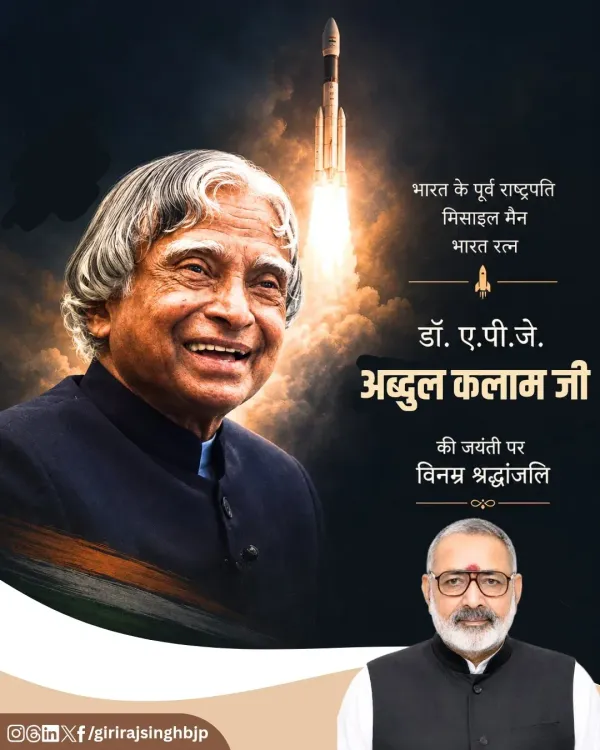
Union Textiles Minister Giriraj Singh paid homage to former President Dr. A.P.J. Abdul Kalam on his birth anniversary on 15 October 2026, honouring the 'Missile Man' and Bharat Ratna laureate's contributions to national development and youth empowerment.
Key Takeaways
Union Textiles Minister Giriraj Singh posted a tribute to Dr.
Abdul Kalam on his birth anniversary, 15 October 2026 .
Kalam was born on 15 October 1931 in Rameswaram, Tamil Nadu, and rose to become a leading aerospace scientist.
He was awarded the Bharat Ratna in 1997 and served as President of India from 2002 to 2007 .
Kalam earned the title 'Missile Man of India' for his central role in developing the Agni and Prithvi ballistic missiles.
Singh highlighted Kalam's 'invaluable contribution to national development and the upliftment of youth' as a lasting source of inspiration.
On the birth anniversary of one of India's most beloved scientist-statesmen, Union Textiles Minister Giriraj Singh offered a heartfelt tribute on 15 October 2026 to Dr. A.P.J. Abdul Kalam — former President, rocket scientist, and the man who gave India's missile programme its spine.
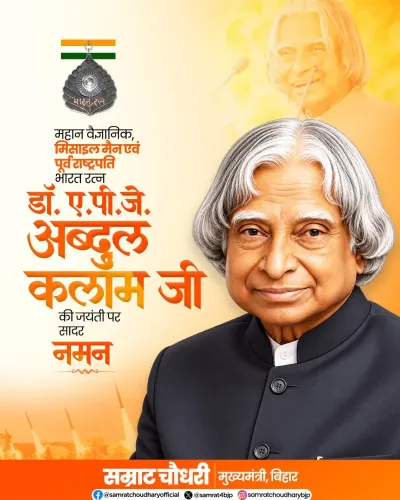
Posting in Hindi, Singh wrote: 'Bharat ke poorv Rashtrapati, 'Missile Man' aur 'Bharat Ratna' se sammanit Dr. A.P.J. Abdul Kalam ji ki jayanti par unhe vinamra shraddhanjali!' — 'A humble tribute to former President of India, the 'Missile Man' and 'Bharat Ratna' awardee Dr. A.P.J. Abdul Kalam on his birth anniversary!' He added that Kalam's 'invaluable contribution to the nation's development and the upliftment of youth will forever remain a source of inspiration for all of us.'
The man behind the missiles — and the dream
Dr. Avul Pakir Jainulabdeen Abdul Kalam was born on 15 October 1931 in Rameswaram, Tamil Nadu. A self-made aeronautical engineer who rose from modest origins, he went on to serve as a senior scientist at ISRO and DRDO, leading the development of the Agni and Prithvi ballistic missiles — the backbone of India's indigenous defence capability. The 'Missile Man' tag was not merely a headline; it reflected decades of precision work that changed India's strategic posture.
He was awarded the Bharat Ratna — India's highest civilian honour — in 1997, and served as the 11th President of India from 2002 to 2007, becoming the rare head of state whose public image was defined less by politics than by an almost evangelical belief in the potential of Indian youth.
A legacy that India's leaders revisit every October
Each year on 15 October, tributes pour in from across the political spectrum — a rare bipartisan ritual in Indian public life. Kalam's vision of a scientifically literate, self-reliant India resonates with leaders regardless of party, and his books and speeches remain staples in school curricula and youth development programmes. Institutions across the country mark the day with lectures, essay competitions, and science fairs in his name.
Singh's tribute, anchored in Kalam's dual legacy of technological might and youth inspiration, reflects that enduring consensus — a reminder that some figures belong not to any one government but to the national imagination itself.
Point of View
With leaders across ideologies invoking his name to signal commitment to science, self-reliance, and youth ambition. For the BJP, Kalam's legacy conveniently reinforces the 'Atmanirbhar Bharat' narrative — indigenous defence technology, scientific temper, national pride. Singh's post fits neatly into that frame. The broader pattern is worth noting: Kalam's memory functions as political common ground, a rare asset in an era of sharp polarisation, which explains why October 15 consistently draws tributes from every corner of the political map.
NationPress
15 Oct 2026
Frequently Asked Questions
When is APJ Abdul Kalam's birth anniversary?
Dr. A.P.J. Abdul Kalam was born on 15 October 1931 in Rameswaram, Tamil Nadu, and his birth anniversary is commemorated every year on that date.
Why is APJ Abdul Kalam called the Missile Man of India?
Kalam earned the title 'Missile Man of India' for leading the development of India's indigenous ballistic missiles, notably the Agni and Prithvi series, during his tenure at DRDO and ISRO.
When did APJ Abdul Kalam receive the Bharat Ratna?
Dr. Kalam was awarded the Bharat Ratna , India's highest civilian honour, in 1997 , recognising his extraordinary contributions to science and national development.
When was APJ Abdul Kalam President of India?
Dr. A.P.J. Abdul Kalam served as the 11th President of India from 2002 to 2007 .
What did Giriraj Singh say about APJ Abdul Kalam?
Union Textiles Minister Giriraj Singh said Kalam's 'invaluable contribution to the nation's development and the upliftment of youth will forever remain a source of inspiration for all of us,' posting the tribute on his birth anniversary on 15 October 2026 .