Rijiju Remembers Kalam on Birth Anniversary
Synopsis
Union Minister Kiren Rijiju remembered Dr. APJ Abdul Kalam on his birth anniversary, honouring the Bharat Ratna scientist-President's contributions to India's missile programme, nuclear deterrence, and his enduring vision of a knowledge-driven, youth-empowered nation.
Key Takeaways
Kiren Rijiju paid tribute to Dr.
APJ Abdul Kalam on his birth anniversary, October 15 .
Kalam, born in 1931 in Rameswaram, Tamil Nadu , led development of the Agni and Prithvi missiles and played a key role in the Pokhran-II nuclear tests of 1998 .
He was awarded the Bharat Ratna in 1997 and served as India's 11th President from 2002 to 2007 .
Kalam passed away on July 27, 2015 while delivering a lecture at IIM Shillong .
The tribute aligns with the government's broader emphasis on indigenous defence capability and science-led national development.
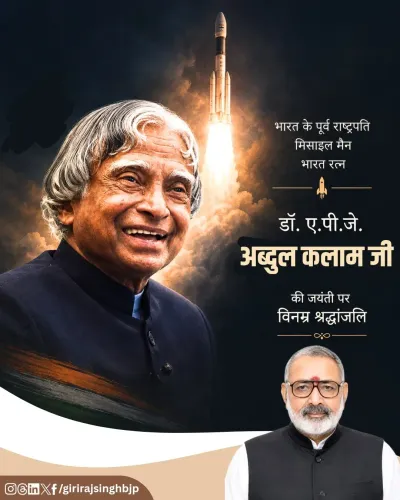
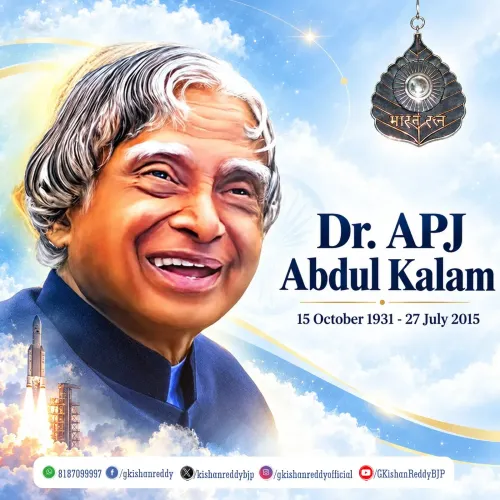
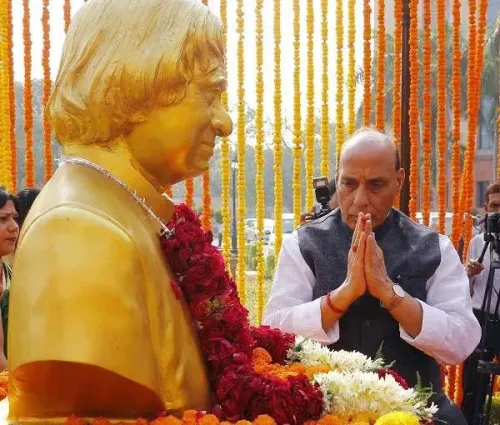
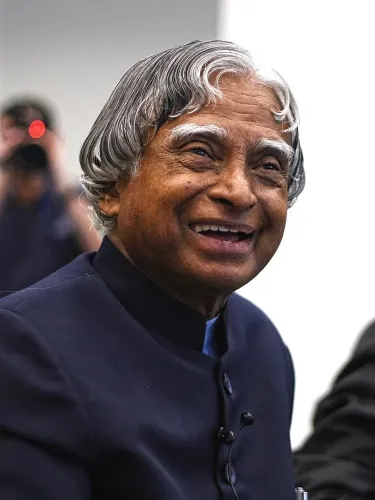
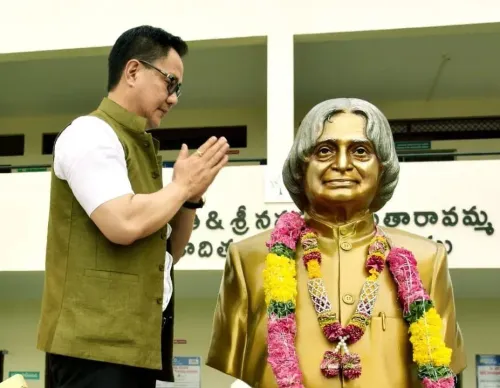
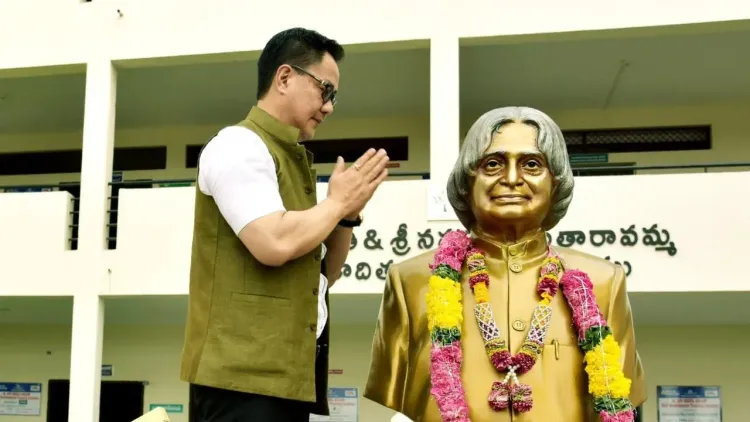
On what would have been his 95th birth anniversary, Union Parliamentary Affairs Minister Kiren Rijiju paid tribute on Thursday, October 15 to Bharat Ratna Dr. APJ Abdul Kalam — the aerospace scientist who became India's 11th President and earned the enduring title 'Missile Man of India'.
Rijiju's post recalled Kalam's twin legacy: his scientific stewardship of India's most consequential defence programmes and his relentless belief in the country's youth as the engine of national transformation. 'His contributions to India's scientific progress and national strength remain significant,' the minister wrote. 'His vision of an empowered India, driven by knowledge and its youth, continues to inspire us all.'
From Rameswaram to Rashtrapati Bhavan
Born on October 15, 1931, in Rameswaram, Tamil Nadu, Kalam rose from a modest background to become the architect of India's missile deterrent. He led the development of the Agni and Prithvi ballistic missiles and played a central role in the Pokhran-II nuclear tests of 1998 — the detonations that announced India as an overt nuclear power. In 1997, the nation recognised that arc with its highest civilian honour, the Bharat Ratna.
He served as President from 2002 to 2007, an unusual tenure for a scientist-technocrat in a largely ceremonial role. Yet Kalam used the platform to speak directly to students and young professionals across the country, cementing the public identity that outlasted his presidency: a scientist who belonged to everyone.
Why October 15 Carries Weight in Science Policy
Since Kalam's death on July 27, 2015 — he collapsed while delivering a lecture at IIM Shillong — his birth anniversary has become an annual moment for the government to underscore its commitment to indigenous technological self-reliance. Senior ministers routinely use the occasion to connect Kalam's legacy to present-day ambitions: the defence indigenisation push, the space economy, and science-driven education reform.
Rijiju's tribute fits that pattern precisely. As a senior member of a government that has made 'Aatmanirbhar Bharat' a cornerstone policy, invoking Kalam on his jayanti is both a genuine homage and a signal — that the ideals of knowledge, self-reliance, and youth empowerment remain live policy commitments, not archived history.
Kalam's legacy is not a relic. It is a benchmark — and every October 15, India measures itself against it.
Point of View
Linking the current government's self-reliance agenda directly to a scientist-president who predates it. Rijiju's invocation of 'knowledge and youth' echoes the language of multiple ongoing policy pushes, from defence indigenisation to the National Education Policy. The consistency of this framing across successive governments also reflects Kalam's rare cross-partisan appeal: he is one of the few public figures whom no political camp disputes. For the BJP in particular, Kalam's Pokhran-II role provides a potent symbol of muscular, science-backed nationalism.
NationPress
15 Oct 2026
Frequently Asked Questions
Why is October 15 significant for APJ Abdul Kalam?
October 15 is the birth anniversary of Dr. APJ Abdul Kalam , who was born on this date in 1931 in Rameswaram, Tamil Nadu . The day is widely observed across India with tributes from leaders, educational institutions, and the scientific community.
Why was APJ Abdul Kalam called the Missile Man of India?
Dr. Kalam earned the title 'Missile Man of India' for his pivotal role in developing India's ballistic missile programme, including the Agni and Prithvi missiles, and for his key contributions to the Pokhran-II nuclear tests of 1998 .
What is Bharat Ratna and when did Kalam receive it?
The Bharat Ratna is India's highest civilian honour. Dr. APJ Abdul Kalam received it in 1997 in recognition of his contributions to India's space and missile programmes.
When did APJ Abdul Kalam pass away?
Dr. APJ Abdul Kalam passed away on July 27, 2015 , after collapsing during a lecture at the Indian Institute of Management (IIM) Shillong .
What did Kiren Rijiju say about APJ Abdul Kalam?
Kiren Rijiju said Kalam's contributions to India's scientific progress and national strength 'remain significant' and that his vision of 'an empowered India, driven by knowledge and its youth, continues to inspire us all.'