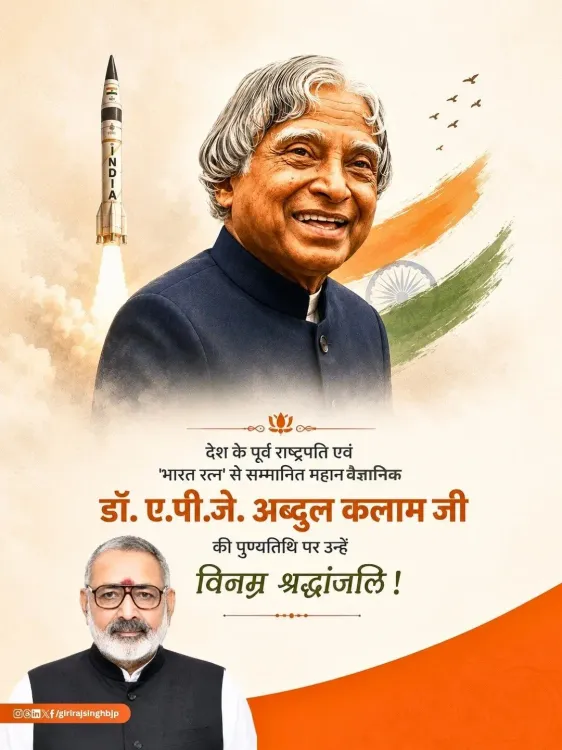
Giriraj Singh pays tribute to APJ Abdul Kalam on death anniversary
Synopsis
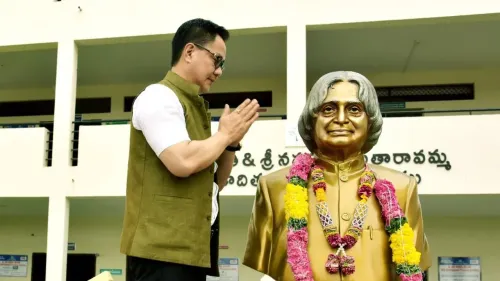
Union Textiles Minister Giriraj Singh on 27 July 2026 paid tribute to former President Dr. A.P.J. Abdul Kalam on his death anniversary, honouring his unparalleled contributions to India's space and defence sectors and his lifelong inspiration to Indian youth.
Key Takeaways
Union Textiles Minister Giriraj Singh posted a tribute on X on 27 July 2026 , the death anniversary of former President Dr.
Kalam, known as the 'Missile Man of India', passed away on 27 July 2015 at age 83 .
He served as India's 11th President (2002–2007) and received the Bharat Ratna in 1997 .
Kalam led the Integrated Guided Missile Development Programme (1983) , producing the Agni, Prithvi, and Akash missiles.
He played a key role at both ISRO (SLV-3 satellite launch vehicle) and DRDO throughout his career.
Singh's tribute highlighted Kalam's simple lifestyle and his lasting inspiration to crores of Indian youth .
Union Textiles Minister Giriraj Singh on Monday, 27 July 2026 paid homage to former President and scientist Dr. A.P.J. Abdul Kalam on his death anniversary, honouring him as the 'Missile Man of India' and a Bharat Ratna laureate whose legacy continues to inspire millions of young Indians.
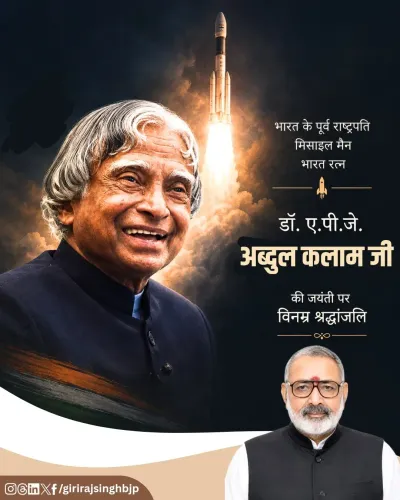
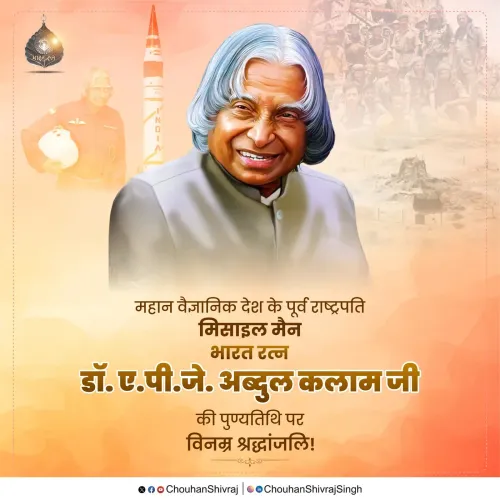
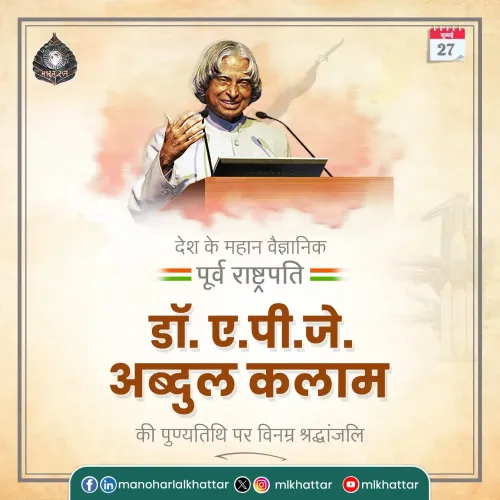
Posting on X in Hindi, Singh wrote: 'देश के पूर्व राष्ट्रपति, 'मिसाइल मैन' एवं 'भारत रत्न' डॉ. ए.पी.जे. अब्दुल कलाम जी की पुण्यतिथि पर उन्हें शत-शत नमन।' ['On the death anniversary of former President, 'Missile Man' and Bharat Ratna Dr. A.P.J. Abdul Kalam, I bow to him a hundredfold.'] He added that Kalam's unparalleled contribution to India's space research and defence sectors, along with his simple way of life, 'will always inspire crores of youth of the country.'
Context
Dr. Avul Pakir Jainulabdeen Abdul Kalam passed away on 27 July 2015 while delivering a lecture at the Indian Institute of Management, Shillong. He was 83 years old. Every year on this date, leaders across the political spectrum pay public tribute to his memory, reflecting the broad national reverence he commands.
Kalam served as India's 11th President from 2002 to 2007 and was awarded the Bharat Ratna — India's highest civilian honour — in 1997. He remains one of the few Presidents to have been popularly called the 'People's President', a title rooted in his accessibility and his consistent engagement with students and young scientists.
Policy Backdrop
Kalam's scientific career spanned both ISRO (Indian Space Research Organisation) and DRDO (Defence Research and Development Organisation). At ISRO, he played a leading role in developing the SLV-3, India's first indigenously built satellite launch vehicle. At DRDO, he directed the Integrated Guided Missile Development Programme, launched in 1983, which produced the Agni, Prithvi, and Akash missile systems that form the backbone of India's strategic deterrent.
In 1992, Kalam was appointed Scientific Adviser to the Defence Minister, and from 1999 he served as Principal Scientific Adviser to the Government of India. Successive governments have invoked his emphasis on technology-driven self-reliance when framing policies for defence indigenisation and the expansion of India's commercial space sector.
Stakeholders and Impact
Kalam's enduring public image as a scientist-statesman from a modest background in Rameswaram, Tamil Nadu, makes him a reference point in national conversations about science education, defence research, and youth empowerment. His books, particularly Wings of Fire, remain widely read in schools and colleges across India.
For India's defence and space scientific community, annual tributes from senior ministers serve as a public reaffirmation of institutional support for the programmes Kalam helped build. The tributes also carry symbolic weight for the DRDO and ISRO workforces, whose work traces a direct lineage to his foundational contributions.
What's Next
Commemorations on Kalam's death anniversary often prompt renewed discussion in parliamentary sessions and at national science forums about schemes honouring his legacy — including science education initiatives and defence R&D outreach programmes. As India continues to expand its space and missile programmes, policymakers are likely to continue invoking Kalam's vision of technological self-reliance as a guiding framework.
Point of View
Invoking Kalam's legacy of defence indigenisation and technology self-reliance aligns neatly with the ruling dispensation's 'Aatmanirbhar Bharat' narrative. The tribute also reflects a broader pattern in which India's political class uses commemorative moments to reinforce continuity between Kalam-era foundational investments in DRDO and ISRO and present-day policy ambitions. What the post does not do — and what observers will watch for — is whether such anniversaries translate into concrete new announcements on science education or defence R&D funding.
NationPress
26 Oct 2026
Frequently Asked Questions
When did APJ Abdul Kalam die?
Dr. A.P.J. Abdul Kalam passed away on 27 July 2015 while delivering a lecture at the Indian Institute of Management in Shillong. He was 83 years old.
Why is APJ Abdul Kalam called the Missile Man of India?
Kalam earned the title 'Missile Man of India' for directing the Integrated Guided Missile Development Programme at DRDO from 1983, which produced key missiles including Agni, Prithvi, and Akash.
What is APJ Abdul Kalam's contribution to ISRO?
At ISRO, Kalam played a leading role in developing the SLV-3, India's first indigenously built satellite launch vehicle, laying the foundation for the country's space launch capability.
Who is Giriraj Singh?
Giriraj Singh is a senior BJP leader and Union Minister of Textiles in the Indian government. He is a Lok Sabha MP from Begusarai, Bihar.
What awards did APJ Abdul Kalam receive?
Dr. Kalam received the Bharat Ratna, India's highest civilian honour, in 1997. He also received the Padma Vibhushan (1990) and Padma Bhushan (1981) earlier in his career.