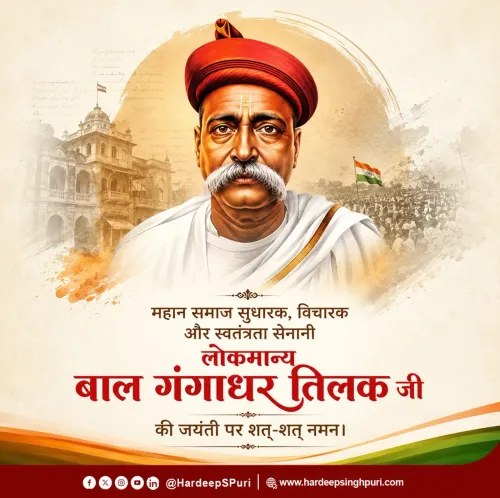
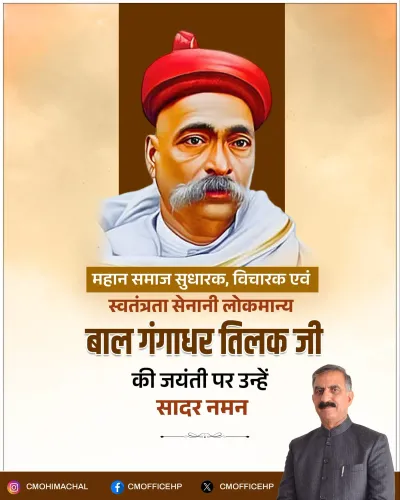
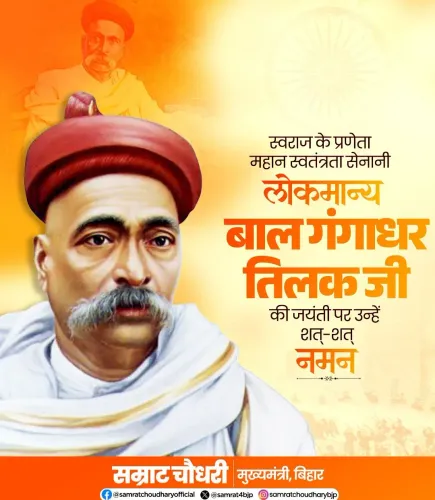
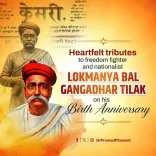
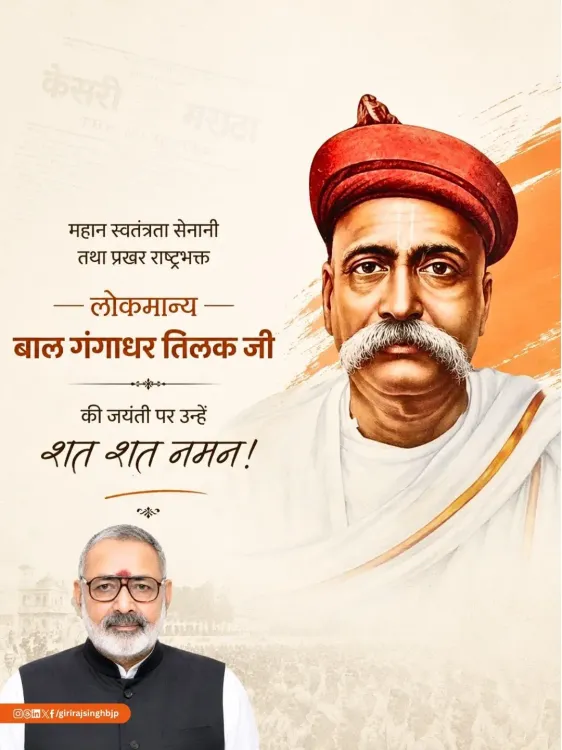
Giriraj Singh pays tribute to Bal Gangadhar Tilak on birth anniversary
Synopsis
Union Textiles Minister Giriraj Singh marked Lokmanya Bal Gangadhar Tilak's birth anniversary on 23 July 2026, invoking his iconic 'Swaraj is my birthright' declaration and honouring his sacrifice, patriotism, and enduring inspiration to the Indian nation.
Key Takeaways
Giriraj Singh paid tribute to Lokmanya Bal Gangadhar Tilak on his birth anniversary, 23 July 2026 .
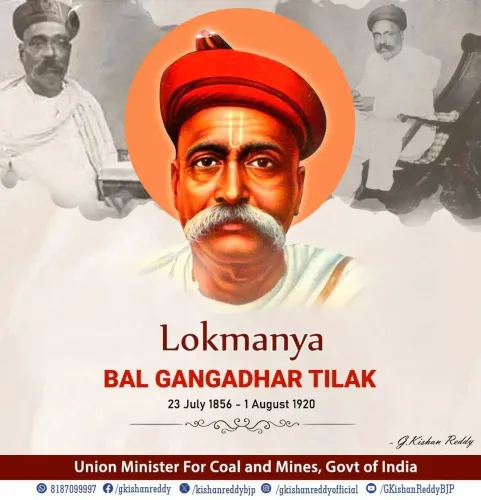
Tilak was born on 23 July 1856 in Ratnagiri, Maharashtra and is regarded as a founding figure of India's independence movement.
His slogan — 'Swaraj is my birthright and I shall have it' — first articulated in 1907 , remains one of the most iconic phrases of the freedom struggle.
Tilak was imprisoned twice by British authorities, including a six-year sentence in Mandalay, Burma , during which he wrote Gita Rahasya .
The minister described Tilak 's patriotism, sacrifice, and ideas as a perpetual source of inspiration for all Indians.
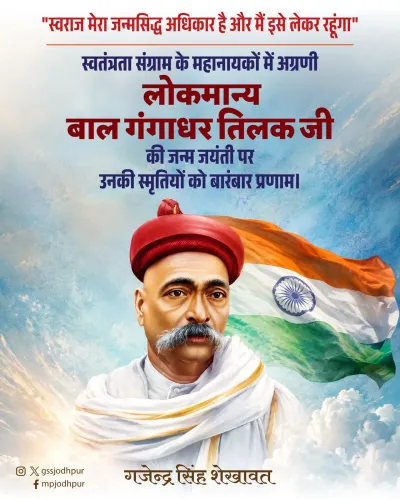
Union Textiles Minister Giriraj Singh on Thursday, 23 July 2026, paid tribute to freedom fighter Bal Gangadhar Tilak on his birth anniversary, hailing him as a great patriot whose spirit of independence continues to inspire the nation.
Context
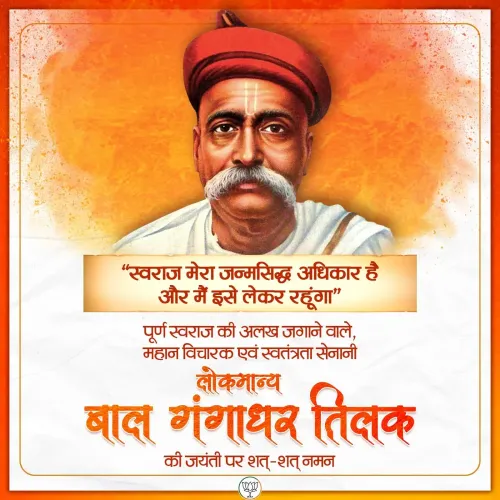
In his post on X, Giriraj Singh invoked Tilak's iconic declaration — 'Swaraj mera janmasiddh adhikar hai aur main ise lekar rahunga' ('Self-rule is my birthright and I shall have it') — describing it as the clarion call that ignited the freedom struggle. He offered 'koti-koti naman' (salutations from millions) to the leader, noting that his love for the nation, sacrifice, and powerful ideas 'will always keep inspiring the countrymen.'
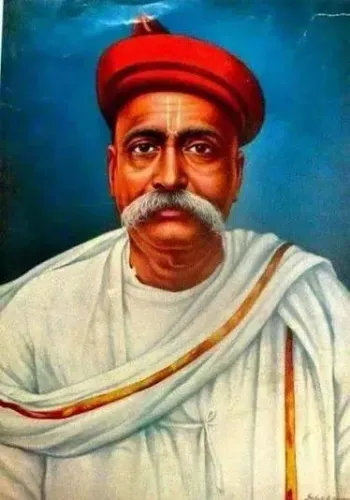
Bal Gangadhar Tilak was born on 23 July 1856 in Ratnagiri, Maharashtra. He is widely regarded as the 'Father of Indian Unrest' — a phrase coined by British colonial authorities — and is counted among the earliest and most forceful advocates of complete independence from British rule.
Policy Backdrop
Tilak was a lawyer, mathematician, journalist, and social reformer who co-founded the Deccan Education Society and edited influential Marathi and English newspapers to spread nationalist thought. He popularised the public celebration of Ganesh Chaturthi and Shivaji Jayanti as platforms to build mass political consciousness at a time when large public gatherings were otherwise suppressed by colonial authorities.
His firebrand slogan — first articulated in 1907 — became one of the most quoted phrases of India's independence movement and remains a touchstone of nationalist discourse. Tilak was imprisoned twice by the British, including a six-year sentence in Mandalay, Burma, during which he wrote the celebrated philosophical work Gita Rahasya. He passed away on 1 August 1920, and the day is observed as Lokmanya Tilak Punyatithi across Maharashtra.
Stakeholders and Impact
Tributes to Tilak on his birth anniversary are observed across party lines, with leaders from various political formations invoking his legacy. However, the Bharatiya Janata Party and its ideological affiliates have consistently emphasised Tilak's cultural nationalism — his use of religious and historical symbols to mobilise popular sentiment — as part of a broader narrative of indigenous political awakening.
For citizens of Maharashtra in particular, Tilak's birth anniversary carries deep cultural resonance. Educational institutions, cultural organisations, and government bodies in the state typically mark the day with programmes honouring his intellectual and political contributions.
What's Next
As India approaches the 80th anniversary of Independence in 2027, tributes to foundational figures of the freedom movement are expected to take on added significance in public and political discourse. The invocation of Tilak's legacy — particularly his insistence on complete self-rule rather than incremental reform — will likely continue to feature prominently in the government's broader narrative around national identity and the contributions of pre-Independence leaders.
Point of View
Culturally rooted nationalist figures from the pre-Independence era. By foregrounding Tilak's 'Swaraj is my birthright' declaration, the minister signals continuity between the freedom movement's most uncompromising voices and the current government's self-positioning as an heir to that tradition. The tribute also carries electoral undertones: Tilak's deep roots in Maharashtra make invocations of his legacy politically resonant in a state that remains a crucial battleground. As India moves toward the 80th Independence anniversary, such commemorations are likely to intensify as part of a broader effort to shape the national memory of the freedom struggle.
NationPress
23 Jul 2026
Frequently Asked Questions
Who was Lokmanya Bal Gangadhar Tilak?
Lokmanya Bal Gangadhar Tilak (1856–1920) was a lawyer, journalist, mathematician, and one of India's earliest and most influential leaders of the independence movement, best known for his slogan 'Swaraj is my birthright and I shall have it.'
When is Bal Gangadhar Tilak's birth anniversary?
Bal Gangadhar Tilak was born on 23 July 1856 , so his birth anniversary — Tilak Jayanti — is observed every year on 23 July .
What is the meaning of Tilak's famous slogan?
The slogan 'Swaraj mera janmasiddh adhikar hai aur main ise lekar rahunga' translates to 'Self-rule is my birthright and I shall have it' — a declaration that self-governance was not a concession to be granted by colonial rulers but an inherent right of every Indian.
Why did Giriraj Singh pay tribute to Tilak?
Union Textiles Minister Giriraj Singh posted a tribute on 23 July 2026 to mark Tilak 's birth anniversary, honouring his patriotism, sacrifice, and the enduring relevance of his nationalist ideas.
What did Tilak write during his imprisonment?
During his six-year imprisonment in Mandalay, Burma , Tilak wrote Gita Rahasya , a philosophical commentary on the Bhagavad Gita that remains an important work in Indian intellectual history.