CM Rekha Gupta backs fast-track courts for paper leak cases

Synopsis
Delhi Chief Minister Rekha Gupta on 23 July 2026 endorsed the formation of fast-track courts for paper leak cases, crediting PM Modi's leadership and vowing strict legal action against those who undermine students' hard work and examination rights.
Key Takeaways
Delhi CM Rekha Gupta publicly backed fast-track courts for paper leak cases on 23 July 2026 .
She credited Prime Minister Narendra Modi with prioritising student welfare and youth futures at the highest level of governance.
The announcement builds on the Public Examinations (Prevention of Unfair Means) Act, 2024 , which introduced strict penalties for exam malpractice.
Fast-track courts are intended to accelerate prosecution and serve as a stronger deterrent against organised paper leak networks.
Millions of competitive exam aspirants — including those preparing for NEET and central recruitment tests — stand to benefit from faster judicial redressal.
Operationalisation details, including bench designation and state-level coordination, remain to be announced.
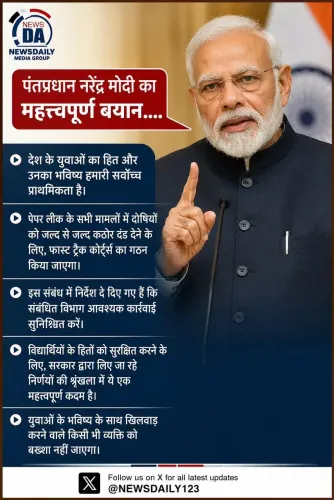
Delhi Chief Minister Rekha Gupta on Thursday, 23 July 2026, voiced strong support for the formation of fast-track courts to hear paper leak cases, stating that the decision marks a significant step toward delivering justice to every hardworking student in the country.
Posting in Hindi on X, CM Gupta credited Prime Minister Narendra Modi with leading an administration that places the protection of students' interests and the security of young people's futures as its 'highest priority.' She wrote: 'पेपर लीक के मामलों में फास्ट ट्रैक कोर्ट्स के गठन और दोषियों के विरुद्ध कठोर कार्रवाई का यह निर्णय हर परिश्रमी छात्र के साथ न्याय सुनिश्चित करने की दिशा में महत्वपूर्ण कदम है' — ('This decision to constitute fast-track courts in paper leak cases and take strict action against the guilty is an important step toward ensuring justice for every hardworking student.')
Context
Paper leak scandals have repeatedly shaken public confidence in India's competitive examination ecosystem. High-profile controversies surrounding national-level tests have put millions of aspirants — who invest years of preparation — at risk of having their results invalidated or delayed. The demand for swift judicial redressal has grown louder with each successive episode.
CM Gupta underscored that the law 'will act with full severity' against those who strike at students' rights and their hard work, signalling a zero-tolerance posture from the ruling dispensation.
Policy Backdrop
The central government enacted the Public Examinations (Prevention of Unfair Means) Act, 2024, to create a dedicated legal framework deterring paper leaks and other malpractices in public recruitment and entrance examinations. The legislation introduced stringent penalties aimed at organised networks that compromise exam integrity.
The proposed fast-track courts represent the next layer of that framework — ensuring that prosecution under the 2024 Act moves quickly enough to serve as a credible deterrent, rather than getting mired in the ordinary backlog of the judicial system.
Stakeholders and Impact
The primary beneficiaries of faster adjudication are the millions of students who appear each year for competitive examinations — from school board tests to central recruitment drives. Delays in resolving paper leak cases have historically meant re-examinations, deferred appointments, and prolonged uncertainty for aspirants.
Coaching institutes, state education boards, and central examination bodies such as those overseeing NEET and UPSC preparatory pathways are also stakeholders, as systemic credibility directly affects enrolment and public trust. Parents and teachers have consistently demanded accountability at the level of exam-conducting authorities as well as criminal networks that traffic in leaked question papers.
What's Next
Attention will now turn to the operationalisation of the fast-track courts — including the designation of specific benches, jurisdictional clarity across states, and timelines for disposing of pending and future cases. State-level coordination between Delhi and the central government will be closely watched to see how the mechanism is rolled out in practice.
If fast-track courts begin delivering convictions at pace, it could reshape the incentive structure around exam malpractice and restore confidence among the student community ahead of upcoming national-level examination cycles.
Point of View
She frames fast-track courts not as a reactive measure but as part of a proactive, leadership-driven reform agenda. The move also signals Delhi's intent to coordinate with central enforcement mechanisms under the 2024 Act, raising the political stakes for swift implementation. Whether the courts materialise quickly will determine if this remains a rhetorical commitment or becomes a tangible policy shift.
NationPress
23 Jul 2026
Frequently Asked Questions
What did Delhi CM Rekha Gupta say about paper leak cases?
On 23 July 2026 , Delhi CM Rekha Gupta stated that the formation of fast-track courts for paper leak cases and strict action against the guilty is an important step toward ensuring justice for every hardworking student.
What is the Public Examinations (Prevention of Unfair Means) Act 2024?
The Public Examinations (Prevention of Unfair Means) Act, 2024 is a central law that introduced stringent penalties to deter paper leaks and other malpractices in public recruitment and entrance examinations across India .
How will fast-track courts help students affected by paper leaks?
Fast-track courts are designed to expedite trials in paper leak cases, ensuring quicker convictions and stronger deterrence, which can reduce delays in re-examinations and result declarations that affect millions of aspirants.
Which exams have been affected by paper leak controversies in India?
High-profile paper leak controversies have surrounded national-level examinations including NEET and various central recruitment tests, triggering demands for stricter legal frameworks and faster judicial action.
What is the role of PM Modi in this paper leak crackdown?
CM Rekha Gupta credited Prime Minister Narendra Modi's leadership for prioritising student welfare, with the fast-track court decision and the 2024 Act both emerging under his administration's push for examination integrity reform.