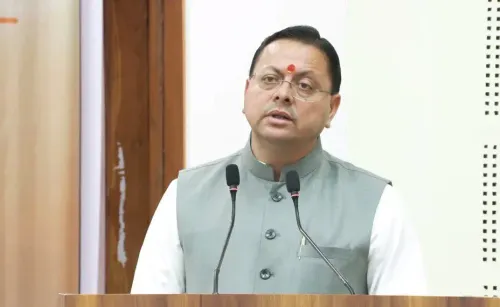
CM Dhami Pushes Inclusive, Life-Skills Education in Uttarakhand
Synopsis
Chief Minister Pushkar Singh Dhami on 23 July 2026 reaffirmed Uttarakhand's commitment to inclusive, quality education, stressing that children must be prepared for life and not just examinations — a position aligned with India's National Education Policy 2020.
Key Takeaways
CM Pushkar Singh Dhami on 23 July 2026 stated that Uttarakhand's goal is inclusive, quality education enabling every child to reach their full potential.
He emphasised preparing children 'for life, not just examinations,' echoing the core philosophy of the National Education Policy 2020 .
NEP 2020 , approved in July 2020 , replaced India's 1986 education framework and prioritises holistic, competency-based learning over rote preparation.
Uttarakhand's mountainous geography makes equitable education delivery a structural challenge, making inclusive policy commitments especially significant for rural and hill-district families.
Teachers, rural families, and school children — particularly in geographically dispersed hill communities — are the primary stakeholders in this policy direction.
The next test will be concrete rollout of NEP-aligned curricula and teacher training in Uttarakhand government schools.
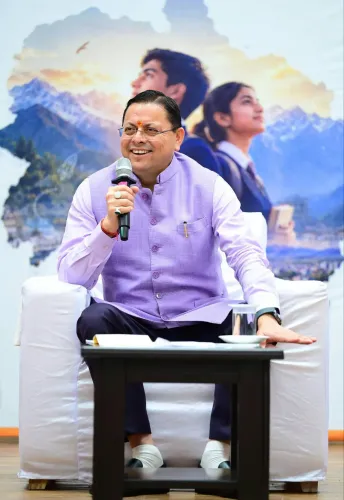
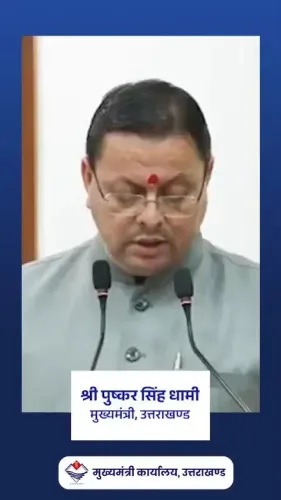
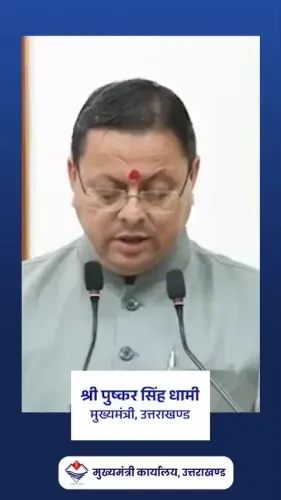
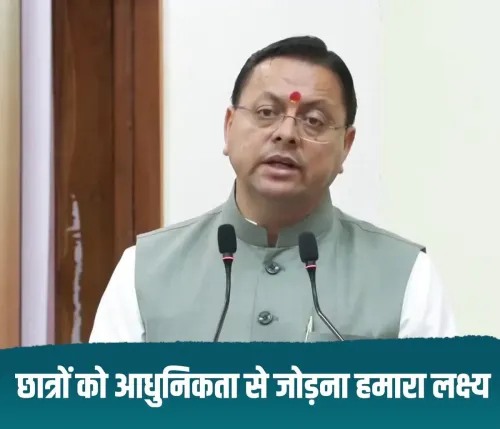
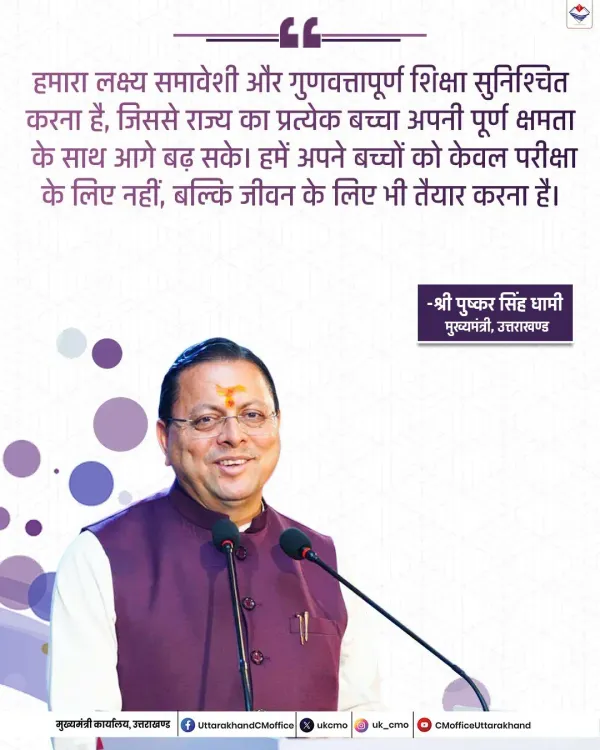
The Chief Minister's Office of Uttarakhand, on behalf of Chief Minister Pushkar Singh Dhami, shared a statement on Thursday, 23 July 2026, reaffirming the state government's commitment to inclusive, quality education that prepares every child not merely for examinations but for life itself.
Quoting CM Dhami directly, the post stated: 'हमारा लक्ष्य समावेशी और गुणवत्तापूर्ण शिक्षा सुनिश्चित करना है, जिससे राज्य का प्रत्येक बच्चा अपनी पूर्ण क्षमता के साथ आगे बढ़ सके।' ['Our goal is to ensure inclusive and quality education, so that every child in the state can move forward with their full potential.'] He added: 'हमें अपने बच्चों को केवल परीक्षा के लिए नहीं, बल्कि जीवन के लिए भी तैयार करना है।' ['We must prepare our children not just for examinations, but for life as well.']
Context
Uttarakhand is a Himalayan state where rugged terrain and dispersed hill settlements have historically made equitable delivery of education services a persistent challenge. Ensuring that children in remote villages receive the same quality of schooling as those in urban centres has long been a stated priority for successive state governments. CM Dhami's statement signals a renewed political emphasis on bridging that gap.
The remarks align closely with the philosophy embedded in the National Education Policy (NEP) 2020, approved by the Union Cabinet in July 2020, which replaced the 1986 education framework. NEP 2020 explicitly shifted the national focus away from rote learning and examination performance toward holistic, competency-based, and life-skills-oriented education.
Policy Backdrop
The National Education Policy 2020 is the central framework guiding school and higher education reform across India. Its core tenets — multidisciplinary learning, mother-tongue instruction in early years, reduced curriculum load, and emphasis on critical thinking — are designed to make students adaptable and capable beyond the classroom. Several Indian states have been in varying stages of adopting NEP-aligned curricula and teacher training programmes.
Uttarakhand has been among the states actively working to align its government school system with NEP 2020 goals. For a state where a significant share of students attend government schools in geographically isolated areas, the shift from exam-centric to life-oriented pedagogy carries particular weight. Teachers in hill districts often serve as the primary, sometimes only, educational resource for children in their communities.
Stakeholders and Impact
The primary beneficiaries of this policy direction are Uttarakhand's school-going children, particularly those from rural and semi-urban families in hill districts who depend entirely on state-run institutions. Teachers are a critical link in any such transformation, as curriculum reform on paper translates into real change only through effective classroom delivery. Rural families, many of whom see education as the primary vehicle for economic mobility, stand to gain most from a system that develops practical life skills alongside academic knowledge.
For the broader educational ecosystem, the statement signals that the state government intends to keep inclusive education at the centre of its agenda. This has implications for budget allocations, teacher training modules, infrastructure in remote schools, and the design of state-level assessments.
What's Next
Attention will now turn to how Uttarakhand translates this articulated vision into on-ground action — specifically, the rollout of NEP-aligned curriculum changes in government schools, the pace and quality of teacher training programmes, and any new state schemes targeting learning outcomes in underserved hill regions. Whether the government follows this statement with concrete policy announcements or budgetary commitments will determine how stakeholders — educators, parents, and civil society — assess the seriousness of the intent. The emphasis on 'life skills' over examination performance, if operationalised effectively, could mark a meaningful shift in how Uttarakhand's public education system is structured and evaluated.
Point of View
The emphasis on inclusive access carries more operational weight than it might in a plains state. The real test will be whether this rhetoric is followed by measurable investment in teacher training and remote-school infrastructure. Statements of this kind, when backed by budgetary action, can shift the baseline for public accountability in state education governance.
NationPress
21 Oct 2026
Frequently Asked Questions
What did CM Pushkar Singh Dhami say about education in Uttarakhand?
On 23 July 2026, CM Dhami stated that Uttarakhand's goal is to ensure inclusive and quality education so every child can reach their full potential, and that children must be prepared for life, not just examinations.
How does Uttarakhand's education policy relate to NEP 2020?
Uttarakhand's stated focus on holistic, life-skills-oriented education aligns with the National Education Policy 2020, which was approved by the Union Cabinet in July 2020 and replaced India's 1986 education framework by emphasising competency-based learning over rote examination preparation.
What are the education challenges in Uttarakhand?
Uttarakhand's Himalayan terrain and dispersed hill settlements make equitable delivery of quality schooling difficult, particularly for children in remote villages who depend entirely on government schools.
Who are the main beneficiaries of Uttarakhand's inclusive education push?
School-going children — especially those from rural and hill-district families relying on government schools — along with teachers and rural communities, are the primary stakeholders and intended beneficiaries.
What should we watch for next in Uttarakhand's education sector?
Key developments to watch include the rollout of NEP-aligned curriculum changes in government schools, teacher training programmes in hill districts, and any new state schemes or budget allocations targeting learning outcomes in underserved areas.