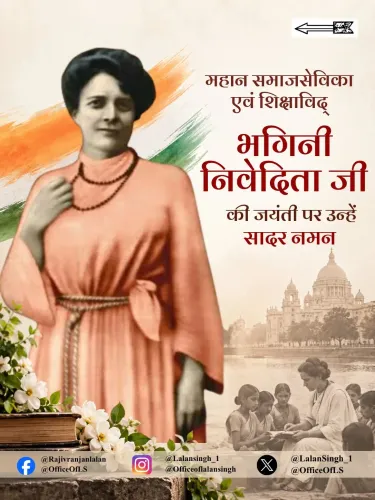
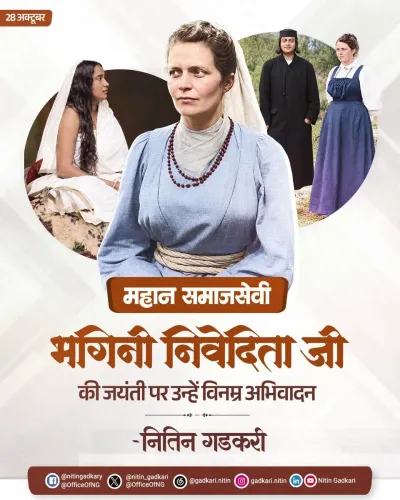
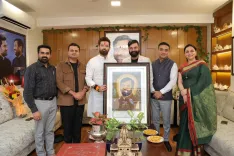
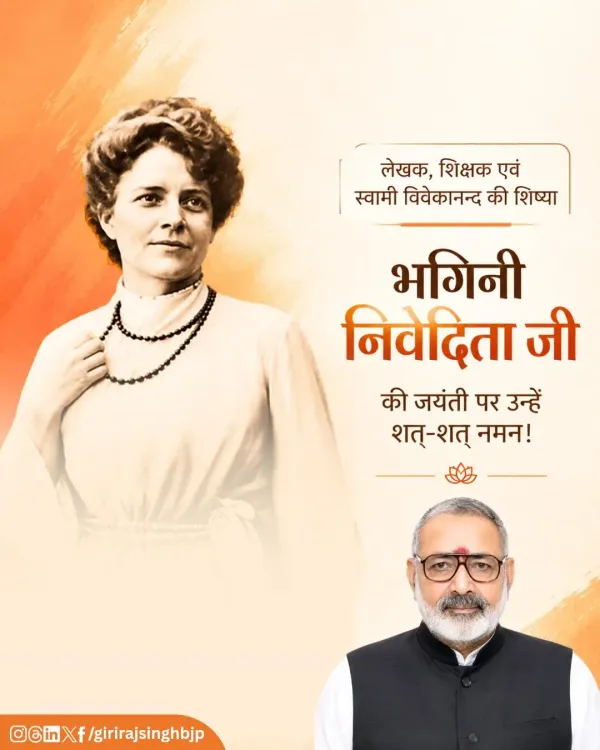
Giriraj Singh pays tribute to Sister Nivedita on her birth anniversary
Synopsis
Union Textiles Minister Giriraj Singh paid homage to Sister Nivedita on her birth anniversary, honouring the Irish-born disciple of Swami Vivekananda who dedicated her life to Indian women's education and national service until her death in 1911.
Key Takeaways
Union Textiles Minister Giriraj Singh posted a tribute to Sister Nivedita on her birth anniversary, 28 October 2026 .
He described her as a 'great writer, teacher, fiery orator and supreme disciple of Swami Vivekananda.' Sister Nivedita was born Margaret Elizabeth Noble in Ireland and devoted her life to women's education and the Indian nationalist cause.
She was a close follower of Swami Vivekananda , founder of the Ramakrishna Mission , and died in 1911 .
The tribute reflects a consistent BJP pattern of commemorating pre-independence cultural and spiritual figures linked to the Vivekananda tradition.
A woman born in Ireland who gave her life to India — Union Textiles Minister Giriraj Singh marked the birth anniversary of Sister Nivedita on Wednesday, 28 October 2026, with a reverential tribute on X, saluting her as a supreme disciple of Swami Vivekananda and a lifelong servant of Indian culture and nationhood.
In his post, Singh wrote: 'महान लेखिका, शिक्षिका, ओजस्वनी वक्ता एवं स्वामी विवेकानन्द जी की परम शिष्या' — calling Nivedita a 'great writer, teacher, fiery orator and supreme disciple of Swami Vivekananda' — and offered 'kotikoti naman' (countless salutations) on her jayanti. He added that her sacrifice, penance and dedication to the nation 'will forever remain a source of inspiration for all of us.'
Who was Sister Nivedita — and why India remembers her
Born Margaret Elizabeth Noble in Ireland, Nivedita crossed continents and cultures to become one of Vivekananda's most devoted followers. She arrived in India in the late nineteenth century and poured herself into women's education, running schools in the lanes of Calcutta and insisting that the uplift of India's women was inseparable from the uplift of the nation itself. She was, in the truest sense, a bridge — between East and West, between spiritual teaching and practical service.
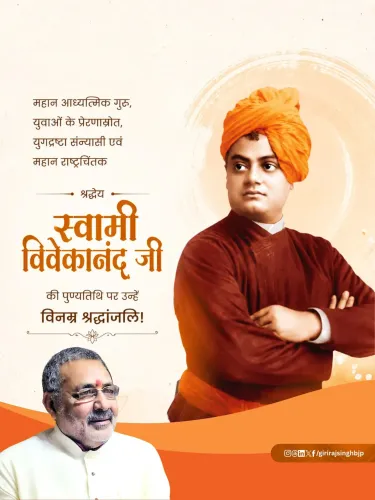
Her connection to Swami Vivekananda, the philosopher-monk who founded the Ramakrishna Mission, gave her both a framework and a fire. Where Vivekananda thundered from lecture halls in Chicago and London, Nivedita embedded herself in Calcutta's neighbourhoods — nursing the sick during a plague outbreak, supporting the early nationalist movement, and writing prolifically on Indian art, science, and culture. She died in 1911, having never left India's soil for the last years of her life.
A consistent BJP pattern of cultural commemoration
Singh's tribute fits a well-established rhythm in Indian political life: BJP leaders and ministers regularly mark the birth anniversaries of pre-independence figures associated with Vivekananda and the Ramakrishna tradition. The practice signals a deliberate alignment with what the party frames as cultural nationalism — honouring those who served India before its formal independence, often outside government or party structures, purely through intellectual and spiritual labour.
For Nivedita specifically, the commemorations tend to resonate in West Bengal, where her legacy is deeply embedded in educational and cultural institutions, and among nationalist youth movements that trace an ideological lineage back through Vivekananda's philosophy of strength-through-service.
A foreigner who chose India as her homeland, a teacher who saw education as revolution, a writer who helped Indians see their own civilisation through freshly confident eyes — Sister Nivedita's life remains a challenge as much as an inspiration, and tributes like Singh's keep that challenge alive in the public square.
Point of View
The party signals that its nationalism is inclusive of those who chose India rather than merely inherited it. The commemoration carries no direct policy weight, but it reinforces the ideological architecture the BJP has consistently built around service, sacrifice, and cultural rootedness as political virtues.
NationPress
28 Oct 2026
Frequently Asked Questions
Who was Sister Nivedita?
Sister Nivedita, born Margaret Elizabeth Noble in Ireland, was a disciple of Swami Vivekananda who moved to India and dedicated her life to women's education, the nationalist movement, and the promotion of Indian culture. She died in 1911 .
When is Sister Nivedita's birth anniversary?
Sister Nivedita's birth anniversary (jayanti) is observed on 28 October each year, and is marked by tributes across cultural and educational institutions, particularly in West Bengal .
What did Giriraj Singh say about Sister Nivedita?
Union Textiles Minister Giriraj Singh called her a 'great writer, teacher, fiery orator and supreme disciple of Swami Vivekananda' and said her sacrifice and dedication to India 'will forever remain a source of inspiration for all of us.'
What is the connection between Sister Nivedita and Swami Vivekananda?
Swami Vivekananda was Sister Nivedita's spiritual teacher and guide. She became one of his most devoted disciples, translating his philosophy of service and cultural revival into direct educational and social work on the ground in India .
Why do BJP leaders regularly pay tribute to Sister Nivedita?
BJP leaders frequently commemorate figures associated with the Vivekananda and Ramakrishna tradition as part of a broader narrative of cultural nationalism, honouring those who served India's civilisational identity before and during the independence movement.