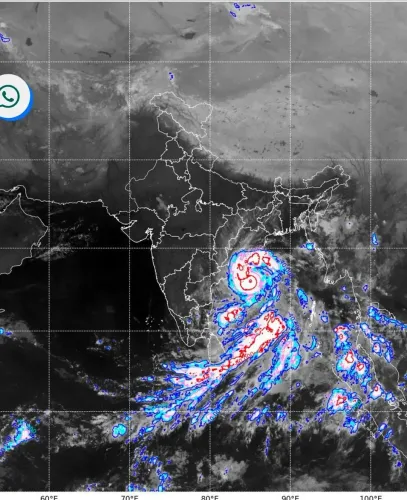
Cyclone Arnab nears Andhra Pradesh coast, landfall imminent: IMD

Synopsis
Cyclone Arnab is making landfall along the Andhra Pradesh coast between Bapatla and Visakhapatnam, with wind gusts reaching 140 kmph. The storm stalled 30 km from Narsapur before crossing — a slow movement that raises inland flooding risk. Crucially, no lives have been lost so far, a testament to early evacuation efforts coordinated across 32,000 state personnel.
Key Takeaways
Very severe cyclonic storm Arnab remained practically stationary off the Andhra Pradesh coast as of 0530 hours IST on 28 October 2026 .
Storm centred 30 km east of Narsapur ; landfall between Bapatla and Visakhapatnam , near Yanam , is underway.
Maximum sustained winds of 115–125 kmph , gusting to 140 kmph , forecast during crossing.
Chandrababu Naidu reviewed the situation via teleconference with 32,000 personnel .
No loss of life reported so far; advance precautions credited by officials.
Crop damage assessments directed; preliminary estimates expected within 24–48 hours .
The India Meteorological Department (IMD) on Wednesday, 28 October 2026, confirmed that very severe cyclonic storm 'Arnab' has remained practically stationary over the West-central Bay of Bengal off the Andhra Pradesh coast for the past three hours, with landfall expected to be completed within the next two hours. The storm's centre was recorded at 0530 hours IST, approximately 30 km east of Narsapur, placing it dangerously close to a densely populated coastal belt.
Current Position and Projected Track
According to the IMD bulletin, Cyclone Arnab lay centred about 30 km east of Narsapur, 45 km south-southwest of Yanam, 70 km south-southwest of Kakinada, 90 km east-northeast of Machilipatnam, and 170 km east-northeast of Bapatla as of the morning bulletin. The department projected the storm would move northwestwards and cross the Andhra Pradesh and Yanam coasts between Bapatla and Visakhapatnam, close to the south of Yanam, as a very severe cyclonic storm. Maximum sustained wind speeds of 115–125 kmph, gusting to 140 kmph, were forecast during the crossing window.
Landfall Process Underway
The IMD noted that Cyclone Arnab was 'continuing to interact with the land surface,' with the wall cloud region of the northern sector having already entered the landline. The Andhra Pradesh State Disaster Management Authority (APSDMA) confirmed that the process of crossing the coast was currently underway. APSDMA Managing Director Prakhar Jain said the cyclone's centre was just 20 km from Narsapur and was over the Yanam coast, with full landfall expected to be completed within an hour of the statement.
Chief Minister Chandrababu Naidu Reviews Situation
Andhra Pradesh Chief Minister N. Chandrababu Naidu conducted a teleconference with approximately 32,000 personnel — ranging from District Collectors to field-level staff — to review the cyclone's impact and the ongoing relief and restoration efforts. Naidu separately held a special review with senior officials, enquiring about crop damage and directing them to prepare preliminary damage estimates. The Chief Minister also instructed authorities to brief the Centre on the measures being undertaken by the state government.
No Loss of Life Reported So Far
According to an official release, no loss of life had been reported as of the morning update. Officials attributed this to advance precautions taken by the administration. Chief Minister Naidu appreciated officials and field-level personnel for working through the night to minimise public inconvenience, urging them to sustain their efforts until normal conditions are restored. This comes amid a broader pattern of the administration's improved early-warning and evacuation protocols along the Andhra coast, which in recent cycles has helped reduce civilian casualties significantly compared to storms of similar intensity a decade ago.
What to Watch Next
With the landfall process ongoing, authorities are closely monitoring potential storm surge along the low-lying coastal districts, particularly around Narsapur, Yanam, and Kakinada. Crop damage assessments are expected to begin once the storm passes, with preliminary estimates likely within 24–48 hours. The cyclone's relatively slow movement increases the risk of prolonged heavy rainfall in interior districts of Andhra Pradesh.
Point of View
Multiplying flood and crop-loss risk even after the winds ease. The zero-casualty status, if it holds, will validate Andhra Pradesh's improved disaster-preparedness architecture built after the devastation of Cyclone Hudhud in 2014. But the real accounting will come in the crop damage numbers: the Krishna-Godavari delta, squarely in Arnab's path, is one of India's most productive rice-growing belts, and standing kharif crops are highly vulnerable at this stage of the season. The Centre's response to the state's briefing request will be an early indicator of how quickly post-cyclone agricultural relief reaches affected farmers.
NationPress
28 Oct 2026
Frequently Asked Questions
Where is Cyclone Arnab making landfall?
Cyclone Arnab is making landfall between Bapatla and Visakhapatnam on the Andhra Pradesh coast, close to the south of Yanam, as confirmed by the IMD on 28 October 2026. The storm's centre was approximately 30 km east of Narsapur at the time of the latest bulletin.
What are the wind speeds associated with Cyclone Arnab?
The IMD forecast maximum sustained wind speeds of 115–125 kmph, gusting up to 140 kmph, during the landfall crossing. This classifies Arnab as a 'very severe cyclonic storm' on the IMD scale.
Has Cyclone Arnab caused any casualties?
No loss of life had been reported as of the 28 October morning update, according to an official release. Authorities attributed this to advance precautionary measures and large-scale evacuation coordination by the Andhra Pradesh administration.
What is the Andhra Pradesh government doing to manage the cyclone?
Chief Minister N. Chandrababu Naidu conducted a teleconference with around 32,000 personnel, from District Collectors to field staff, to review relief and restoration measures. He also directed officials to prepare preliminary crop damage estimates and to brief the Centre on steps being taken.
Why did Cyclone Arnab remain stationary before landfall?
The IMD noted that Arnab remained practically stationary over the West-central Bay of Bengal for at least three hours before the landfall process began. A slow-moving cyclone poses elevated risk of prolonged heavy rainfall and flooding in coastal and interior districts even after the initial landfall.