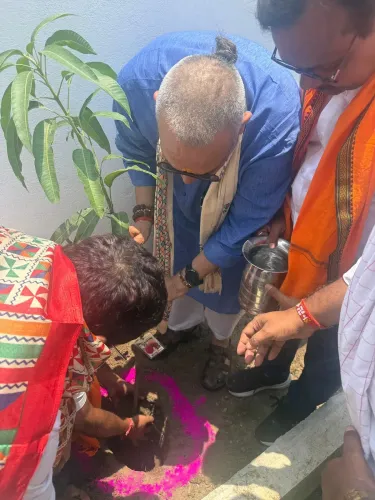
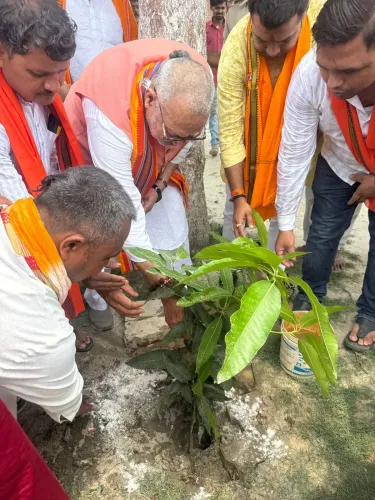
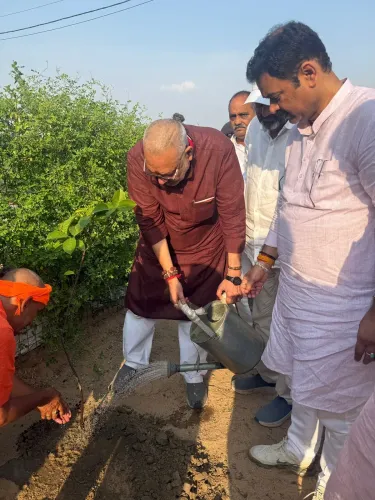
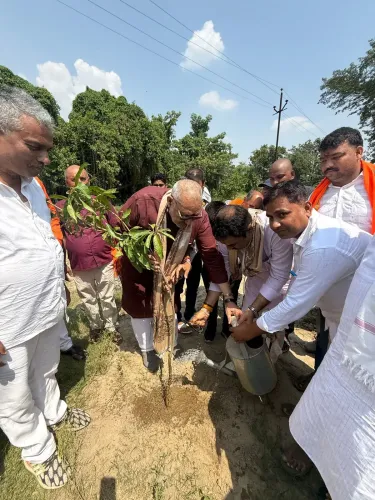
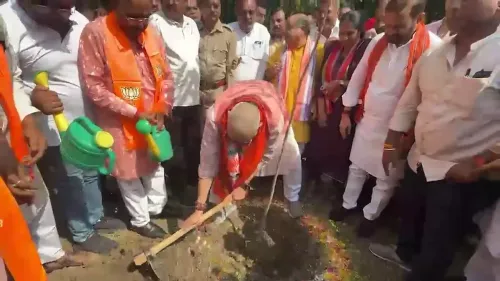
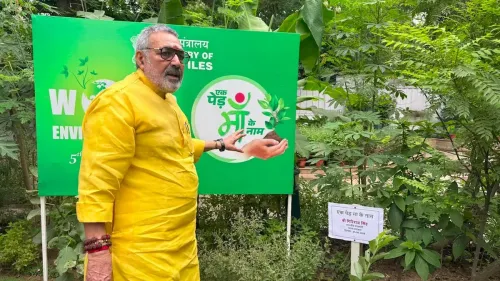
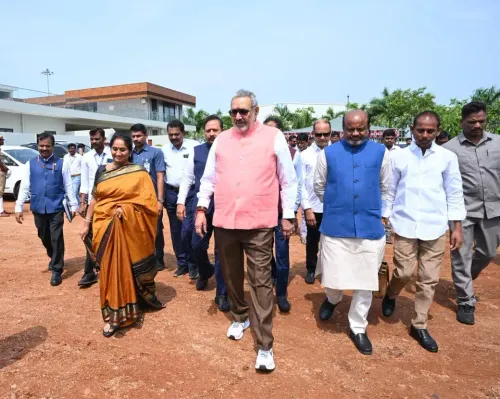
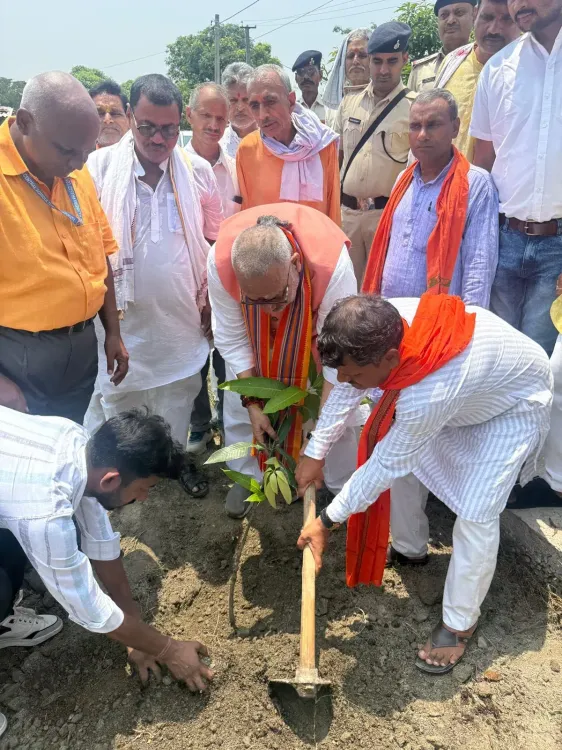
Giriraj Singh plants saplings under Ek Ped Maa Ke Naam at KVK Khodavanpur
Synopsis
Union Textiles Minister Giriraj Singh joined the Ek Ped Maa Ke Naam tree plantation campaign at KVK Khodavanpur in Begusarai, Bihar on 18 June 2026, calling every sapling the foundation of a bright future for coming generations.
Key Takeaways
Union Textiles Minister Giriraj Singh participated in a tree plantation drive at KVK Khodavanpur, Cheriyabariyarpur, Begusarai on 18 June 2026 .
The event was held under the national campaign Ek Ped Maa Ke Naam (One Tree in Mother's Name), which encourages dedicating saplings to mothers for environmental conservation.
The venue, a Krishi Vigyan Kendra , connects the drive directly to Bihar's farming communities and rural outreach.
The plantation aligns with the National Mission for a Green India (approved 2014 ) and annual monsoon-season Vriksharopan campaigns.
Singh described each sapling as 'the foundation of a bright future for us and generations to come,' framing the act as a multigenerational environmental commitment.
Sapling survival rates and state-level reporting on campaign outcomes in Bihar will be key indicators of on-ground impact.
Union Textiles Minister Giriraj Singh participated in a tree plantation drive at Krishi Vigyan Kendra (KVK), Khodavanpur in the Cheriyabariyarpur area of Begusarai, Bihar, on 18 June 2026, under the national campaign Ek Ped Maa Ke Naam (One Tree in Mother's Name).
Posting on X, Singh wrote: 'एक पेड़ माँ के नाम' ('One Tree in Mother's Name') ke antargat KVK, Khodavanpur mein paudhaaropan kiya — announcing the plantation and adding that 'every sapling, with the resolve to protect Mother Nature, is the foundation of a bright future for us and generations to come.'
Context
Ek Ped Maa Ke Naam is a national tree plantation campaign that encourages citizens and public figures to dedicate saplings to their mothers as a gesture of environmental conservation. The drive aligns with India's broader afforestation goals and is typically intensified ahead of and during the monsoon season, when saplings have the highest survival rates.
The venue — KVK Khodavanpur — is an agricultural extension centre in the Cheriyabariyarpur locality of Begusarai district, which is also Singh's Lok Sabha constituency. Holding the event at a Krishi Vigyan Kendra underscores the campaign's rural outreach dimension, connecting farmers and rural communities directly with afforestation messaging.
Policy Backdrop
The plantation drive fits within the framework of the National Mission for a Green India, approved in 2014, which seeks to increase forest and tree cover across the country and strengthen ecosystem services. Annual Vriksharopan (tree plantation) campaigns have since become a fixture of the government's climate and environment communication calendar.
Singh's participation as Textiles Minister — a portfolio not directly linked to forestry — reflects a wider pattern in which central ministers carry environment messaging into their home constituencies, amplifying national targets through local visibility. Bihar, with its agrarian landscape and dense rural population, is a key geography for such drives.
Stakeholders and Impact
The primary beneficiaries of plantation activity at a KVK are farmers and rural communities in Begusarai, who gain both awareness and, in some cases, saplings for agroforestry. KVKs serve as knowledge-transfer hubs, meaning the event also signals institutional support for integrating green practices into agricultural extension work.
Environmentalists and state forest departments track such drives for follow-through: the real measure of success lies in sapling survival rates in the months after planting, a metric that has drawn scrutiny in previous monsoon plantation cycles across Indian states.
What's Next
Attention will now turn to whether state agencies release data on the number of saplings planted and their survival rates under the Ek Ped Maa Ke Naam campaign in Bihar this monsoon season. Parliamentary questions on Green India Mission progress are expected in the next session, which could bring renewed focus on ground-level outcomes of such drives. The campaign's momentum will also be watched as India approaches its international climate reporting commitments.
Point of View
Cross-portfolio participation in green campaigns has become a standard tool for projecting whole-of-government commitment to India's climate targets ahead of international reviews. The real test, as critics have consistently noted, remains post-monsoon survival data — a metric that rarely receives the same public attention as the planting events themselves.
NationPress
19 Sept 2026
Frequently Asked Questions
What is Ek Ped Maa Ke Naam?
Ek Ped Maa Ke Naam, meaning 'One Tree in Mother's Name,' is a national tree plantation campaign in India that encourages citizens to plant and dedicate saplings to their mothers as an act of environmental conservation.
Where did Giriraj Singh plant trees on 18 June 2026?
Giriraj Singh planted saplings at Krishi Vigyan Kendra (KVK) Khodavanpur in the Cheriyabariyarpur area of Begusarai district, Bihar.
What is KVK Khodavanpur?
KVK Khodavanpur, or Krishi Vigyan Kendra Khodavanpur, is an agricultural extension centre located in the Cheriyabariyarpur locality of Begusarai, Bihar, that provides farming knowledge and support to rural communities.
What is the National Mission for a Green India?
The National Mission for a Green India is a government programme approved in 2014 that aims to increase forest and tree cover across India and strengthen ecosystem services.
Why is Giriraj Singh planting trees if he is the Textiles Minister?
Indian central ministers regularly participate in plantation drives beyond their core portfolios to amplify national afforestation targets, particularly in their home constituencies. Singh represents Begusarai in Bihar as a Lok Sabha MP, making it a natural venue for such outreach.