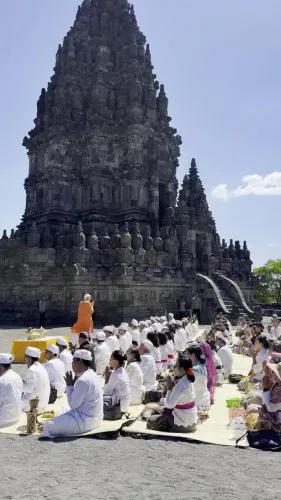
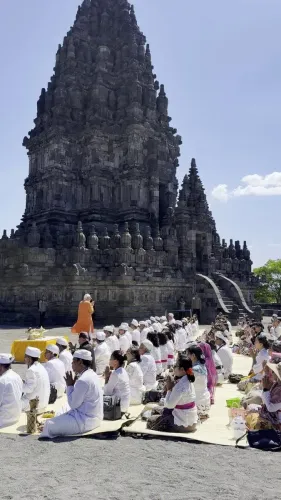
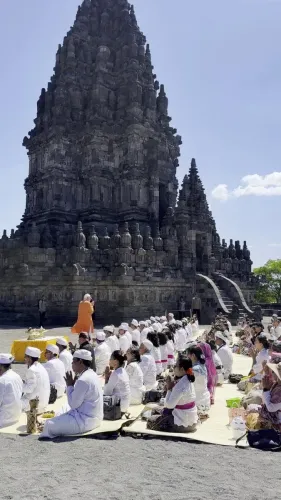
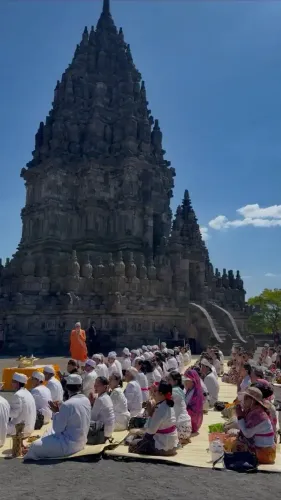
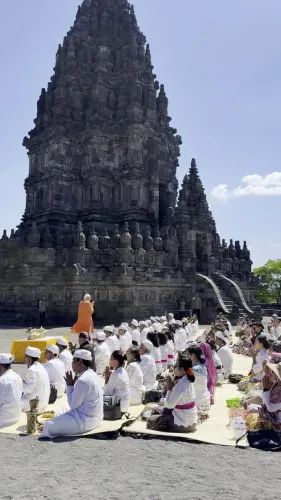
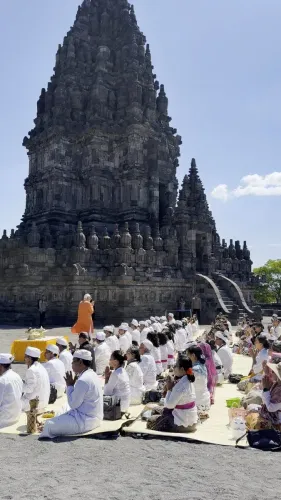
Giriraj Singh shares Om Namah Shivay chants from Prambanan Temple
Synopsis
Union Textiles Minister Giriraj Singh shared sacred Om Namah Shivay chants from Indonesia's 9th-century Prambanan Temple on 8 July 2026, spotlighting India's deep civilisational ties with Southeast Asia under the Act East Policy.
Key Takeaways
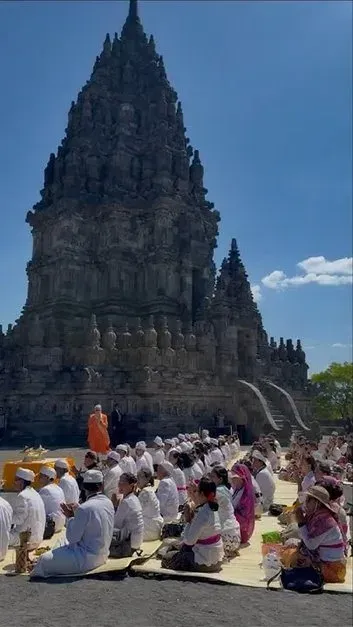
Union Textiles Minister Giriraj Singh shared a video of Hindu chants at Prambanan Temple, Central Java, Indonesia on 8 July 2026 .
Prambanan is a 9th-century UNESCO World Heritage Site dedicated to the Hindu Trimurti, reflecting centuries of Indian cultural influence in Southeast Asia.
The post was distributed via the NaMo App , integrating cultural diplomacy into official digital outreach infrastructure.
India and Indonesia have maintained a bilateral Cultural Agreement since 1955 , with the annual Ramayana Ballet at Prambanan featuring Indian artists.
PM Modi's 2018 Indonesia visit foregrounded shared Hindu-Buddhist civilisational links, a theme senior ministers continue to amplify.
The post aligns with India's Act East Policy of deepening people-to-people ties with ASEAN nations through heritage and religious diplomacy.
Union Textiles Minister Giriraj Singh on Wednesday, 8 July 2026, shared a video of sacred Hindu chants resonating at the Prambanan Temple complex in Central Java, Indonesia, calling attention to the ancient civilisational ties between India and the Southeast Asian archipelago. The post, shared via the NaMo App, opens with the salutation 'Om Namah Shivay' — a devotional invocation to Lord Shiva — underscoring the living religious heritage that connects both nations across centuries.
Context
The Prambanan Temple is a 9th-century Hindu temple complex dedicated to the Trimurti — Brahma, Vishnu and Shiva — and is a UNESCO World Heritage Site. Located in Central Java, it stands as one of the most striking examples of ancient Indian cultural influence in Southeast Asia, built during the reign of the Sanjaya dynasty. The sight and sound of 'Om Namah Shivay' echoing within its precincts carries deep symbolic weight for both Indian and Indonesian Hindus.
Indonesia, home to the world's largest Muslim-majority population, nonetheless preserves a rich Hindu-Buddhist heritage rooted in kingdoms such as Majapahit and Srivijaya, which maintained close maritime and cultural ties with Indian kingdoms for over a millennium. The island of Bali remains a living centre of Hindu practice, while temples like Prambanan serve as shared heritage landmarks for the broader region.
Policy Backdrop
India and Indonesia formalised cultural cooperation through a bilateral Cultural Agreement as far back as 1955, covering exchanges in arts, archaeology and heritage preservation. Prime Minister Narendra Modi's landmark visit to Indonesia in 2018 placed civilisational linkages — particularly references to the Ramayana and shared Hindu-Buddhist heritage — at the heart of the bilateral relationship.
The Ramayana Ballet performed annually at Prambanan since the 1960s has regularly featured Indian artists under cultural exchange programmes, reinforcing the temple's role as a living bridge between the two countries. Minister Singh's post fits squarely within India's Act East Policy, which successive governments have used to deepen people-to-people ties with ASEAN nations through soft-power diplomacy, joint heritage projects and religious tourism.
Stakeholders and Impact
The post resonates with multiple communities: the Indonesian Hindu community, which regards Prambanan as a sacred site; the Indian diaspora across Southeast Asia, for whom such cultural affirmations carry emotional significance; and cultural diplomacy organisations working to preserve and promote shared heritage. Senior ministers amplifying such content on widely-followed platforms extends the reach of these messages well beyond formal diplomatic channels.
For India's soft-power outreach, the NaMo App's role as a distribution channel signals that cultural messaging is being integrated into official digital infrastructure. Sharing devotional content tied to a UNESCO site abroad also reinforces the narrative of a shared Hindu civilisational space that transcends modern national borders.
What's Next
Observers of India-Indonesia relations will watch for any new Memoranda of Understanding on heritage conservation or religious tourism at the next India-Indonesia Joint Commission Meeting. With ASEAN-India summitry a recurring fixture on the diplomatic calendar, such cultural gestures by senior ministers often precede or complement formal announcements on bilateral cooperation. The broader pattern suggests that temple heritage and shared religious history will remain a consistent thread in India's engagement with Southeast Asia.
Point of View
Not incidental. It fits a broader BJP pattern of using devotional and heritage content to simultaneously appeal to domestic religious sentiment and project India's civilisational reach internationally. With ASEAN-India relations a strategic priority, such gestures by Cabinet ministers carry diplomatic undertones even when framed as purely cultural.
NationPress
8 Jul 2026
Frequently Asked Questions
What is the Prambanan Temple and why is it significant to India?
Prambanan is a 9th-century Hindu temple complex in Central Java, Indonesia, dedicated to the Trimurti and a UNESCO World Heritage Site. It reflects the deep historical spread of Indian culture and Hinduism across Southeast Asia, making it a symbol of shared civilisational heritage between India and Indonesia.
Why did Giriraj Singh post about Prambanan Temple?
Union Textiles Minister Giriraj Singh shared a video of Om Namah Shivay chants at Prambanan to highlight the ancient Hindu cultural connections between India and Indonesia. The post aligns with India's Act East Policy of reinforcing people-to-people ties with ASEAN nations through shared heritage.
What is the NaMo App used for?
The NaMo App is an official mobile application linked to Prime Minister Narendra Modi, used to share government messages, cultural content and political communications with a wide audience across India.
What is India's cultural relationship with Indonesia?
India and Indonesia signed a bilateral Cultural Agreement in 1955 covering arts, archaeology and heritage. The annual Ramayana Ballet at Prambanan has featured Indian artists for decades, and PM Modi's 2018 visit to Indonesia emphasised shared Hindu-Buddhist civilisational links.
What is India's Act East Policy?
The Act East Policy is India's strategic framework for deepening political, economic and cultural engagement with Southeast Asian and Pacific nations. It builds on the earlier Look East Policy and uses soft power — including heritage diplomacy — to strengthen ASEAN-India ties.