Giriraj Singh Slams Opposition for Parliament Disruptions
Synopsis
Union Textiles Minister Giriraj Singh on 23 July 2026 accused the opposition of disrupting Parliament rather than debating student issues, saying they prioritise headlines over solutions. His remarks highlight a recurring tension between opposition protest tactics and floor debate in Indian parliamentary sessions.
Key Takeaways
Giriraj Singh , Union Textiles Minister and BJP MP from Begusarai , posted the critique on 23 July 2026 .
He accused the opposition of disrupting parliamentary proceedings instead of engaging in debate on student-related concerns.
Singh stated the opposition is 'more concerned with headlines than with solutions.' Parliamentary disruptions linked to education and student issues reflect a recurring pattern across recent Lok Sabha terms, reducing legislative productivity.
The National Education Policy 2020 remains a live policy backdrop against which student-related parliamentary disputes play out.
Future sessions may see calls for all-party meetings or structured floor debate on examination and education legislation.
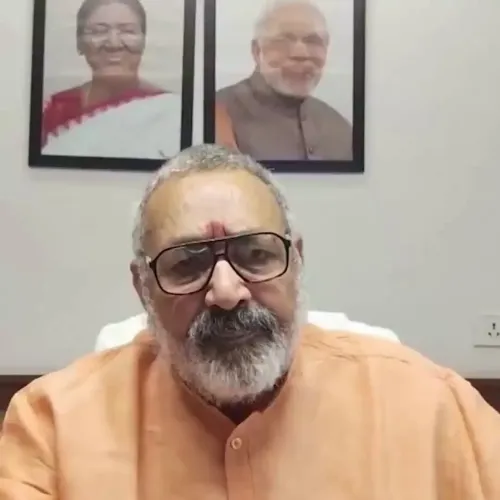
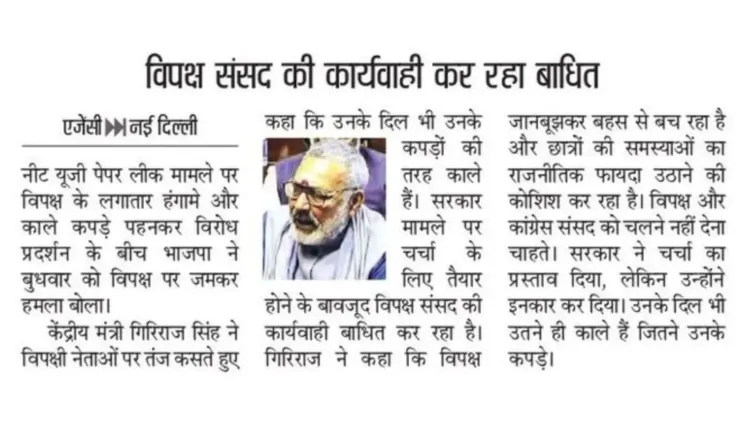
Union Textiles Minister Giriraj Singh on Thursday, 23 July 2026, sharply criticised the opposition for disrupting parliamentary proceedings instead of engaging in debate on issues concerning students, accusing them of prioritising headlines over solutions.
Posting on X, Singh wrote in Hindi: 'विपक्ष का उद्देश्य यदि छात्रों के हितों की रक्षा होता, तो संसद में चर्चा करता, न कि कार्यवाही बाधित करता।' ('If the opposition's purpose were to protect students' interests, it would have debated in Parliament rather than disrupting proceedings.') He added that it was 'clear they are more concerned with headlines than with solutions.'
Context
The post comes amid what appears to be a session of the Parliament of India marked by opposition-led disruptions linked to student-related concerns. While the specific trigger cannot be independently confirmed, Singh's remarks reflect a direct government response to opposition conduct on the floor of the House. The minister's intervention signals that the ruling BJP is keen to frame the opposition's actions as performative rather than substantive.
Policy Backdrop
Parliamentary disruptions over education and student issues are not new. Official session records across recent Lok Sabha terms show a recurring pattern of reduced legislative productivity when opposition parties stage walkouts or adjournment demands instead of participating in floor debates. The National Education Policy (NEP) 2020, approved by the Union Cabinet, introduced sweeping changes to school and higher education, including multiple entry-exit options and multidisciplinary learning — reforms that have periodically drawn opposition scrutiny and public debate.
Critics of disruption-led protest argue that issues affecting large population groups, particularly students, deserve structured parliamentary discussion rather than adjournments. Supporters of the opposition, however, contend that disruptions are sometimes the only tool available when the government refuses to schedule dedicated debate time.
Stakeholders and Impact
At the centre of the dispute are Indian students and the millions of families whose futures are tied to education and examination policy. Opposition MPs have a constitutional role to hold the government accountable, and the manner in which they exercise that role — whether through debate or disruption — directly affects how swiftly legislative or administrative remedies reach students. Singh's post implicitly argues that disruption harms the very constituency the opposition claims to champion.
For the BJP, framing the opposition as headline-hungry rather than solution-oriented is a well-established political posture, particularly ahead of session recesses when each side seeks to control the public narrative about parliamentary productivity.
What's Next
Political observers will watch whether the current session produces any all-party meetings aimed at restoring order and scheduling structured debate on student-related matters. Future monsoon or winter sessions could see education or examination-related legislation come to the floor, at which point the opposition's willingness — or refusal — to engage substantively will be under scrutiny. Singh's public statement raises the political stakes, making it harder for either side to avoid a floor discussion without reputational cost.
Point of View
The minister occupies the moral high ground without committing to a specific policy response. This fits a broader arc in which the ruling party uses social media to prosecute parliamentary battles outside the chamber, reaching voters directly when floor proceedings stall. The opposition will need to demonstrate tangible legislative engagement — not just street-level optics — to counter this framing effectively.
NationPress
23 Jul 2026
Frequently Asked Questions
Why did Giriraj Singh criticise the opposition in Parliament?
Giriraj Singh criticised the opposition on 23 July 2026 for disrupting parliamentary proceedings on student-related issues instead of participating in floor debate, accusing them of seeking headlines rather than solutions.
What did Giriraj Singh say about students and Parliament?
He said that if the opposition truly wanted to protect students' interests, it would debate the matter in Parliament rather than disrupting proceedings — implying their actions harm the students they claim to represent.
What is Giriraj Singh's role in the government?
Giriraj Singh is the Union Minister of Textiles, a senior BJP leader, and a Lok Sabha MP elected from Begusarai, Bihar.
How often does the Indian opposition disrupt Parliament?
Official session records show that opposition-led disruptions are a recurring feature of recent Lok Sabha terms, often reducing legislative productivity when parties stage walkouts or adjournment demands instead of floor debates.
What is the National Education Policy 2020?
The National Education Policy 2020 is a Union Cabinet-approved reform framework for school and higher education in India, introducing multiple entry-exit options and multidisciplinary learning, and has periodically been a subject of parliamentary debate and opposition scrutiny.