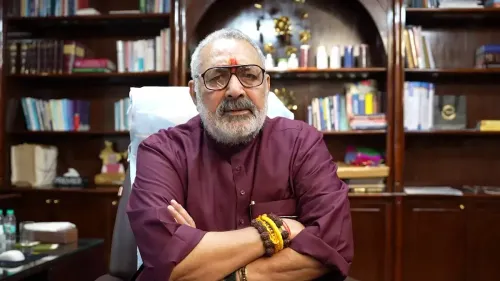
Giriraj Singh warns against foreign-backed destabilisation bids
Synopsis
Union Textiles Minister Giriraj Singh posted a sharp warning on October 24, 2026, asserting that foreign-backed attempts to spread anarchy in India — by those who have lost public mandate — will never succeed. The statement reflects a recurring BJP framing on sovereignty and foreign interference in domestic politics.
Key Takeaways
Union Textiles Minister Giriraj Singh posted a Hindi-language warning on X on October 24, 2026 .
He declared that attempts to spread 'anarchy and unrest' using foreign support, after losing electoral mandate, will not be allowed to succeed.
The statement does not name any specific country, party, movement, or triggering event.
Such 'foreign hand' warnings are a recurring feature of BJP political messaging during periods of domestic protest or opposition pressure.
As a Union Cabinet minister and senior party leader, Giriraj Singh's posts carry weight beyond routine party communication.
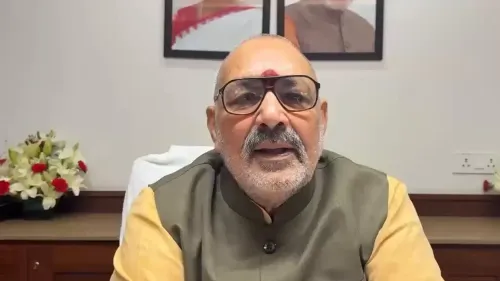
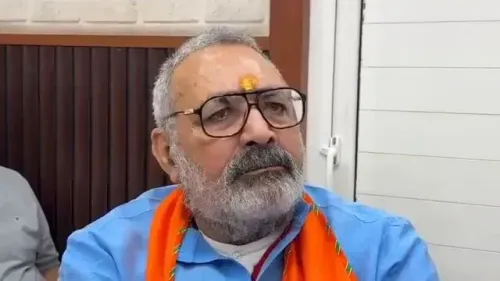
A sharp warning about sovereignty and foreign interference landed on Saturday evening — and it came from Union Textiles Minister Giriraj Singh, who took to X on October 24, 2026 to deliver a pointed message about what he sees as attempts to engineer instability in India using outside support.
Posting in Hindi, the senior BJP leader and Lok Sabha MP from Begusarai, Bihar wrote: 'Janmat khone ke baad videshi shaktiyon ke sahare desh mein arajkata aur upadrav failane ka kutsit prayas Bharat ki janta kabhi safal nahin hone degi.' In plain terms: 'After losing public mandate, the vile attempt to spread anarchy and unrest in the country with the help of foreign powers will never be allowed to succeed by the people of India.'
The message is a single, direct sentence — but its weight carries a familiar political charge.
The 'foreign hand' charge — a recurring instrument of Indian political discourse
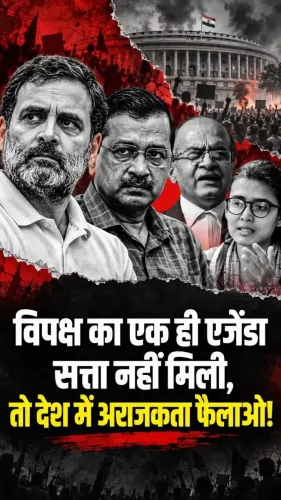
Warnings about foreign-backed destabilisation are not new in Indian politics. Ruling-party figures have reached for this framing at moments of significant public protest, electoral defeat, or social unrest — essentially arguing that domestic dissent, when it turns disruptive, is amplified or orchestrated from outside India's borders. The logic is twofold: it questions the organic character of any opposition-led street pressure, and it reinforces a nationalist narrative centred on popular sovereignty — the idea that India's citizens themselves are the ultimate safeguard against outside manipulation. Giriraj Singh's formulation follows that template precisely. He does not name a country, a movement, or an event. He names a condition — janmat khona, 'losing the public mandate' — and links it to what he calls a 'vile attempt' to spread 'anarchy and unrest.' The implication is clear even if the target is left unstated: entities that have failed at the ballot box are, in his framing, seeking an alternative route to power through chaos underwritten by foreign forces.Why this kind of statement carries political weight
Statements of this kind do real political work. They pre-emptively delegitimise opposition-led agitation by labelling it externally driven, they rally a nationalist base around the idea of India under siege, and they shift the conversation from whatever underlying grievance may be fuelling public discontent to the question of who is really behind it. For a senior minister speaking from within the government, the statement also carries an implicit signal to security and administrative agencies about how the ruling coalition frames the threat landscape. Giriraj Singh is no backbencher — as a cabinet minister and one of the BJP's most vocal voices, his posts on X function as semi-official messaging, read closely by both supporters and critics. A sentence from him lands differently than an identical sentence from a party spokesperson. Whether a specific episode triggered Saturday evening's post is not immediately clear. What is clear is that the language is deliberate, the audience is national, and the message is unmistakable: those who lose elections should not expect foreign backing to substitute for democratic legitimacy. India's parliament — and the public square — will determine whether that argument is tested in the weeks ahead.Point of View
Such statements gain traction when public unrest or opposition momentum is already visible, suggesting the minister may be responding to a charged political environment. Watch for whether this framing is picked up in parliamentary debates or official government communications as a signal of how far the sovereignty-under-threat narrative is being institutionalised.
NationPress
24 Oct 2026
Frequently Asked Questions
What did Giriraj Singh say about foreign powers and India?
On October 24, 2026, Giriraj Singh posted on X that those who have lost public mandate are making a vile attempt to spread anarchy and unrest in India using foreign powers — and that India's citizens will never allow such attempts to succeed.
Who is Giriraj Singh?
Giriraj Singh is a senior BJP leader, Union Minister of Textiles in the Indian government, and a Lok Sabha MP representing Begusarai constituency in Bihar.
What does 'foreign hand in Indian politics' mean?
The term refers to allegations that foreign governments, organisations, or interests are funding or directing domestic protest movements or opposition activities to destabilise India — a charge that ruling-party figures have periodically levelled, particularly after contested elections or large-scale agitations.
Did Giriraj Singh name any country or party in his post?
No. His October 24 post did not name any specific country, foreign entity, political party, or domestic movement — leaving the accusation broad and the target unstated.
Is the 'foreign interference' charge new in Indian politics?
No. Accusations of foreign-backed destabilisation have surfaced repeatedly in Indian political discourse, particularly from ruling-party figures during periods of significant public protest or opposition pressure, and form part of a well-established nationalist messaging pattern.