Goa CM Office Invites Students, Officials for Yoga Day 2026
Synopsis
The Chief Minister's Office of Goa has called on all students and government officials to participate in International Day of Yoga 2026, aligning the state with a nationwide health and well-being movement anchored in a UN-recognised observance established at India's initiative in 2014.
Key Takeaways
The Chief Minister's Office of Goa issued the participation call on 20 June 2026 , a day before the event.
The invite specifically targets students and government officials across the state.
International Day of Yoga falls on 21 June each year, declared by the UN General Assembly in December 2014 .
The observance was proposed by Prime Minister Narendra Modi at the UN in September 2014 .
India's Ministry of AYUSH coordinates national Yoga Day activities, with state governments mobilising local participation.
No specific venue, target numbers, or new schemes were announced in the post.
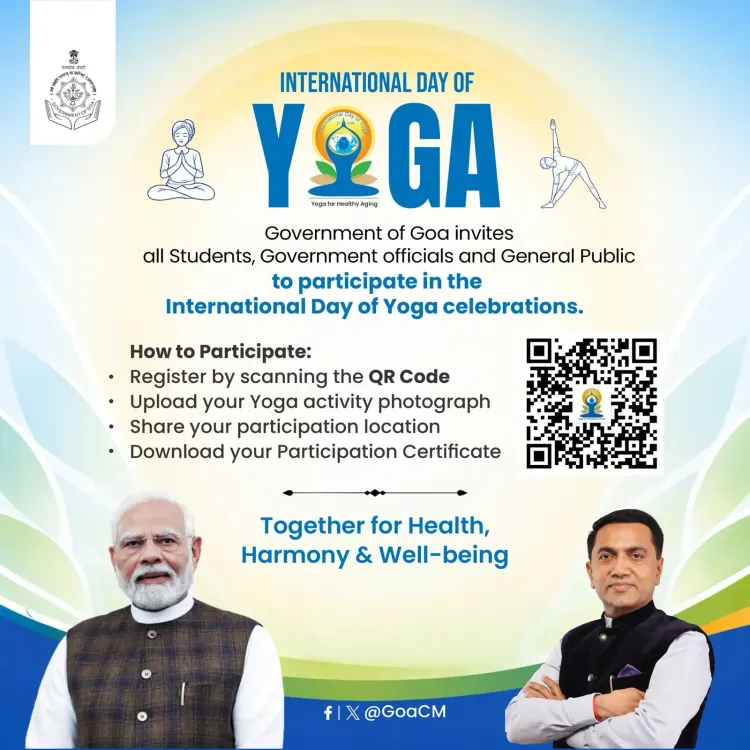
The Chief Minister's Office of Goa on Saturday, 20 June 2026 called upon all students and government officials in the state to participate in the International Day of Yoga 2026, describing the observance as a nationwide movement for health and well-being.
Context
The post, issued by the official Government of Goa account, urges two specific groups — students and government servants — to join the annual celebration falling on 21 June 2026. The call frames participation not merely as a ceremonial gesture but as alignment with a broader national health agenda. No specific venue or operational details were announced in the post.
Policy Backdrop
The International Day of Yoga was established by the United Nations General Assembly in December 2014 after Prime Minister Narendra Modi proposed the observance during his address to the UN General Assembly in September 2014. The date 21 June — the summer solstice, the longest day of the year in the Northern Hemisphere — was chosen for its significance across many cultures. Since then, successive Indian governments have mainstreamed yoga into public health and education policy, channelled largely through the Ministry of AYUSH, which treats yoga as a low-cost, preventive wellness measure.
State administrations across India routinely issue participation directives to schools and civil-service departments ahead of 21 June each year, scaling national observances down to the district and local level. Goa's call follows this established pattern of government-led mobilisation.
Stakeholders and Impact
The directive targets two distinct constituencies: students enrolled in government and aided schools, and government officials across state departments. By explicitly naming these groups, the Government of Goa signals an institutional expectation of participation rather than a voluntary public appeal. This mirrors how several other state governments have framed their Yoga Day communications in recent years.
For students, participation typically involves school-level yoga sessions conducted by trained instructors. For government officials, events are generally organised at department headquarters or public grounds, with attendance often tracked as part of employee wellness initiatives under AYUSH guidelines.
What's Next
The immediate focus will shift to state-level logistics — venue arrangements, school timetable adjustments, and departmental coordination — ahead of 21 June 2026. Follow-up communications from the Goa health and education departments are expected to provide operational specifics. Post-event, attendance data and coverage from district-level programmes typically feed into state reports submitted to the central government as part of the broader national Yoga Day exercise.
As India continues to position yoga as a soft-power instrument internationally and a public-health tool domestically, state-level participation rates have become one measure of policy penetration — making Goa's early mobilisation call a signal of administrative intent ahead of the observance.
Point of View
But significant as a signal of administrative alignment with the AYUSH ministry's mainstreaming push. By explicitly naming students and government officials, the CMO frames participation as institutional duty rather than civic choice, a framing that has become increasingly standard across BJP-governed states. The post also reflects how International Yoga Day has evolved from a diplomatic initiative into a domestic governance instrument, with state compliance serving as a visible metric of policy reach. For Goa, a tourism-heavy state with a distinct identity, publicly anchoring in a pan-Indian wellness movement carries a degree of soft political messaging beyond the health rationale.
NationPress
19 Sept 2026
Frequently Asked Questions
When is International Day of Yoga 2026?
International Day of Yoga 2026 falls on Sunday, 21 June 2026 . The date is observed annually on 21 June, the summer solstice, following a UN General Assembly declaration in December 2014.
Who proposed International Day of Yoga at the United Nations?
Prime Minister Narendra Modi proposed the International Day of Yoga during his address to the UN General Assembly in September 2014 . The resolution was adopted by the General Assembly in December 2014 .
What has the Goa government announced for Yoga Day 2026?
The Chief Minister's Office of Goa has invited all students and government officials in the state to participate in International Day of Yoga 2026, calling it a nationwide movement for health and well-being. Specific venue or programme details were not included in the announcement.
Which ministry organises Yoga Day events in India?
The Ministry of AYUSH is the nodal central ministry for coordinating International Day of Yoga events across India. State governments, including Goa, issue their own participation directives aligned with the ministry's national programme.
Are government employees required to participate in Yoga Day in Goa?
The Government of Goa has specifically invited government officials to participate in Yoga Day 2026, signalling an institutional expectation. However, the post does not explicitly state mandatory attendance; operational details are expected closer to or on 21 June 2026 .