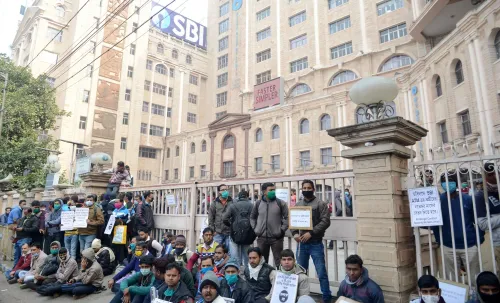
Govt urges public sector bank staff to call off Sep 28-30 strike
Synopsis
With a three-day bank strike looming from 28–30 September — timing that coincides with the half-yearly financial closing — the Finance Ministry is pushing hard for a stand-down. The government says it has already suspended the contentious PLI scheme, but unions are holding firm on a five-day workweek, and an indefinite strike from 26 October is already on the calendar.
Key Takeaways
The Finance Ministry on 21 September 2026 urged public sector bank and RRB employees to withdraw a three-day strike planned for 28–30 September .
The government suspended the Performance Linked Incentive (PLI) scheme , fulfilling one of the unions' two main demands.
The outstanding demand — a five-day banking week — remains unresolved and continues to be examined.
The strike coincides with the half-yearly bank closing on 30 September , raising concerns about disruption to financial operations.
A prior one-day strike was held on 11 September ; an indefinite strike from 26 October is also proposed if the workweek demand is not met.
The United Forum of Bank Unions and allied groups are leading the agitation across public sector banks and regional rural banks.
The Finance Ministry on Monday, 21 September 2026 urged employees of public sector banks and regional rural banks (RRBs) to withdraw a proposed three-day strike scheduled from 28 to 30 September, arguing that the government has already met one of their two core demands by placing the Performance Linked Incentive (PLI) scheme in abeyance. The appeal comes amid an escalating standoff with the United Forum of Bank Unions and allied union groups.
What the Government Said
In a formal statement, the Finance Ministry said that 'most concerns of the Unions have been substantially addressed' and that the remaining demand 'continues to be examined.' The ministry called on bank employees to 'refrain from resorting to strikes, work towards resolving issues through dialogue, and ensure that banking services remain uninterrupted.'
The government noted that it had held several rounds of conciliation talks with the unions, in keeping with the established practice of bilateral dispute resolution. Despite this engagement and the partial concession on PLI, a one-day strike was held on 11 September, a further three-day stoppage is now set for 28–30 September, and an indefinite strike has been proposed from 26 October on the single outstanding demand of a five-day banking week.
Why the Timing Is Particularly Sensitive
The Finance Ministry highlighted that the 30 September date coincides with the half-yearly closing of banks — a period of critical importance for reconciliation, provisioning, and treasury and market operations. Combined with the preceding weekend, a three-day walkout would effectively result in a five-day closure of banking services at one of the most sensitive points in the financial calendar.
This disruption, the ministry cautioned, would cause 'considerable inconvenience to customers, businesses, government transactions, and international banking operations.' The statement pointedly noted that banking continuity 'directly affects the everyday lives of the general public.'
The Unions' Demands
The United Forum of Bank Unions and certain other unions representing employees of public sector banks and RRBs have been agitating on two main planks: implementation of a five-day banking week, and withdrawal of the PLI scheme. The government's decision to hold the PLI in abeyance addressed the second demand. The five-day workweek, however, remains unresolved.
The government pointed out that it had already designated the 2nd and 4th Saturdays of every month as public holidays for public sector banks — a step taken in 2015. The remaining Saturdays, it argued, continue to serve as an important access window for citizens who rely on in-branch banking.
State of Public Sector Banks
The Finance Ministry sought to frame any strike action as counterproductive, noting that public sector banks 'today stand on a healthy and robust footing — a position achieved through the sustained efforts of the government and active contribution of bankers and bank management over the years.' It urged all stakeholders to preserve this financial stability rather than risk disrupting it.
Critics, however, argue that bank unions have a legitimate right to collective bargaining and that the five-day workweek demand reflects broader concerns about employee workload and work-life balance — issues that have persisted for years in the sector.
What Happens Next
Should the unions proceed with the 28–30 September strike, customers, businesses, and government entities face the prospect of a near-week-long gap in public banking services at a critical financial juncture. The government said it 'remains committed to the welfare and well-being of bank employees' and to resolving genuine concerns through 'constructive engagement.' Whether that commitment translates into a fresh round of meaningful talks before 28 September will determine whether the disruption can be averted.
Point of View
A three-day stoppage on 28 September, and an indefinite walkout proposed from 26 October — suggests the unions have a sequenced pressure strategy, not a spontaneous grievance. The real test is whether the Finance Ministry offers a concrete timeline on the workweek issue before 28 September, or whether it is betting that public inconvenience will erode union support. The half-yearly closing date makes this a high-stakes gamble either way.
NationPress
21 Sept 2026
Frequently Asked Questions
Why are public sector bank employees planning to strike from 28 to 30 September?
Bank employees, led by the United Forum of Bank Unions, are striking primarily over two demands: the implementation of a five-day banking week and the withdrawal of the Performance Linked Incentive (PLI) scheme. The government has suspended the PLI scheme but has not yet conceded on the five-day workweek, prompting the continuing agitation.
What has the government done to address bank union demands?
The Finance Ministry placed the PLI scheme in abeyance after detailed discussions, fulfilling one of the two main union demands. It has also held multiple rounds of conciliation talks and previously designated the 2nd and 4th Saturdays as public holidays for bank employees. The five-day workweek demand is said to be under examination.
Why is the 28–30 September strike window particularly significant?
The strike period coincides with the half-yearly closing of banks on 30 September, a critical date for reconciliation, provisioning, and treasury operations. Combined with the preceding weekend, a three-day stoppage would effectively create a five-day banking shutdown at one of the most sensitive points in the financial calendar.
What is the five-day banking week demand?
Bank unions are seeking a reduction in working days from six to five per week across public sector banks. Currently, the 2nd and 4th Saturdays are already public holidays, but unions want all Saturdays off. The government has not yet agreed to this demand, citing public access to banking services on remaining Saturdays.
Is there a longer-term strike planned beyond September?
Yes. In addition to the three-day strike on 28–30 September, an indefinite strike has been proposed from 26 October if the five-day workweek demand is not met. A one-day strike had already taken place on 11 September, indicating a stepped escalation strategy by the unions.