Goyal shares Venkaiah Naidu's column on Modi's record PM tenure
Synopsis
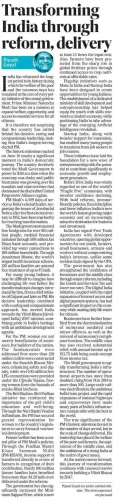
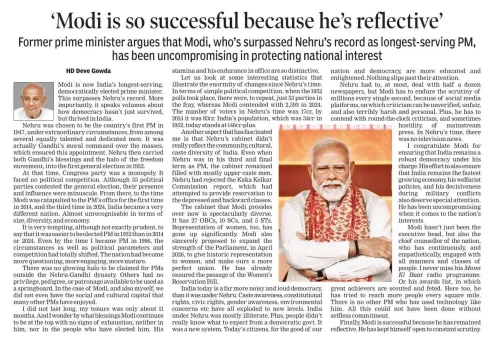
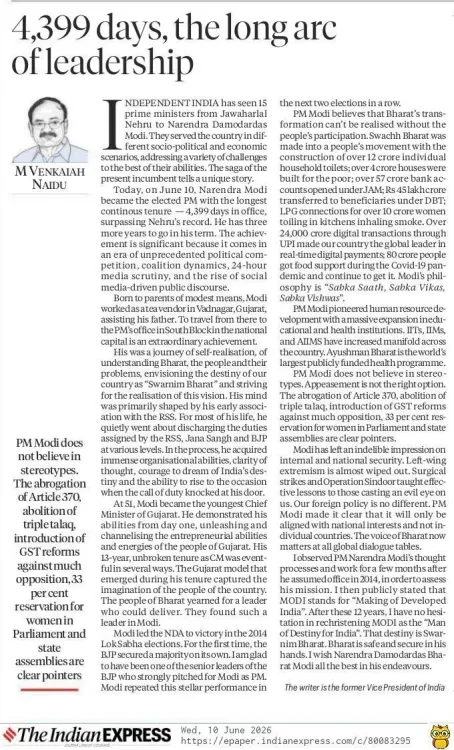
Union Minister Piyush Goyal on June 10, 2026 shared former Vice President Venkaiah Naidu's column hailing PM Modi as India's longest-serving elected Prime Minister, citing welfare expansion, digital governance, national security and foreign policy as pillars of his record tenure.
Key Takeaways
Piyush Goyal shared former VP Venkaiah Naidu's column on June 10, 2026 , describing PM Modi as India's longest-serving elected Prime Minister.
Naidu's column covers four broad areas: welfare expansion, digital governance, national security, and foreign policy.
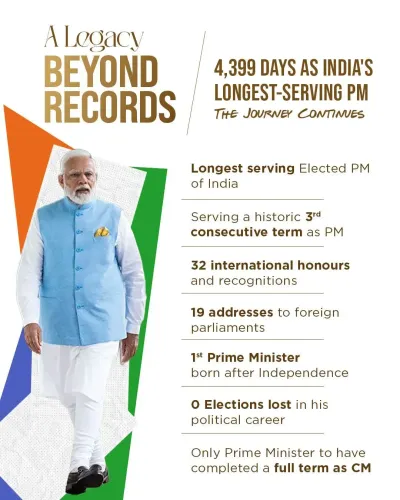
Narendra Modi has served as Prime Minister continuously since May 2014 , through three successive terms including a third sworn in June 2024 .
The post used the hashtag #LongestServingElectedPMModi , reflecting coordinated ruling-party messaging around the milestone.
Goyal is Leader of the House in the Rajya Sabha and a senior Cabinet minister, making his amplification of the column politically significant.
The framing positions the tenure record as a 'foundation' for a 'developed and confident India', signalling a forward-looking political argument ahead of the monsoon parliamentary session.
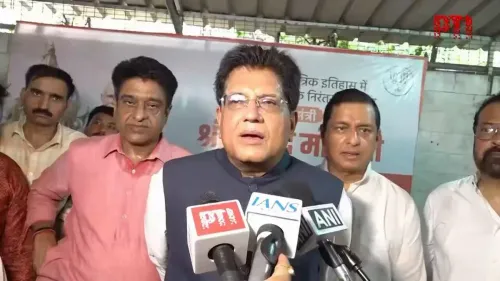
Union Commerce and Industry Minister Piyush Goyal on Wednesday, June 10, 2026, shared a column by former Vice President M. Venkaiah Naidu that describes Prime Minister Narendra Modi as India's longest-serving elected Prime Minister, highlighting his record tenure as a foundation for the country's future development.
Context
Goyal shared Naidu's opinion piece, noting that the former Vice President 'emphasised that PM Modi ji's record tenure can be the foundation of a developed and confident India.' The column, according to Goyal's post, covers Modi's performance across welfare expansion, digital governance, national security, and foreign policy. The hashtag #LongestServingElectedPMModi accompanied the post, situating it within broader ruling-party messaging around the milestone.
M. Venkaiah Naidu served as Vice President of India from 2017 to 2022 and is a senior figure in the Bharatiya Janata Party (BJP). His commentary on governance and leadership has historically carried weight as an elder-statesman voice within the party's ideological ecosystem.
Policy Backdrop
Narendra Modi was first sworn in as Prime Minister in May 2014, leading a BJP-majority government. He was re-elected in 2019 and sworn in for a third consecutive term in June 2024 following general elections, making his uninterrupted tenure a subject of political commentary and institutional record-keeping.
Key programmes cited in Goyal's summary of the column include the Digital India initiative, launched in July 2015, which aimed to expand e-governance and digital public infrastructure across the country. Welfare expansion and India's evolving foreign policy posture have similarly been recurring themes in official government communication since 2014.
Goyal, as Leader of the House in the Rajya Sabha and a senior Cabinet minister, is among the government's most prominent voices in amplifying such milestones, particularly ahead of parliamentary sessions where governance records often form part of the political discourse.
Stakeholders and Impact
The column and its amplification by a sitting Union Minister are directed at multiple audiences: voters, policy commentators, and parliamentary peers who debate the government's long-term record. By framing an extended tenure as a platform for continuity rather than merely a statistical record, the messaging links political stability with developmental outcomes.
For citizens, the reference to welfare expansion and digital governance touches programmes that have directly affected daily life — from direct benefit transfers to the Jan Dhan-Aadhaar-Mobile architecture. For India's external partners, the foreign policy dimension signals an emphasis on strategic consistency over successive terms.
What's Next
The framing of Modi's tenure as a 'foundation' suggests the ruling party intends to use this milestone as a forward-looking political argument rather than a retrospective celebration. Watch for follow-up references in parliamentary proceedings, particularly in the upcoming monsoon session, where governance outcomes and policy continuity are likely to feature in debates. Additional opinion columns and official statements anchored to the tenure record may follow as the government builds a broader institutional narrative around long-term policy outcomes.
Point of View
A constitutional figure seen as above partisan fray, the ruling party lends elder-statesman credibility to a claim that might otherwise read as self-congratulation. The four-pillar framing — welfare, digital governance, security, foreign policy — mirrors the BJP's standard electoral communication architecture, suggesting this milestone is being road-tested as a campaign-adjacent narrative. With the monsoon session approaching, expect this tenure argument to surface in parliamentary debates as the government seeks to anchor current policy discussions in a long arc of stability.
NationPress
25 Oct 2026
Frequently Asked Questions
Who is India's longest-serving elected Prime Minister?
As of June 2026, Prime Minister Narendra Modi is described as India's longest-serving elected Prime Minister, having held the office continuously since May 2014 across three terms.
What did Venkaiah Naidu write about PM Modi?
Former Vice President M. Venkaiah Naidu wrote an opinion column arguing that PM Modi's record tenure, spanning welfare expansion, digital governance, national security, and foreign policy, can serve as the foundation for a developed and confident India.
Why did Piyush Goyal share Venkaiah Naidu's column?
As Union Commerce and Industry Minister and Leader of the House in the Rajya Sabha, Piyush Goyal shared the column to amplify the ruling party's messaging around PM Modi's record tenure milestone on June 10, 2026.
How long has Narendra Modi been Prime Minister of India?
Narendra Modi has been Prime Minister since May 2014, completing a first term, a second term from 2019, and beginning a third term in June 2024 — a continuous stretch that makes him India's longest-serving elected Prime Minister.
What is the Digital India programme mentioned in the context of Modi's tenure?
Digital India is a government initiative launched in July 2015 aimed at expanding e-governance and digital public infrastructure across India; it is one of the key programmes cited in discussions of Modi's governance record.