Goyal hails PM Modi as longest-serving elected PM, cites delivery record
Synopsis
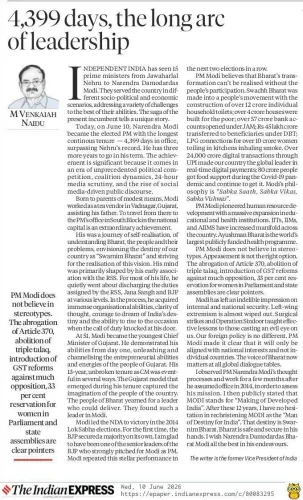
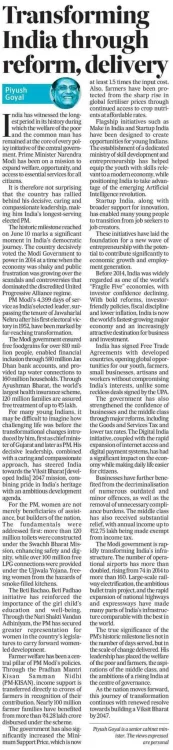
Commerce Minister Piyush Goyal, writing on June 10, 2026, argues that PM Modi's standing as India's longest-serving elected Prime Minister is defined by the scale of welfare and infrastructure delivery for the poor, farmers, women, and youth — not merely by the number of days in office.
Key Takeaways
Piyush Goyal published an opinion piece on June 10, 2026 framing PM Modi's tenure milestone as a record of delivery rather than longevity.
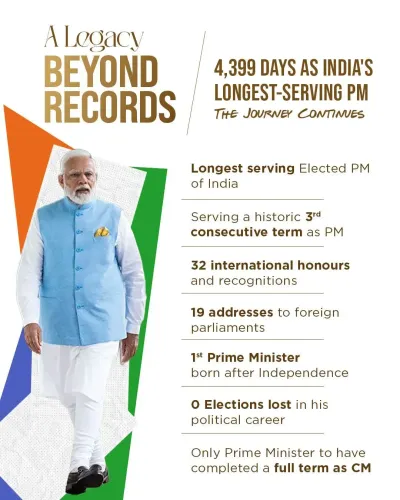
PM Narendra Modi is described as India's longest-serving elected Prime Minister, having held office continuously since May 2014 .
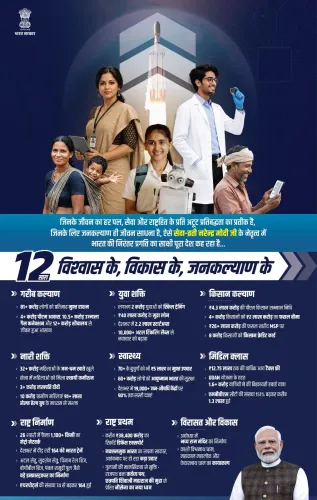
Goyal highlights welfare for the poor, farmers, women, and youth as the defining priorities of Modi's tenure.
Key schemes cited in the policy backdrop include PM Jan Dhan Yojana , Ujjwala Yojana , PM-KISAN , and Bharatmala Pariyojana .
The post carried the hashtag #LongestServingElectedPMModi , indicating coordinated BJP political messaging.
As Leader of the House in the Rajya Sabha , Goyal's commentary carries institutional weight beyond a personal opinion.
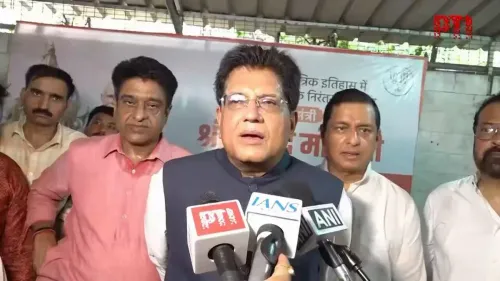
Union Commerce and Industry Minister Piyush Goyal on Wednesday, June 10, 2026, published an opinion piece arguing that Prime Minister Narendra Modi's significance as India's longest-serving elected Prime Minister lies not in the number of days served but in the scale of welfare and infrastructure transformation delivered for the poor, farmers, women, and youth.
Context
Goyal shared the piece on X with the caption: 'The politics of delivery, not just a record!' — framing Modi's milestone as a governance achievement rather than a numerical one. He wrote that the PM has 'prioritized welfare and transformation, focusing on the poor, farmers, women, youth, and infrastructure,' adding that 'the true significance of the PM's historic milestone isn't the number of days served; it's the scale of change delivered.'
The post carried the hashtag #LongestServingElectedPMModi, signalling a coordinated BJP messaging effort around the tenure milestone.
Policy Backdrop
Modi has been Prime Minister since May 2014, re-elected in 2019 and again thereafter, making his continuous tenure the longest for any directly elected Prime Minister in India's history. During this period, the central government launched a series of large-scale direct-benefit programmes: Pradhan Mantri Jan Dhan Yojana (2014) for financial inclusion of unbanked households, Pradhan Mantri Ujjwala Yojana (2016) delivering LPG connections to women in below-poverty-line families, and PM-KISAN (2019) providing direct income support to landholding farmers.
On the infrastructure side, the Bharatmala Pariyojana highway programme, approved in 2017, has been a flagship connectivity initiative cited repeatedly in government delivery tallies. Successive Union Budgets and NITI Aayog reports have tracked coverage numbers across these schemes as primary governance metrics.
Stakeholders and Impact
The constituencies Goyal specifically names — the poor, farmers, women, and youth — align directly with the beneficiary categories of the government's flagship direct-transfer programmes. This framing is deliberate: senior ministers have consistently juxtaposed cumulative delivery statistics against length of tenure as a political counter-narrative to opposition critiques.
As Leader of the House in the Rajya Sabha, Goyal is among the most prominent government voices in Parliament. His opinion pieces carry institutional weight beyond personal commentary, often previewing or reinforcing the government's broader communication strategy ahead of legislative sessions.
What's Next
Attention will now turn to the next Union Budget, where announcements on extensions or new phases of direct-transfer programmes are expected to further reinforce the 'delivery' narrative. Parliamentary debates on infrastructure funding bills in upcoming sessions will also serve as forums where this record is likely to be cited by treasury benches.
The BJP's framing of governance as measurable delivery — rather than ideological positioning alone — reflects a longer-term electoral strategy that will almost certainly intensify as the party approaches future state and national election cycles.
Point of View
Shifting the debate from how long Modi has ruled to what he has delivered. By anchoring the argument in welfare beneficiaries — farmers, women, the poor — rather than GDP figures or foreign policy wins, the party is speaking directly to its core vote bank ahead of future electoral cycles. The choice of a senior minister and Rajya Sabha leader to author the piece, rather than a party spokesperson, signals that this narrative is being elevated to official government communication. It also preemptively counters opposition arguments about incumbency fatigue by reframing longevity as accumulated impact.
NationPress
26 Oct 2026
Frequently Asked Questions
Why is PM Modi called the longest-serving elected Prime Minister of India?
PM Narendra Modi has held office continuously since May 2014, a tenure that surpasses all previous elected Prime Ministers of India in total consecutive years served.
What did Piyush Goyal write about PM Modi's milestone?
Goyal wrote that the true significance of Modi's milestone is not the number of days served but the scale of change delivered for the poor, farmers, women, youth, and infrastructure.
What welfare schemes are associated with PM Modi's tenure?
Key schemes include Pradhan Mantri Jan Dhan Yojana for financial inclusion, Pradhan Mantri Ujjwala Yojana for LPG access, PM-KISAN for farmer income support, and Bharatmala Pariyojana for highway infrastructure.
What is Piyush Goyal's role in the Indian government?
Piyush Goyal is the Union Minister of Commerce and Industry and the Leader of the House in the Rajya Sabha, making him one of the most senior BJP figures in Parliament.
What does #LongestServingElectedPMModi mean?
It is a BJP hashtag used to mark PM Modi's milestone as India's longest-serving elected Prime Minister, part of a coordinated political messaging campaign highlighting his governance record.