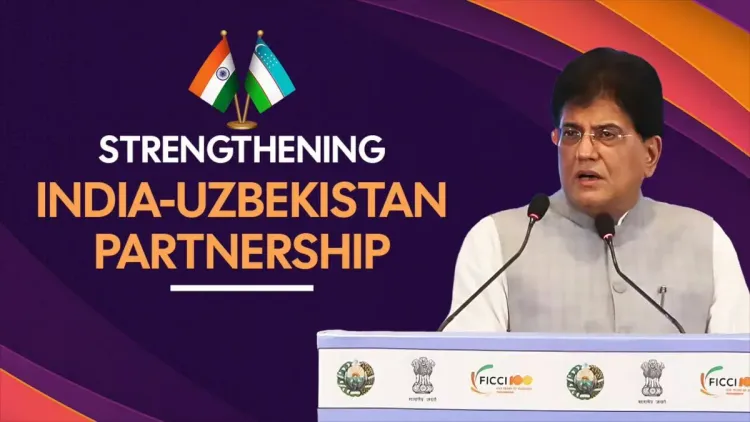
Goyal Calls on India, Uzbekistan Businesses to Invest in Each Other
Synopsis
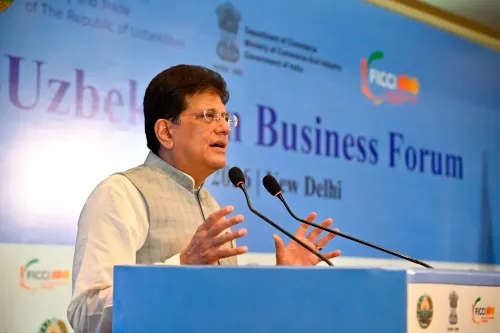
Union Commerce Minister Piyush Goyal called on businesses in India and Uzbekistan to invest in each other's markets, reinforcing New Delhi's Connect Central Asia strategy and the two countries' growing engagement within the SCO framework.
Key Takeaways
Piyush Goyal publicly urged Indian and Uzbek businesses to pursue two-way investment on 3 August 2026 .
Uzbekistan is a priority partner in India's Connect Central Asia policy , launched in 2012 .
Both nations are members of the Shanghai Cooperation Organisation (SCO) , a key platform for bilateral economic dialogue.
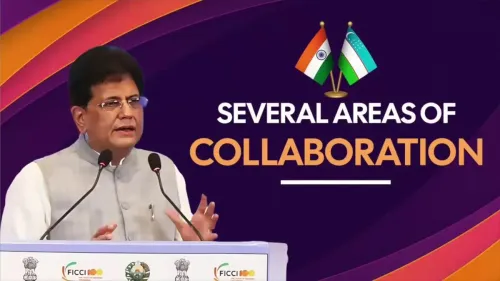
Key sectors for collaboration include textiles, pharmaceuticals, energy, IT services, and agro-processing .
India's Central Asia outreach is driven by the strategic goal of supply-chain diversification beyond traditional trading partners.
The next milestones to watch are SCO summits and bilateral trade committee meetings where investment frameworks may be formalised.
A direct call to action from Union Commerce and Industry Minister Piyush Goyal on Monday, 3 August 2026: Indian and Uzbek businesses should stop leaving opportunity on the table and start investing in each other's markets.
The pitch for two-way investment
Goyal's message was unambiguous — 'Businesses in India and Uzbekistan must look at investing in each other's opportunities.' The call signals that New Delhi views the relationship not merely as a diplomatic courtesy but as a commercial frontier worth actively cultivating. Uzbekistan, a landlocked Central Asian republic of roughly 36 million people, has been sharpening its own economic reform agenda, making it an increasingly credible destination for Indian capital in sectors such as textiles, pharmaceuticals, and energy.
India's Central Asia play and where Uzbekistan fits
India's outreach to Central Asia is not new. The Connect Central Asia policy, launched in 2012, set the strategic intent: deepen trade, investment, and connectivity with the five republics of the region. Uzbekistan sits at the geographic and economic heart of that corridor. Both countries are members of the Shanghai Cooperation Organisation (SCO), which has served as a recurring platform for economic dialogue and connectivity discussions between New Delhi and Tashkent.
The broader strategic logic is supply-chain diversification. India has steadily sought to reduce dependence on a narrow set of trading partners, and Central Asia — with its mineral wealth, growing consumer base, and transit potential — fits neatly into that calculus. Goyal's post reflects a pattern of ministerial-level nudges designed to translate policy intent into boardroom decisions.
What businesses on both sides stand to gain
For Indian firms, Uzbekistan offers proximity to Afghan, Iranian, and Russian markets via road and rail corridors, a young workforce, and a government actively courting foreign investment. For Uzbek investors, India represents scale — one of the world's fastest-growing large economies with deep manufacturing capacity and a vast domestic market. The sectors with the most natural overlap include generic medicines, cotton-based textiles, IT services, and agro-processing.
The next concrete test will likely come at upcoming SCO-level summits or bilateral trade committee meetings, where investment facilitation frameworks and market-access commitments can move from ministerial encouragement to signed agreements.
The flag is planted. Now the question is whether the private sector on both sides picks it up and runs.
Point of View
However, will require concrete steps on connectivity infrastructure and market-access barriers, not just rhetorical encouragement.
NationPress
3 Aug 2026
Frequently Asked Questions
Why is Piyush Goyal calling for India-Uzbekistan investment?
As Union Commerce and Industry Minister, Goyal is pushing to translate India's Connect Central Asia policy into real business activity, encouraging firms on both sides to explore manufacturing, pharma, textiles, and services opportunities in each other's markets.
What is India's Connect Central Asia policy?
Launched in 2012 , India's Connect Central Asia policy is a strategic framework to deepen trade, investment, and connectivity with the five Central Asian republics, including Uzbekistan.
What is the role of the SCO in India-Uzbekistan ties?
Both India and Uzbekistan are members of the Shanghai Cooperation Organisation (SCO) , which provides a multilateral platform for economic dialogue, connectivity projects, and trade facilitation between the two countries.
Which sectors offer the most potential for India-Uzbekistan business?
The strongest overlap lies in pharmaceuticals, textiles, IT services, agro-processing, and energy , where Indian manufacturing capacity and Uzbekistan's resources and reform agenda create complementary openings.
What are the next steps in India-Uzbekistan economic engagement?
Upcoming SCO summits and bilateral trade committee meetings are the most likely forums where investment facilitation measures, market-access commitments, and connectivity agreements could be advanced.