Goyal marks 10 years of GeM with taxpayer savings push
Synopsis
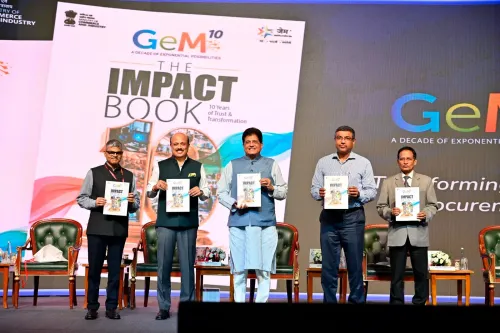
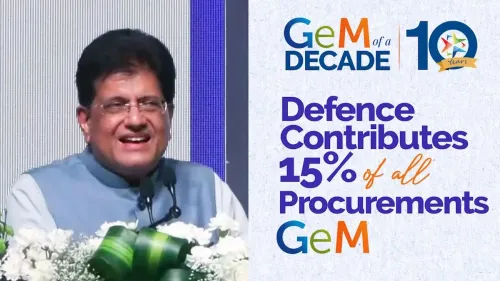
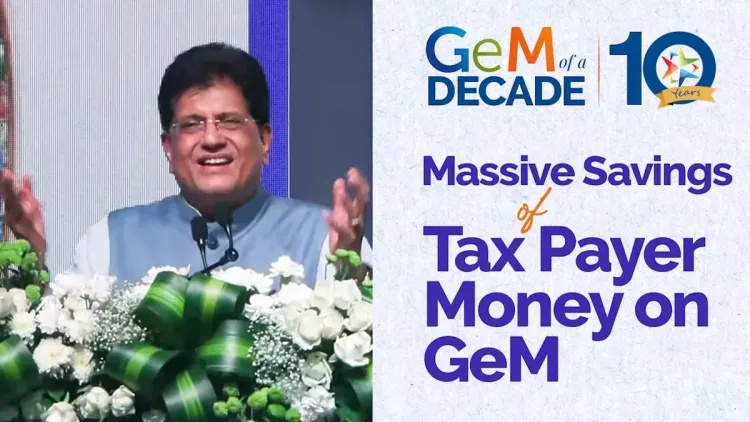
Union Commerce and Industry Minister Piyush Goyal has marked the tenth anniversary of Government e-Marketplace, highlighting massive taxpayer savings delivered through transparent digital public procurement since the platform's launch on 9 August 2016.
Key Takeaways
GeM was launched on 9 August 2016 to replace manual, paper-based government tendering with transparent online procurement.
Minister Piyush Goyal cited 'massive savings of taxpayer money' in a post marking the platform's tenth anniversary .
GeM is the mandated procurement channel for central government purchases above specified thresholds, overseen by the Ministry of Commerce and Industry .
MSMEs are a primary beneficiary, gaining direct access to government buyers without intermediaries.
Potential expansion of mandatory GeM use to state governments is a key policy watch-point that could multiply the platform's fiscal impact.
Ten years ago, a quiet digital experiment replaced India's paper-heavy government procurement with a single online marketplace. Today, Union Commerce and Industry Minister Piyush Goyal is marking that milestone — and making the case that Government e-Marketplace (GeM) has delivered massive savings of taxpayer money through transparent public procurement.
From manual tendering to a national digital bazaar
GeM was launched on 9 August 2016 by the Prime Minister as a direct assault on the opacity that had long plagued government purchasing. Before it existed, departments navigated a labyrinth of manual tenders, paper trails, and discretionary vendor selection — a system that critics argued was structurally vulnerable to inflated pricing and rent-seeking. GeM replaced that with competitive online bidding, real-time price comparison, and a publicly visible audit trail. The platform is now the mandated channel for central government purchases of goods and services above prescribed thresholds, with the Ministry of Commerce and Industry serving as the nodal authority. Sellers range from large enterprises to micro and small manufacturers — with MSMEs positioned as a key beneficiary group, gaining direct access to government buyers without middlemen.Why 'transparent procurement' is the operative phrase
Goyal's post homes in on two words: 'transparent' and 'savings.' That pairing is deliberate. The traditional procurement argument was always that competitive tendering saves money — but GeM's design goes further, making the entire process observable. Every bid, every price, every vendor is logged on the portal, shrinking the room for manipulation that existed when deals were struck across desks. The #10YearsOfGeM hashtag signals a broader government communications push around the anniversary, framing the platform not just as a procurement tool but as a governance achievement — one strand in a wider post-2014 e-governance framework that also includes Direct Benefit Transfer and digital identity infrastructure.What the next decade of GeM could look like
The platform's expansion is not finished. Policymakers and procurement reformers are watching for two things: the release of the next GeM annual savings report with verified aggregate figures, and any cabinet decision that extends mandatory GeM usage to state governments — a move that would dramatically widen the platform's footprint and fiscal impact. If states are brought fully into the GeM ecosystem, the savings arithmetic changes by an order of magnitude. India's state governments collectively spend far more on procurement than the Centre, and their purchasing processes remain patchier in transparency and digitisation. A decade in, GeM has moved from pilot to pillar. The question now is whether it becomes the floor for all public procurement in India — or remains a central-government success story waiting for a federal sequel.Point of View
Not merely an efficiency play. Goyal's emphasis on 'transparent procurement' is a pointed contrast with the pre-2014 tender culture — a framing that doubles as political messaging. The real policy frontier, however, is state-level adoption; if GeM remains primarily a central-government tool, its transformative potential stays only partially realised. Analysts will look to the next annual savings report for hard numbers that can either validate or complicate the anniversary claims.
NationPress
25 Sept 2026
Frequently Asked Questions
What is Government e-Marketplace (GeM)?
GeM is India's national online procurement portal, launched on 9 August 2016 , where central government departments buy goods and services through transparent competitive bidding rather than manual tendering.
How has GeM saved taxpayer money?
By replacing discretionary manual tenders with open online bidding and real-time price comparison, GeM reduces opportunities for inflated pricing and corruption — though exact verified savings figures for 2026 are pending the next official annual report.
Who oversees GeM in India?
The Ministry of Commerce and Industry , currently headed by Minister Piyush Goyal , is the nodal authority responsible for GeM operations and public procurement policy.
How does GeM benefit MSMEs?
Micro, small, and medium enterprises can register directly on the portal as sellers, giving them access to government buyers across India without needing intermediaries or navigating complex paper-based tender processes.
Could GeM be extended to state governments?
Extending mandatory GeM usage to state governments is an active policy discussion. Since states collectively spend far more on procurement than the Centre, such a move would significantly expand the platform's reach and potential savings.