Piyush Goyal Marks 12 Years of Modi Govt's Security Push
Synopsis
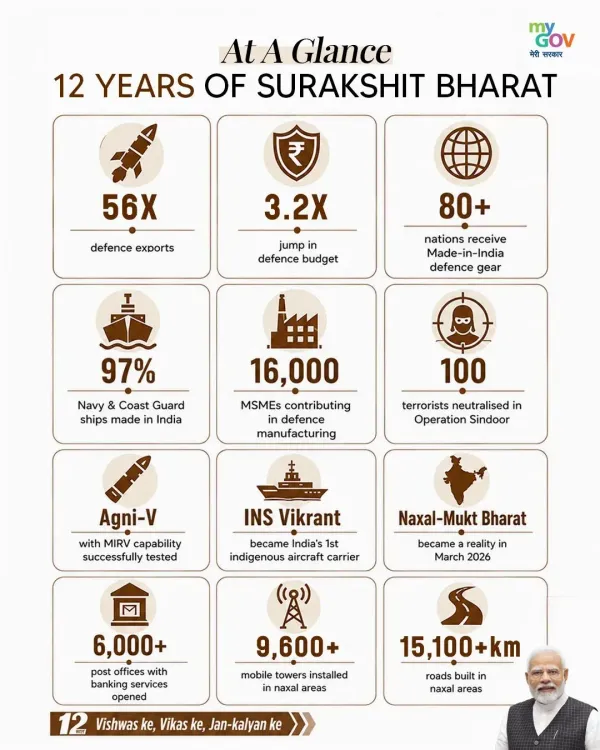
Commerce Minister Piyush Goyal marked twelve years of the Modi government on June 17, 2026, highlighting national security and self-reliance as its defining achievements under the #12YearsOfSurakshitBharat banner.
Key Takeaways
Piyush Goyal posted on June 17, 2026 invoking #12YearsOfSurakshitBharat to mark twelve years of PM Modi 's government.
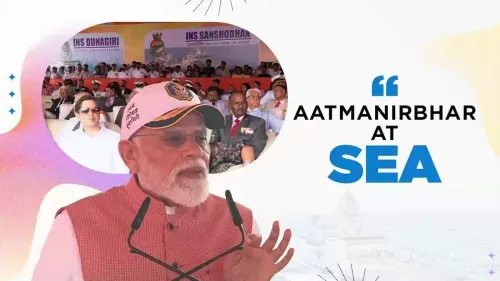
National security and self-reliance in defence are framed as the twin pillars of the Modi government 's tenure since May 2014 .
Atmanirbhar Bharat Abhiyan , launched in May 2020 , formalised the defence indigenisation push with dedicated PLI schemes and import substitution targets.
The Defence Procurement Procedure 2016 introduced higher indigenous content requirements, giving priority to Indian vendors.
As Commerce and Industry Minister, Goyal's portfolio directly links trade policy, FDI rules, and export promotion to defence manufacturing goals.
Upcoming Defence Budget 2026-27 allocations and defence expo announcements will be the next test of the indigenisation agenda.
Union Commerce and Industry Minister Piyush Goyal on Wednesday, June 17, 2026, invoked the hashtag #12YearsOfSurakshitBharat to highlight what he described as the twin pillars of national security and self-reliance at the heart of Prime Minister Narendra Modi's twelve-year tenure.
Context
Goyal's post, shared on the morning of June 17, credits PM Modi's government — which first took office in May 2014 — with making national security and self-reliance central to India's governance agenda. The hashtag #12YearsOfSurakshitBharat ('12 years of a secure India') frames the anniversary as a moment to take stock of strategic and defence-sector achievements. The minister's decision to amplify this theme underscores the BJP's effort to link economic policy with strategic autonomy in public messaging.
Policy Backdrop
The self-reliance strand of the government's defence agenda crystallised formally with the launch of Atmanirbhar Bharat Abhiyan in May 2020, which included a dedicated push for defence indigenisation and production-linked incentives. Earlier, the Defence Procurement Procedure 2016 introduced higher indigenous content requirements and gave priority to Indian vendors in government tenders. Successive updates to procurement rules have steadily expanded the list of items reserved for domestic production, reducing dependence on imports for platforms ranging from small arms to larger systems.
As Union Minister of Commerce and Industry, Goyal sits at the intersection of trade policy and strategic manufacturing. His ministry has been tasked with aligning foreign direct investment rules, PLI (Production-Linked Incentive) schemes, and export promotion frameworks to support security outcomes — an explicit recognition that economic and defence objectives are intertwined.
Stakeholders and Impact
The primary beneficiaries of a sustained indigenisation drive are domestic defence manufacturers — both public sector undertakings and a growing cohort of private firms — who have seen order books expand as import substitution targets tighten. The Indian Armed Forces are the end-users, with the stated policy goal of ensuring that a larger share of their equipment is sourced domestically, reducing foreign-exchange outflows and supply-chain vulnerabilities. Defence export targets, which the government has set ambitiously in successive budgets, add a commercial dimension to what was originally framed as a purely strategic objective.
For ordinary citizens, the 'Surakshit Bharat' ('Secure India') framing connects border security and internal stability to the government's broader economic narrative, making national security a visible plank of electoral and policy communication.
What's Next
Attention will now turn to the Defence Budget 2026-27 allocations and any fresh announcements of items reserved exclusively for indigenous production. Major defence exhibitions such as Aero India and DefExpo serve as platforms where policy commitments are typically translated into procurement and partnership announcements. As the BJP marks twelve years in power, expect continued high-profile messaging that ties the government's trade and manufacturing record directly to national security outcomes — a narrative that ministers like Goyal are well-positioned to amplify given their portfolio overlap between commerce and strategic industry.
Point of View
Unified narrative at the twelve-year mark. By deploying the 'Surakshit Bharat' frame, the party signals that defence indigenisation is not merely a procurement policy but a civilisational and electoral proposition. For Goyal specifically, amplifying this theme reinforces his ministry's role as an enabler of strategic manufacturing, not just a trade regulator. The move also pre-positions the government ahead of budget season, where defence capital expenditure and indigenisation targets will face scrutiny from both Parliament and the defence industry.
NationPress
16 Sept 2026
Frequently Asked Questions
What is #12YearsOfSurakshitBharat?
#12YearsOfSurakshitBharat ('12 years of a secure India') is a hashtag used by BJP leaders including Commerce Minister Piyush Goyal to mark twelve years of the Narendra Modi government, highlighting national security and self-reliance as its central achievements.
What has India done for defence self-reliance under Modi?
The Modi government launched Atmanirbhar Bharat Abhiyan in May 2020 with a dedicated defence indigenisation component, updated Defence Procurement Procedures to mandate higher indigenous content, and introduced PLI schemes to boost domestic defence manufacturing and exports.
What is Atmanirbhar Bharat Abhiyan in defence?
Atmanirbhar Bharat Abhiyan, announced in May 2020, includes a defence production and export push that reserves certain items for domestic manufacturers, offers production-linked incentives, and aims to reduce India's dependence on imported military equipment.
Why is Piyush Goyal talking about national security?
As Union Minister of Commerce and Industry, Goyal's portfolio encompasses PLI schemes, FDI policy, and export promotion — all of which are directly linked to building India's domestic defence industrial base, making him a key voice on the intersection of trade and strategic self-reliance.
What is India's defence indigenisation target?
India has set successive targets to increase the share of domestically produced defence equipment; the government has also announced ambitious defence export targets in recent budgets, aiming to make India a significant global defence supplier alongside reducing imports.