Piyush Goyal Marks 12 Years of Middle-Class Empowerment
Synopsis
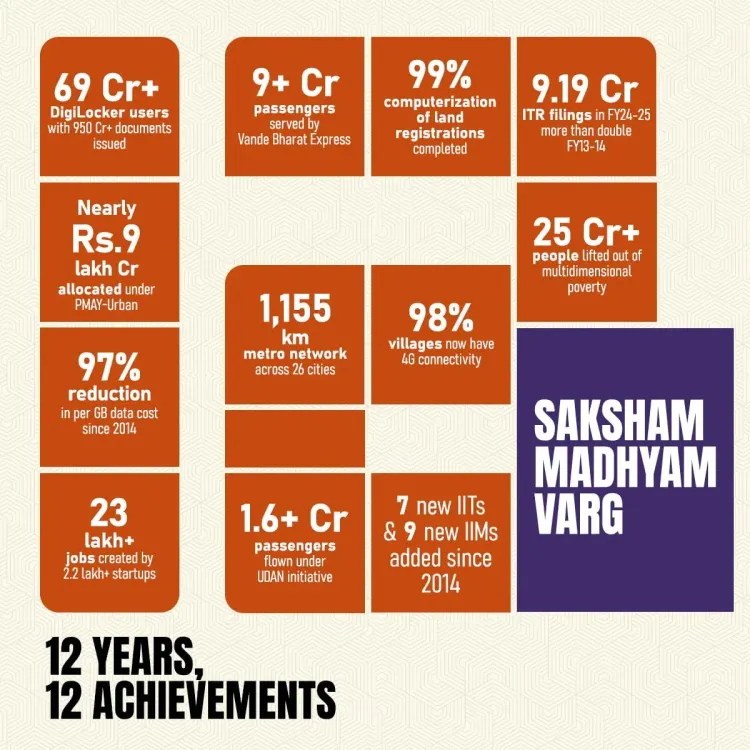
Union Minister Piyush Goyal marked twelve years of the Modi government on June 15, 2026, citing sweeping reforms, Digital India, and GST as pillars of middle-class empowerment under the hashtag #12YearsOfSakshamMiddleClass.
Key Takeaways
Piyush Goyal posted on June 15, 2026 marking twelve years of the BJP-led Modi government under the hashtag #12YearsOfSakshamMiddleClass .
The government's reform arc includes Pradhan Mantri Jan Dhan Yojana (2014) , Digital India (2015) , and GST (2017) as flagship interventions.
The post credits 'far-reaching reforms, digital inclusion and citizen-centric governance' for expanding opportunities and financial security for millions of families.
India's middle class , particularly in urban and semi-urban areas, is identified as the primary beneficiary of twelve years of policy continuity.
The messaging aligns with India's long-term goal of becoming a developed economy by 2047 under the Viksit Bharat vision.
Upcoming 2026-27 Union Budget proposals and parliamentary debates on ease-of-living metrics are expected to reflect this narrative further.
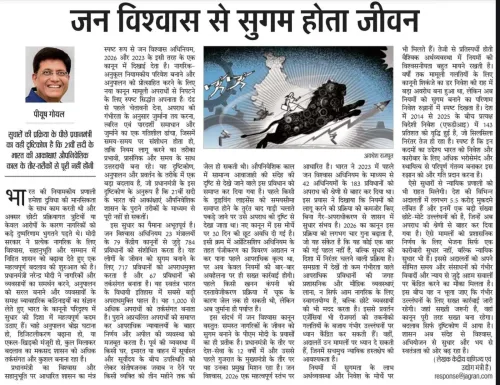
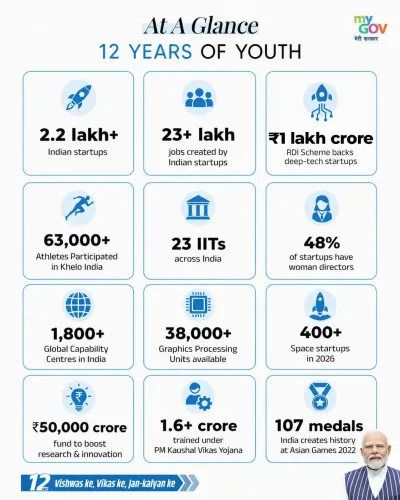
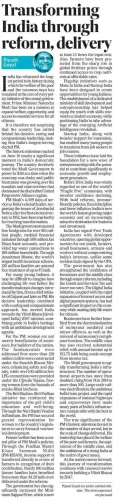
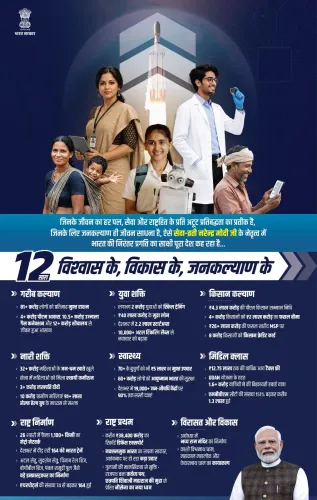
Union Commerce and Industry Minister Piyush Goyal on Monday, June 15, 2026, marked twelve years of the BJP-led government under Prime Minister Narendra Modi by highlighting what he called one of the most significant socio-economic transformations in India's history, crediting reforms, digital inclusion, and citizen-centric governance for expanding opportunities and financial security for millions of families.
Context
The post, shared under the hashtag #12YearsOfSakshamMiddleClass ('12 years of an empowered middle class'), marks the completion of twelve years since the Narendra Modi government assumed office in May 2014. Goyal's message frames this period as a watershed in India's economic and social history, centring the narrative on the lived experience of ordinary households rather than macroeconomic aggregates alone.
As Leader of the House in the Rajya Sabha and a senior BJP figure, Goyal has been a consistent voice for the government's reform agenda, making his framing of this anniversary significant within the party's political communication strategy.
Policy Backdrop
The government's reform arc over the past twelve years has spanned several landmark interventions. The Pradhan Mantri Jan Dhan Yojana, launched in 2014, brought banking access to previously unbanked households, laying the foundation for direct benefit transfers and reduced leakages in welfare delivery.
The Digital India initiative, rolled out in 2015, expanded digital infrastructure and e-governance services, accelerating financial inclusion and citizen access to state services. The introduction of the Goods and Services Tax (GST) in 2017 replaced a fragmented indirect tax regime with a unified national system, formalising large segments of the economy and improving compliance.
Together, these measures have been central to the BJP government's consistent messaging that structural reform, when combined with digital public infrastructure, can expand the middle class through formalisation and efficiency gains.
Stakeholders and Impact
India's middle class — spanning urban and semi-urban households — has been the primary addressee of this policy communication. The government has repeatedly argued that reduced corruption through direct benefit transfers, broader financial access, and simplified taxation have collectively improved ease of living for this demographic.
The framing of 'empowerment' through 'greater opportunities, ease of living, and financial security' reflects the administration's long-term narrative of linking governance quality to household welfare, a message that resonates particularly in aspirational Tier-2 and Tier-3 cities across the country.
What's Next
With the 2026-27 fiscal cycle underway, attention will turn to whether the government introduces new middle-class targeted measures in upcoming Union Budget proposals or announces fresh schemes aligned with the Viksit Bharat ('Developed India') goal of achieving developed-economy status by 2047. Parliamentary debates on ease-of-living metrics and the pace of formalisation are also expected to intensify in the coming months.
The anniversary messaging signals that the BJP intends to keep the middle-class empowerment narrative central to its political identity heading into the next legislative cycle.
Point of View
Using a milestone marker to consolidate the government's reform credentials with its core middle-class constituency. The choice of 'Saksham' — meaning capable or empowered — is deliberate, positioning the middle class not as a passive recipient of welfare but as an active participant in India's growth story. This framing serves a dual purpose: it defends the government's economic record while pre-empting opposition narratives around inequality and joblessness. As India approaches the 2047 Viksit Bharat deadline, such messaging is likely to intensify, anchoring electoral identity to long-run developmental aspirations.
NationPress
14 Sept 2026
Frequently Asked Questions
What is #12YearsOfSakshamMiddleClass?
#12YearsOfSakshamMiddleClass is a hashtag used by BJP leaders, including Union Minister Piyush Goyal, to mark twelve years of the Narendra Modi government and highlight policy reforms said to have empowered India's middle class since 2014.
What reforms has the Modi government introduced for the middle class?
Key reforms include the Pradhan Mantri Jan Dhan Yojana for financial inclusion (2014), the Digital India initiative for e-governance and digital access (2015), and the introduction of GST as a unified indirect tax system (2017).
Who is Piyush Goyal?
Piyush Goyal is India's Union Minister of Commerce and Industry, a senior BJP leader, and the Leader of the House in the Rajya Sabha.
What is Viksit Bharat and how does it relate to middle-class policy?
Viksit Bharat, meaning 'Developed India,' is the government's stated goal of achieving developed-economy status by 2047. Middle-class empowerment through formalisation, digital infrastructure, and welfare efficiency is central to this long-term vision.
What can India's middle class expect in the 2026-27 Union Budget?
Analysts expect the 2026-27 Union Budget to include new middle-class targeted measures, potentially building on existing digital and financial inclusion frameworks, though no specific proposals have been announced yet.