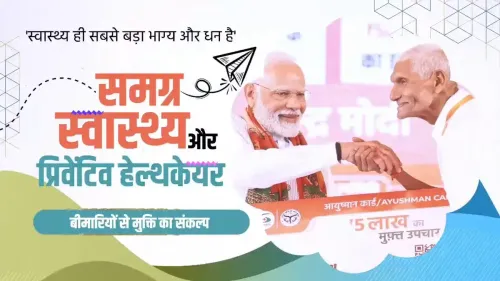
Piyush Goyal marks 12 years of India's health revolution
Synopsis
Union Minister Piyush Goyal marked twelve years of India's health revolution on June 14, 2026, championing the principle that no family should face financial ruin due to a medical emergency — with Ayushman Bharat PM-JAY at the centre of this transformation.
Key Takeaways
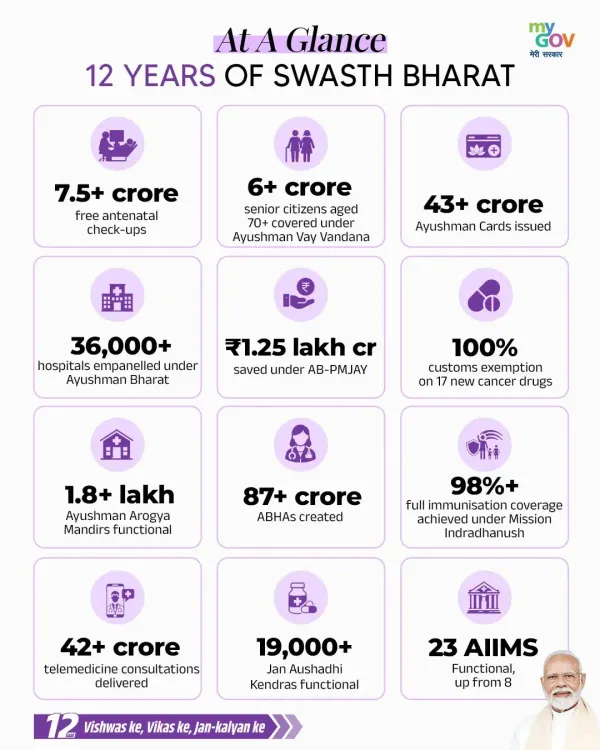
Union Minister Piyush Goyal posted on June 14, 2026 to mark #12YearsOfSwasthBharat , twelve years of BJP-led health reforms since 2014 .
Ayushman Bharat PM-JAY , launched in 2018 , provides up to Rs 5 lakh annual health cover per family to approximately 500 million people.
The government's stated philosophy: a medical emergency must never become a financial crisis for a family.
The National Health Policy 2017 set a target of raising public health spending to 2.5 per cent of GDP and cutting out-of-pocket expenditure.
India has presented its health schemes internationally as models for other developing countries pursuing rapid universal coverage.
The next phase of Ayushman Bharat expansion and digital health integration is expected to be outlined in the 2026-27 Union Budget .
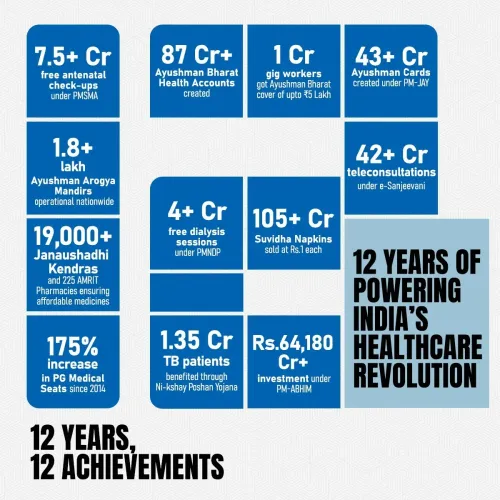
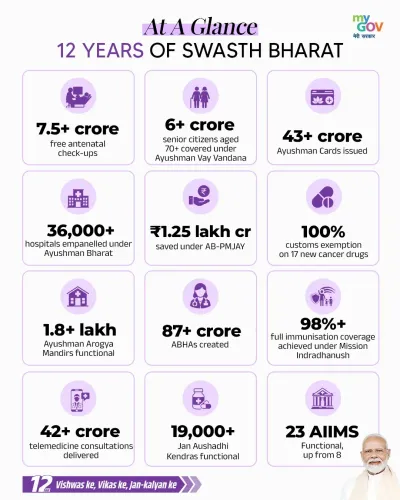
Union Commerce and Industry Minister Piyush Goyal on Sunday, June 14, 2026, marked twelve years of India's health policy transformation, highlighting the country's emergence as a global leader in large-scale healthcare initiatives and underscoring the government's philosophy that a medical emergency must never push a family into financial ruin.
Context
Goyal's post, tagged #12YearsOfSwasthBharat, reflects on a decade-plus of health sector reforms under the National Democratic Alliance government. The hashtag marks twelve years since the BJP-led government, under Prime Minister Narendra Modi, took office in May 2014 and began systematically scaling public health coverage. The minister described the core animating idea as 'ensuring that a medical emergency never morphs into a financial crisis for a family.'
India's health architecture has been reshaped through a series of interlocking programmes designed to push coverage down to the lowest income strata. The government has repeatedly positioned these efforts not merely as domestic welfare policy but as a model for developing nations worldwide.
Policy Backdrop
Ayushman Bharat Pradhan Mantri Jan Arogya Yojana (PM-JAY), launched in 2018, is the centrepiece of this transformation. It provides up to Rs 5 lakh annual health insurance cover per family, targeting approximately 500 million people from low-income households — making it one of the largest government-funded health insurance schemes in the world.
The National Health Mission, which merged the National Rural Health Mission and the National Urban Health Mission under a single umbrella, strengthened primary and secondary healthcare infrastructure across rural and urban India. The National Health Policy 2017 set an explicit target of raising public health expenditure to 2.5 per cent of GDP and reducing catastrophic out-of-pocket spending that historically drove millions below the poverty line.
Successive Union budgets since 2014 have scaled both health insurance and primary-care infrastructure, deploying direct-benefit architecture and IT platforms — an approach mirrored in other flagship welfare programmes. The Ayushman Bharat Digital Mission has further sought to create interoperable health records, positioning India at the frontier of digital health governance.
Stakeholders and Impact
The primary beneficiaries of this policy arc are low-income families who previously faced the stark choice between seeking treatment and avoiding financial catastrophe. Public hospital networks have been the delivery mechanism, receiving capital infusions and capacity-building support under successive budget cycles.
India has also leveraged these programmes diplomatically, presenting them in multilateral forums as replicable models for other developing countries seeking to expand healthcare coverage rapidly without equivalent private insurance markets. The scale of PM-JAY in particular has drawn attention from global health institutions studying government-led universal health coverage pathways.
What's Next
Attention will now turn to the next phase of Ayushman Bharat expansion and its possible deeper integration with the Ayushman Bharat Digital Mission, with the 2026-27 Union Budget and National Health Authority notifications expected to outline the roadmap. As India consolidates twelve years of health reform, the policy challenge shifts from scheme launch to sustained outcomes — ensuring that coverage translates into quality care at the point of delivery for the country's most vulnerable households.
Point of View
Using the #12YearsOfSwasthBharat moment to reinforce the BJP's welfare-state credentials ahead of what is likely a busy legislative and budgetary calendar. By framing health policy around financial protection rather than medical metrics alone, the government is signalling that it sees Ayushman Bharat not just as a healthcare programme but as an anti-poverty instrument — a framing that has proven politically durable. The invocation of India leading 'several of the world's largest healthcare initiatives' also reflects the government's consistent effort to project domestic welfare programmes as models of global governance. The next stress test will be whether the scheme's expansion in quality and digital integration matches the scale already achieved in enrolment numbers.
NationPress
13 Sept 2026
Frequently Asked Questions
What is #12YearsOfSwasthBharat?
#12YearsOfSwasthBharat marks twelve years since the BJP-led NDA government took office in May 2014 and began a systematic overhaul of India's public health architecture, including the launch of Ayushman Bharat PM-JAY in 2018.
What is Ayushman Bharat PM-JAY and who does it cover?
Ayushman Bharat Pradhan Mantri Jan Arogya Yojana (PM-JAY) is a government-funded health insurance scheme that provides up to Rs 5 lakh annual cover per family, targeting approximately 500 million people from low-income households across India.
Why did Piyush Goyal post about India's healthcare on June 14, 2026?
Piyush Goyal posted to mark twelve years of health reforms since the BJP government came to power in 2014, celebrating India's emergence as a global leader in large-scale healthcare initiatives under the #12YearsOfSwasthBharat hashtag.
How has India's health spending target changed since 2014?
The National Health Policy 2017 set a target of raising public health expenditure to 2.5 per cent of GDP and reducing catastrophic out-of-pocket spending that historically pushed millions of families into poverty.
What comes next for Ayushman Bharat?
The next phase is expected to focus on expanding coverage and deeper integration with the Ayushman Bharat Digital Mission , with the 2026-27 Union Budget and National Health Authority notifications anticipated to lay out the roadmap.