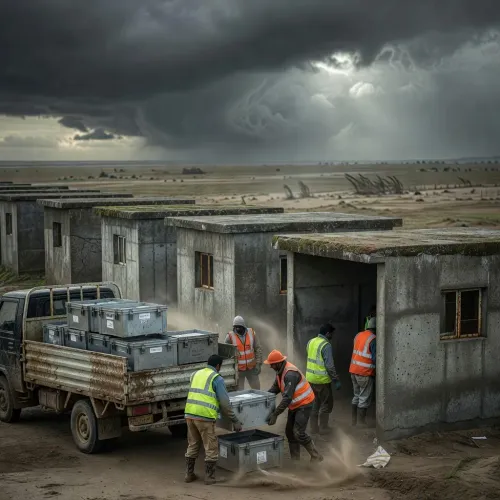
Odisha CMO: Relief & rescue surge after Cyclone Arnab

Synopsis
The Chief Minister's Office of Odisha announced on 29 October 2026 that relief and rescue operations are being accelerated in the aftermath of Cyclone Arnab, with continuous post-cyclone monitoring underway and public safety declared the government's highest priority.
Key Takeaways
The Chief Minister's Office of Odisha confirmed that relief and rescue operations have been accelerated in response to Cyclone Arnab .
Public safety has been declared the top priority , with all necessary steps being taken by the state government.
Continuous monitoring of post-cyclone conditions is ongoing in affected areas alongside active recovery work.
Odisha's disaster framework traces back to the 1999 super cyclone that killed over 10,000 people , leading to creation of dedicated response infrastructure.
The state's model — which enabled the evacuation of roughly 1.2 million people before Cyclone Fani in 2019 — is the template being deployed now.
Coastal communities and fisherfolk are among the most vulnerable groups in the government's focus for immediate relief.
As Cyclone Arnab moves through Odisha's coastline, the state government has thrown its full disaster-response machinery into gear — accelerating rescue operations, setting recovery in motion, and placing public safety at the top of every priority list. The Chief Minister's Office of Odisha confirmed the push in a post on Thursday, 29 October 2026, signalling that the administration is in active crisis mode.
The CMO's statement, issued in Odia and English, reads: 'ବାତ୍ୟା ପରବର୍ତ୍ତୀ ସ୍ଥିତି ଉପରେ ନିରନ୍ତର ନଜର ରଖିବା ସହ ପ୍ରଭାବିତ ଅଞ୍ଚଳରେ ରିଲିଫ୍ ଓ ପୁନରୁଦ୍ଧାର କାର୍ଯ୍ୟ ଜାରି ରହିଛି' — ['Continuous monitoring of post-cyclone conditions is ongoing alongside relief and recovery work in affected areas.'] The government, it says, is 'accelerating relief and rescue operations in the wake of Cyclone Arnab, prioritising public safety and post-cyclone recovery.'
Odisha's battle-tested cyclone machine kicks in
Odisha is no stranger to this moment. The state sits square in the Bay of Bengal's cyclone corridor, and the memory of the 1999 super cyclone — which killed more than 10,000 people — transformed how the government responds to every storm that follows. Out of that catastrophe came the Odisha State Disaster Management Authority, a network of cyclone shelters, and one of India's most sophisticated coastal early-warning systems.
The fruits of that investment were visible during Cyclone Fani in 2019, when authorities evacuated roughly 1.2 million people ahead of landfall — one of the largest pre-cyclone evacuations in India's history. That model — rapid evacuation, district-level disaster response forces, close coordination with the National Disaster Response Force (NDRF) — is now standard operating procedure whenever a system makes landfall.
What the post-landfall response looks like on the ground
Statements like Wednesday's typically accompany the activation of district-level command centres across coastal Odisha, with relief camps opened for displaced residents. Fisherfolk and coastal communities — the most exposed — are the first focus of rescue teams. The administration simultaneously begins damage assessment across affected districts, a step that feeds into any formal request for central government assistance.
Authorities say relief distribution and post-cyclone recovery work are already underway in the worst-hit areas, with the government committed to 'continuous monitoring' of conditions until the situation stabilises.
Eyes now on damage counts and central support
The immediate questions now are the ones that always follow landfall: how extensive is the crop and infrastructure damage across coastal districts, how many relief camps are operational, and will the state seek additional funds or forces from New Delhi? Odisha's institutional memory and preparedness have repeatedly turned potential catastrophes into managed emergencies. Whether Cyclone Arnab tests those limits will become clear in the hours and days ahead.
Odisha has built something rare in Indian disaster governance — a system that responds faster than the storm moves. The real test, as always, is the recovery that follows once the winds die down.
Frequently Asked Questions
What is Cyclone Arnab and where did it hit?
Cyclone Arnab is a tropical cyclone that made landfall affecting the coastal state of Odisha on the Bay of Bengal. The Odisha government issued relief and rescue updates on 29 October 2026 confirming that post-cyclone recovery operations are underway.
What is the Odisha government doing about Cyclone Arnab?
The Odisha government has accelerated relief and rescue operations, placed public safety as its top priority, and is conducting continuous monitoring of post-cyclone conditions in affected areas while relief and recovery work continues in impacted districts.
How does Odisha manage cyclone disasters?
Odisha established the Odisha State Disaster Management Authority after the devastating 1999 super cyclone, building a network of cyclone shelters, early-warning systems and district-level response forces. The state coordinates with the National Disaster Response Force and has conducted large-scale evacuations, most notably moving roughly 1.2 million people before Cyclone Fani in 2019.
Which communities are most at risk during Odisha cyclones?
Coastal communities and fisherfolk along Odisha's Bay of Bengal coastline face the greatest exposure during cyclone events and are typically the first focus of government rescue and relief efforts.
What should people in affected areas of Odisha do during Cyclone Arnab?
Residents in affected areas should follow instructions from local disaster authorities, move to designated cyclone shelters if directed, and monitor official updates from the Chief Minister's Office and district administrations.