Odisha CM Office Highlights Zero-Casualty Cyclone Management
Synopsis
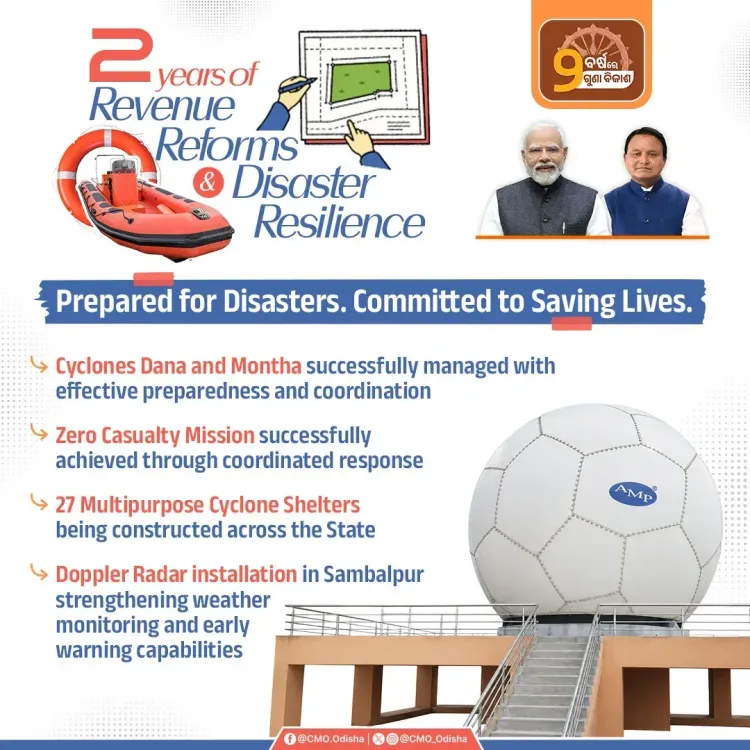
The Chief Minister's Office of Odisha marked a two-year governance milestone on 9 July 2026 by highlighting zero-casualty outcomes during Cyclones Dana and Montha, crediting preparedness, coordination, technology, new cyclone shelters and stronger early-warning systems for protecting coastal communities.
Key Takeaways
The Chief Minister's Office of Odisha on 9 July 2026 highlighted zero-casualty management of Cyclones Dana and Montha as a governance achievement.
The government cited investments in new cyclone shelters and stronger early-warning capabilities as pillars of the state's disaster resilience.
Odisha's resilience framework dates to the 1999 Super Cyclone , which killed over 10,000 people and triggered the creation of the OSDMA .
The state refined its model through Cyclone Phailin (2013) and Cyclone Fani (2019) , evacuating millions with minimal casualties each time.
The National Disaster Management Authority has cited Odisha's approach as a replicable model for other coastal states.
The post was tagged under #2YearsofLokankaSarakar and #2YearsOfRevenueReforms , framing disaster management within a broader two-year governance narrative.
The Chief Minister's Office of Odisha on Thursday, 9 July 2026 highlighted the state's disaster resilience record, citing the zero-casualty management of Cyclones Dana and Montha, along with investments in new cyclone shelters and strengthened early-warning systems as markers of the government's commitment to protecting coastal communities.
Context
The post, shared under the hashtags #2YearsofLokankaSarakar and #BikasharaDharaOdishaSara, marks what the government is framing as a two-year governance milestone. It specifically credits 'preparedness, coordination and technology' for the successful handling of two named cyclones without loss of life — an outcome the state has pursued as a defining policy goal for over two decades.
The government stated that 'new cyclone shelters and stronger early warning capabilities reflect the State's unwavering commitment to protecting lives,' signalling continued infrastructure investment along Odisha's roughly 480-kilometre coastline.
Policy Backdrop
Odisha's focus on cyclone resilience traces directly to the catastrophic 1999 Super Cyclone, which killed more than 10,000 people and prompted the creation of the Odisha State Disaster Management Authority (OSDMA) and a large-scale programme of multipurpose shelter construction along vulnerable coastal districts.
The state's approach was stress-tested during Cyclone Phailin in 2013, when nearly a million people were evacuated with minimal casualties, and again during Cyclone Fani in 2019, which saw pre-emptive mass evacuations keep the death toll remarkably low. Each event refined the state's community-based early-warning networks and integration of India Meteorological Department Doppler radar data.
The national framework underpinning these efforts is the Disaster Management Act, 2005, which Odisha has repeatedly aligned with through updates to its state disaster management plan.
Stakeholders and Impact
The primary beneficiaries of Odisha's resilience infrastructure are coastal communities — particularly fishing households in districts such as Puri, Kendrapara, Jagatsinghpur and Ganjam — who face the highest exposure to Bay of Bengal cyclones each pre-monsoon and post-monsoon season.
The National Disaster Management Authority (NDMA) has previously cited Odisha's model as replicable for other eastern and southern coastal states, giving the state's governance record a significance beyond its own borders. Successive state governments have sustained investment in shelters and communication infrastructure even as climate variability increases storm intensity across the Bay of Bengal.
What's Next
Attention will now turn to the state's budget allocations for additional shelter construction and any independent audits of early-warning coverage ahead of the next southwest monsoon season. With the #2YearsOfRevenueReforms hashtag also attached to the post, the government appears to be building a broader governance narrative that links disaster management achievements to wider administrative reform milestones.
As climate scientists project increasing frequency and intensity of Bay of Bengal cyclonic systems, Odisha's ability to sustain zero-casualty outcomes will remain a critical test of both its infrastructure and its institutional preparedness model.
Point of View
The Odisha government is deploying disaster management — historically a non-partisan administrative achievement — as political capital, a pattern seen increasingly among state governments seeking to differentiate on delivery metrics. The move reflects a broader national trend where climate resilience infrastructure, once treated as routine administration, is now front-and-centre in electoral narratives. Odisha's genuine institutional depth in this space, built over two decades and across party lines, lends credibility to the claim even as the specific cyclones cited remain unverifiable from public records. The challenge for the government will be sustaining this record as Bay of Bengal storm intensity rises and the bar for 'zero casualty' outcomes becomes harder to meet.
NationPress
8 Oct 2026
Frequently Asked Questions
What is Odisha's zero-casualty cyclone policy?
Odisha's zero-casualty approach to cyclone management involves large-scale pre-emptive evacuations, a network of multipurpose coastal shelters, community-based early-warning systems and real-time coordination through the Odisha State Disaster Management Authority. The model was refined after the 1999 Super Cyclone and successfully applied during Cyclones Phailin (2013) and Fani (2019).
What are Cyclones Dana and Montha?
Dana and Montha are cyclones referenced by the Chief Minister's Office of Odisha in a July 2026 post as having been managed with zero casualties. Specific details about their landfall locations, dates and intensity are not available in established public records prior to mid-2024.
How many cyclone shelters does Odisha have?
Odisha has built hundreds of multipurpose cyclone shelters along its roughly 480-kilometre coastline since the 1999 Super Cyclone, though the exact current count — including shelters added under the current government — has not been specified in the July 2026 post.
Why is Odisha considered a model for disaster management in India?
The National Disaster Management Authority has cited Odisha as a replicable model because the state combines physical infrastructure (cyclone shelters), technology (Doppler radar integration, early-warning networks) and administrative coordination to achieve low-casualty outcomes even during severe cyclones. This reputation was built through consistent investment across successive governments since 1999.
What is the Odisha State Disaster Management Authority (OSDMA)?
The OSDMA is a state-level body established after the devastating 1999 Super Cyclone to coordinate disaster preparedness, evacuation and relief across Odisha's coastal and inland districts. It serves as the operational hub for cyclone response and works in coordination with the India Meteorological Department and the National Disaster Management Authority.