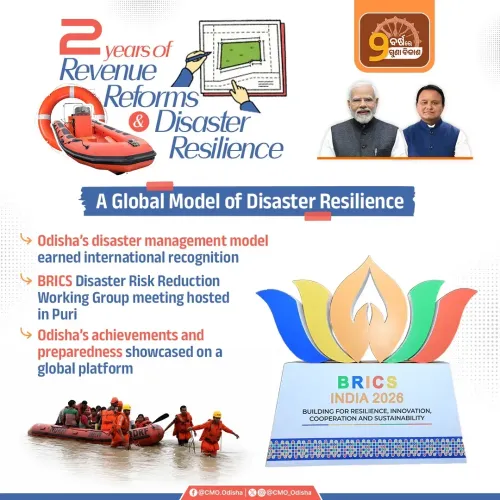
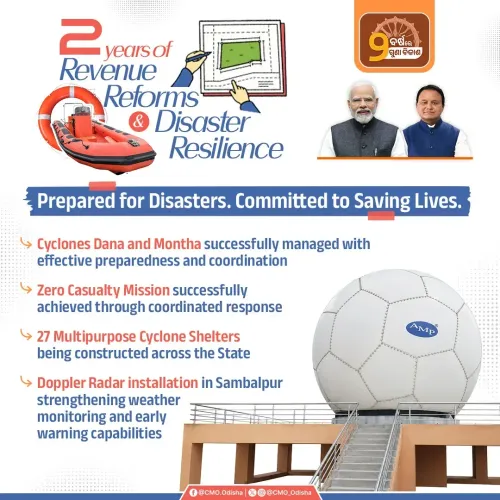
Odisha CMO Reaffirms State's Zero-Casualty Disaster Mission

Synopsis
The Chief Minister's Office of Odisha on 23 June 2026 reaffirmed the state's zero-casualty mission in disaster management, ahead of the monsoon and cyclone season. Rooted in lessons from the 1999 super cyclone and the landmark Phailin evacuation of 2013, the commitment signals full activation of Odisha's nationally recognised disaster preparedness framework.
Key Takeaways
The Chief Minister's Office of Odisha publicly reaffirmed the state's zero-casualty disaster mission on 23 June 2026 .
Odisha's preparedness doctrine was forged after the 1999 super cyclone , which killed more than 10,000 people .
During Cyclone Phailin (2013) , the state evacuated over one million people , setting a national benchmark for zero-casualty operations.
The Odisha State Disaster Management Authority (OSDMA) coordinates early-warning systems, cyclone shelters, and community evacuation drills across vulnerable coastal districts.
The reaffirmation signals that district administrations and shelter infrastructure must be fully operational ahead of the 2026 cyclone season.
Odisha's model is increasingly referenced as a template for disaster-risk reduction by other Indian coastal states.
The Chief Minister's Office of Odisha on Tuesday, 23 June 2026 publicly reaffirmed the state's long-standing zero-casualty mission in disaster management, underscoring that every human life remains the central priority in the government's preparedness framework.
Context
The post, titled 'Every Life Matters: Odisha Reaffirms Its Zero-Casualty Mission,' signals that the state government is reinforcing its disaster-risk-reduction posture ahead of the active monsoon and cyclone season. Odisha sits along one of India's most cyclone-exposed coastlines, making pre-season reaffirmations of preparedness a significant governance signal rather than a routine communication.
The timing — late June, when the Bay of Bengal typically enters its most volatile phase — aligns with the state's established practice of publicly committing to evacuation readiness before peak weather events arrive.
Policy Backdrop
Odisha's zero-casualty doctrine traces its origins to the catastrophic 1999 super cyclone, which killed more than 10,000 people and exposed deep gaps in early-warning and evacuation infrastructure. That disaster catalysed the creation of the Odisha State Disaster Management Authority (OSDMA) and a network of multipurpose cyclone shelters across vulnerable coastal districts.
The approach was stress-tested during Cyclone Phailin in 2013, when the state evacuated more than one million people in one of the largest such operations in India's history, resulting in minimal loss of life. That event became the operational benchmark against which subsequent cyclone responses have been measured, and it drew international recognition for Odisha's community-based evacuation model.
Successive administrations have treated cyclone and flood preparedness as a core governance priority, combining permanent infrastructure — shelters, embankments, communication towers — with regular community drills and coordination with the National Disaster Management Authority (NDMA).
Stakeholders and Impact
Coastal communities across cyclone-vulnerable districts stand as the primary beneficiaries of the zero-casualty framework. The policy's emphasis on pre-emptive evacuation over post-disaster relief has shifted risk-reduction responsibility upstream, making shelter maintenance, early-warning dissemination, and community awareness the front lines of disaster governance.
The reaffirmation also carries institutional weight for the OSDMA and district administrations, signalling that the political leadership expects the preparedness apparatus to be fully operational. For Odisha's roughly 4.5 lakh people living in the most cyclone-exposed coastal belt, the commitment translates directly into evacuation drills, shelter readiness checks, and last-mile communication protocols.
What's Next
Attention will now turn to state announcements on pre-monsoon cyclone shelter maintenance, coordination meetings between OSDMA and district collectors, and the activation of early-warning dissemination channels for the 2026 cyclone season. The Chief Minister's Office is expected to follow this reaffirmation with operational directives to district administrations.
Odisha's zero-casualty model has increasingly been cited as a template for other coastal states, and how the government performs during the 2026 season will determine whether that reputation is sustained — and whether it translates into formal policy adoption elsewhere in India.
Point of View
And periodic high-profile reaffirmations serve to keep that apparatus politically accountable. What makes Odisha's approach distinctive is that it has survived changes in administration, suggesting the zero-casualty doctrine has been institutionalised rather than personalised. The real test, as always, will be whether the infrastructure and coordination mechanisms deliver when the next major storm makes landfall.
NationPress
22 Sept 2026
Frequently Asked Questions
What is Odisha's zero-casualty mission in disaster management?
Odisha's zero-casualty mission is a state policy commitment to prevent loss of human life during cyclones and floods through pre-emptive mass evacuations, early-warning systems, and a network of multipurpose cyclone shelters managed by the Odisha State Disaster Management Authority.
Why is Odisha considered a model for disaster management in India?
Odisha earned that reputation primarily through its response to Cyclone Phailin in 2013, when it evacuated over one million people with minimal casualties — a sharp contrast to the 1999 super cyclone that killed more than 10,000 people and exposed severe gaps in the state's preparedness.
What is the Odisha State Disaster Management Authority (OSDMA)?
OSDMA is the state body established after the 1999 super cyclone to coordinate disaster preparedness across Odisha, including early-warning dissemination, cyclone shelter construction and maintenance, and community-level evacuation drills in coastal districts.
When did the Odisha CMO reaffirm the zero-casualty goal in 2026?
The Chief Minister's Office of Odisha posted its reaffirmation of the zero-casualty mission on 23 June 2026, ahead of the active monsoon and Bay of Bengal cyclone season.
How many people were evacuated during Cyclone Phailin in Odisha?
More than one million people were evacuated by the Odisha government ahead of Cyclone Phailin in 2013, making it one of the largest pre-cyclone evacuation operations in India's history.