CM Majhi Reinforces Odisha's Zero-Casualty Disaster Model

Synopsis
The Chief Minister's Office of Odisha reaffirmed on June 23, 2026, that CM Mohan Majhi's government is reinforcing the state's Zero Casualty disaster model through pre-preparedness, modern alert systems, and integrated evacuation — building on a legacy forged after the deadly 1999 Super Cyclone.
Key Takeaways
The CMO Odisha on June 23, 2026 reaffirmed commitment to strengthening the state's Zero Casualty disaster management model under CM Mohan Charan Majhi .
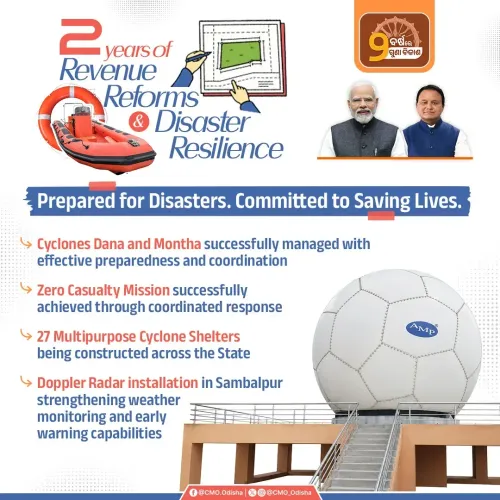
Key focus areas include pre-preparedness, advanced early warning systems , rapid information dissemination, robust shelters, and safe evacuation.
Odisha's model traces its origins to reforms after the 1999 Super Cyclone , which killed over 10,000 people .
During Cyclone Fani (2019) , more than 1.2 million people were evacuated with near-zero casualties, setting a national benchmark cited by the NDMA .
The statement is pegged to #2YearsofLokankaSarakar , positioning disaster resilience as a core achievement of the current government.
Upgraded alert systems are expected to be operationalised ahead of the ongoing 2026 cyclone season .
The Chief Minister's Office of Odisha on Tuesday, June 23, 2026, reaffirmed the state government's commitment to strengthening its internationally recognised 'Zero Casualty' disaster management model under the leadership of Chief Minister Mohan Charan Majhi, with renewed emphasis on pre-preparedness, advanced early warning systems, and rapid information dissemination.
Context
The CMO's post, shared in Odia, states that special priority is being given to pre-preparedness, cutting-edge alert infrastructure, and swift information spread to further consolidate the state's successful 'Zero Casualty' model. The original text reads: 'ଜିରୋ କାଜୁଆଲ୍ଟି ମଡେଲ' — the Zero Casualty Model — which has come to define Odisha's approach to cyclone response over the past two decades. The post also underscores that protection of lives and property through robust shelter networks, safe evacuation mechanisms, and integrated disaster management remains the government's highest priority.
Policy Backdrop
Odisha's disaster management architecture was fundamentally rebuilt after the catastrophic 1999 Super Cyclone, which killed more than 10,000 people and left the state's coastline devastated. The state established the Odisha State Disaster Management Authority in 2000 and invested heavily in a network of multipurpose cyclone shelters along its Bay of Bengal coastline. The results were transformative: during Cyclone Fani in 2019, authorities evacuated more than 1.2 million people, achieving near-zero casualties — a feat later referenced in National Disaster Management Authority (NDMA) guidelines as a national benchmark.
Successive governments in Odisha have maintained this investment trajectory, prioritising community-level drills, last-mile alert dissemination, and inter-agency coordination. The current administration under CM Majhi, in office since June 2024, is continuing and seeking to upgrade this legacy, with the CMO's statement pointing to technology modernisation as the next frontier.
Stakeholders and Impact
The communities most directly affected by these measures are the millions of residents in Odisha's coastal and cyclone-prone districts, which face recurring threats from Bay of Bengal storms, particularly during the June–November cyclone season. Robust shelter infrastructure and reliable early warnings are not administrative abstractions for these populations — they are the difference between life and loss. The state's model has also influenced disaster preparedness planning in other Indian coastal states, making Odisha's policy choices consequential well beyond its own borders.
The CMO's statement frames the initiative as a 'people's government' (ଲୋକଙ୍କ ସରକାର) effort toward building a 'safe, empowered, and disaster-resilient Odisha' — language that signals both a governance priority and a political identity ahead of the state's continued tenure under the BJP-led administration.
What's Next
Attention will now turn to the operational rollout of upgraded alert systems and any new shelter or evacuation protocols ahead of the 2026 cyclone season, which is already under way. Observers will also watch whether the central government, through the NDMA or state capacity-building programmes, moves to scale elements of the Odisha model to other vulnerable states. The CMO's reaffirmation, timed to the hashtag #2YearsofLokankaSarakar marking two years of the current government, positions disaster resilience as a central plank of the Majhi administration's governance record.
Point of View
It frames disaster resilience as the Majhi administration's most bankable credential. Odisha's Zero Casualty model is one of the few areas of Indian state governance that commands genuine cross-party and international respect, giving the ruling dispensation strong incentive to own it loudly. The emphasis on technology upgrades also suggests awareness that the model's reputation, built on Fani-era successes, must be actively maintained as climate risks intensify and public expectations rise. Whether the rhetoric translates into verifiable infrastructure investment before the 2026 season closes will be the real test of this commitment.
NationPress
22 Sept 2026
Frequently Asked Questions
What is Odisha's Zero Casualty disaster management model?
Odisha's Zero Casualty model is the state's approach to cyclone response, combining mass pre-emptive evacuations, a network of multipurpose cyclone shelters, and robust early warning systems to prevent deaths during major storms. It gained international recognition after over 1.2 million people were evacuated with near-zero casualties during Cyclone Fani in 2019.
Who is CM Mohan Majhi and what is his role in Odisha's disaster management?
Mohan Charan Majhi has been the Chief Minister of Odisha since June 2024. Under his leadership, the state is continuing and seeking to upgrade its established disaster management infrastructure, with the CMO reaffirming this commitment on June 23, 2026.
What happened during the 1999 Odisha Super Cyclone?
The 1999 Super Cyclone struck Odisha's coast and killed more than 10,000 people, making it one of the deadliest natural disasters in India's post-independence history. It directly prompted the creation of the Odisha State Disaster Management Authority in 2000 and a major overhaul of the state's disaster preparedness systems.
How did Odisha achieve near-zero casualties during Cyclone Fani?
During Cyclone Fani in 2019, Odisha authorities evacuated more than 1.2 million people in under 48 hours using pre-positioned shelter networks, community-level drills, and coordinated early warning dissemination. The operation resulted in near-zero casualties and was later cited in national NDMA guidelines as a model for other states.
What upgrades is Odisha planning for its disaster management system in 2026?
The CMO's June 2026 statement highlights plans to further strengthen pre-preparedness measures, modernise early warning systems, and improve rapid information dissemination ahead of the ongoing cyclone season, though specific funding and implementation timelines have not been publicly detailed.