Piyush Goyal Shares VP's Yoga Day Article on Healthy Ageing
Synopsis
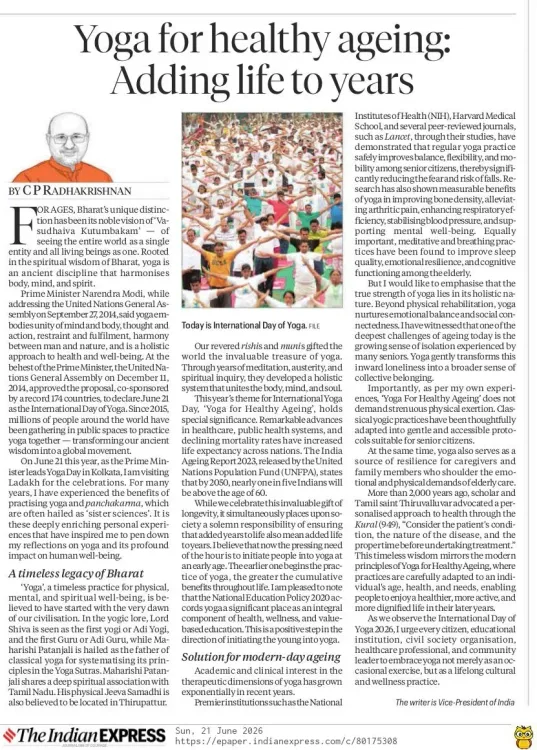
On International Yoga Day 2026, Union Minister Piyush Goyal amplified an article by the Vice President of India centred on this year's theme 'Yoga for Healthy Ageing', stressing yoga as a lifelong practice for physical, mental and emotional well-being.
Key Takeaways
Union Minister Piyush Goyal shared the Vice President of India's article on 21 June 2026 , International Yoga Day.
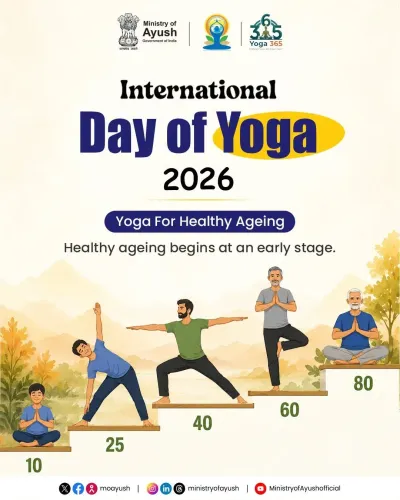
This year's official theme is 'Yoga for Healthy Ageing' , highlighting yoga's role for senior citizens and preventive health.
The Vice President's piece stresses yoga as a lifelong practice , not merely an occasional exercise.
International Yoga Day has been observed on 21 June every year since a 2014 UN General Assembly resolution at India's initiative.
The Ministry of AYUSH , established in 2014 , anchors India's policy push to integrate traditional wellness systems into national health programmes.
The endorsement by two senior constitutional and ministerial figures reinforces institutional momentum behind yoga in public health policy .
Union Commerce and Industry Minister Piyush Goyal on Sunday, 21 June 2026 shared an article authored by the Vice President of India marking International Yoga Day, calling it insightful and highlighting its focus on this year's theme, 'Yoga for Healthy Ageing'.
Context
In his post on X, Minister Goyal described the Vice President's piece as one that 'underscores yoga's special significance and elaborates on its numerous benefits for physical, mental and emotional well-being.' He added that the article encourages everyone to embrace yoga 'not merely as an occasional exercise, but as a lifelong practice that nurtures health, balance and holistic wellness.'
International Yoga Day is observed annually on 21 June, a date established by a United Nations General Assembly resolution in 2014 following India's proposal. The Vice President of India holds the second-highest constitutional office in the country and serves as the ex-officio Chairman of the Rajya Sabha, of which Goyal is the Leader of the House.
Policy Backdrop
India's push for a dedicated global yoga observance was first made at the United Nations in 2014 by Prime Minister Narendra Modi, and the UN General Assembly responded with a resolution that same year. Alongside this, the government established the Ministry of AYUSH in 2014 to promote traditional health systems — including yoga — as part of national health policy.
This year's theme, 'Yoga for Healthy Ageing', reflects a deliberate pivot toward addressing the needs of India's growing senior population and the rising burden of lifestyle diseases. Successive governments have integrated yoga into preventive health messaging, positioning it as a low-cost, accessible intervention for chronic conditions linked to sedentary modern life.
Stakeholders and Impact
The emphasis on healthy ageing speaks directly to senior citizens and public health planners grappling with India's demographic transition. Yoga's inclusion in national wellness frameworks has expanded through AYUSH-backed community programmes, school curricula, and wellness tourism initiatives, making it relevant to a broad cross-section of the population.
For the general public, the Vice President's article — amplified by a senior cabinet minister — reinforces the government's consistent message that yoga should be a daily, lifelong discipline rather than a ceremonial activity confined to one day a year. The convergence of constitutional authority and ministerial endorsement lends institutional weight to the wellness messaging.
What's Next
Attention will turn to whether yoga modules are more formally embedded in national health programmes such as those under Ayushman Bharat and AYUSH wellness centres, particularly targeting elderly beneficiaries. The 2027 International Yoga Day theme and its accompanying government outreach will indicate how far India's yoga-in-public-health agenda has progressed beyond annual observance into routine preventive care.
Point of View
Shifting from broad soft-power projection toward targeted public health outcomes for an ageing population. This aligns with the AYUSH ministry's expanding footprint in preventive care and wellness tourism. The pattern suggests yoga is being repositioned from a symbolic annual event into a durable plank of India's health governance narrative.
NationPress
20 Sept 2026
Frequently Asked Questions
What is the theme of International Yoga Day 2026?
The theme of International Yoga Day 2026 is 'Yoga for Healthy Ageing', emphasising yoga's benefits for senior citizens and long-term physical and mental wellness.
When is International Yoga Day celebrated and why?
International Yoga Day is celebrated on 21 June every year. The UN General Assembly declared it in 2014 following a proposal by Prime Minister Narendra Modi at the United Nations.
What did Piyush Goyal post on International Yoga Day 2026?
Minister Piyush Goyal shared the Vice President of India's article on International Yoga Day 2026, describing it as insightful and highlighting its message that yoga should be a lifelong practice for holistic wellness.
What is the Ministry of AYUSH and what does it do?
The Ministry of AYUSH was established in 2014 to promote traditional Indian health systems including yoga, Ayurveda, and naturopathy as part of national health and preventive care policy.
Why is yoga important for healthy ageing?
Yoga supports healthy ageing by improving flexibility, balance, and mental clarity while reducing stress — benefits highlighted in the Vice President's article shared on International Yoga Day 2026.