Piyush Goyal calls for Swadeshi resolve on Independence Day
Synopsis
On India's Independence Day, 15 August 2026, Union Commerce Minister Piyush Goyal called on all Indian families to uphold the Tricolour's honour, embrace Swadeshi, and commit to the nation's progress during the Amrit Kaal period leading to India's centenary in 2047.
Key Takeaways
Piyush Goyal posted Independence Day greetings on 15 August 2026 , addressing all Indian families.
He invoked Amrit Kaal — the government's term for the period from India's 75th to 100th independence anniversary ( 2022–2047 ).
The post called on citizens to uphold the honour of the Tricolour and adopt Swadeshi (domestic goods and enterprise).
The Swadeshi emphasis aligns with Goyal's Commerce Ministry mandate to promote domestic manufacturing and reduce import dependence.
The messaging frames patriotism and economic self-reliance as a single civic commitment for every Indian household.
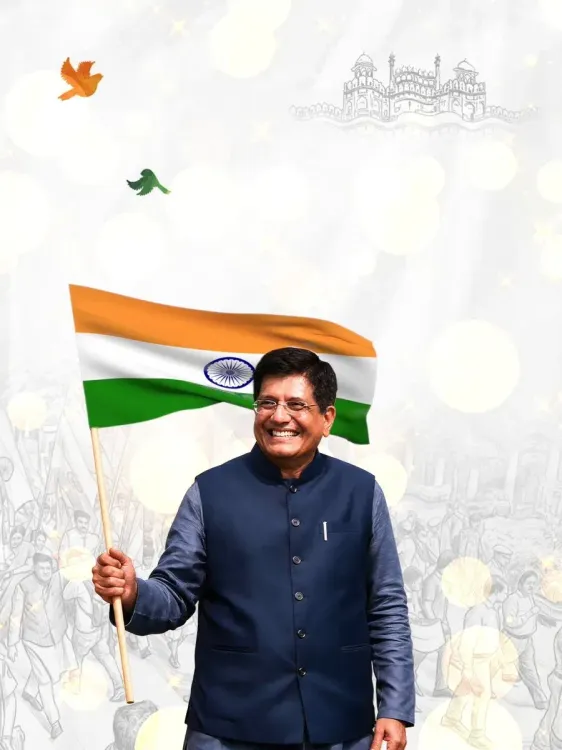
On the 79th Independence Day, 15 August 2026, Union Commerce and Industry Minister Piyush Goyal extended greetings to every Indian family and called on citizens to embrace Swadeshi — homegrown goods and enterprise — as their personal contribution to the nation's progress.
Posting in Hindi on X, Goyal wrote: 'Heartfelt Independence Day greetings to all families of India. In this Amrit Kaal of freedom, let us all pledge to uphold the honour and pride of the Tricolour above all else, adopt Swadeshi, and ensure our contribution to India's progress.'
Amrit Kaal and the Swadeshi pledge
The phrase Amrit Kaal — the 'nectar period' — has anchored official government communication since 2022, framing the years between India's 75th and 100th anniversaries of independence as a defining window for national transformation. Goyal's invocation of it on 15 August places the day's celebrations firmly within that longer arc: not just a commemoration, but a call to action stretching toward 2047.
The Swadeshi emphasis is consistent with a policy posture Goyal has championed as Commerce Minister — prioritising domestic manufacturing, reducing import dependence, and building Indian brands. Pairing it with the Tricolour on Independence Day is a deliberate rhetorical move: patriotism and economic self-reliance presented as a single, indivisible commitment.
A message aimed at every household
The post is addressed to sabhī parivārajanoṃ — 'all family members' of India — a deliberately inclusive frame that bypasses political audiences and speaks directly to citizens. Independence Day messaging from Union ministers routinely combines national pride with policy nudges, but Goyal's specific coupling of the Tricolour's honour (ān-bān-shān) with a Swadeshi pledge gives the seasonal greeting a sharper economic edge.
As India moves deeper into the Amrit Kaal decade, every Independence Day becomes another marker on the road to 2047 — and ministers like Goyal are using each one to remind citizens that the centenary goal demands choices made at the household level, not just in policy corridors.
Point of View
Linking the emotional weight of the Tricolour to the economic imperative of Swadeshi. For a Commerce Minister, this is brand-consistent: the message reinforces the government's self-reliance narrative without requiring a press conference. The 2047 centenary frame also signals that the BJP intends to keep Amrit Kaal as a live political and policy reference point well beyond its 2022 launch, turning every Independence Day into a progress checkpoint on that longer journey.
NationPress
29 Sept 2026
Frequently Asked Questions
What did Piyush Goyal say on Independence Day 2026?
Piyush Goyal extended greetings to all Indian families, called on citizens to uphold the honour of the Tricolour, adopt Swadeshi, and pledge their contribution to India's progress during the Amrit Kaal period.
What is Amrit Kaal in India?
Amrit Kaal refers to the period from India's 75th independence anniversary in 2022 to its centenary in 2047 , framed by the government as a defining era for national transformation and development.
What does Swadeshi mean and why is Goyal promoting it?
Swadeshi means preferring domestically produced goods and enterprises. As Union Commerce and Industry Minister , Piyush Goyal has consistently promoted self-reliance and domestic manufacturing as pillars of India's economic policy.
When is India's Independence Day celebrated?
India celebrates Independence Day on 15 August every year, marking freedom from British rule on 15 August 1947 .
What is Piyush Goyal's role in the Indian government?
Piyush Goyal is the Union Minister of Commerce and Industry , a senior BJP leader, and serves as Leader of the House in the Rajya Sabha .