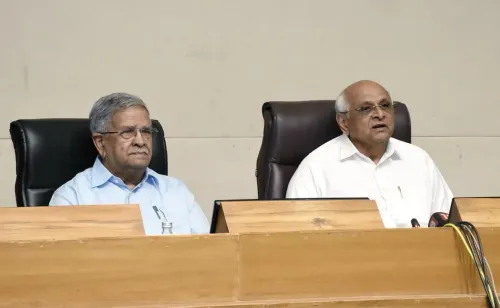
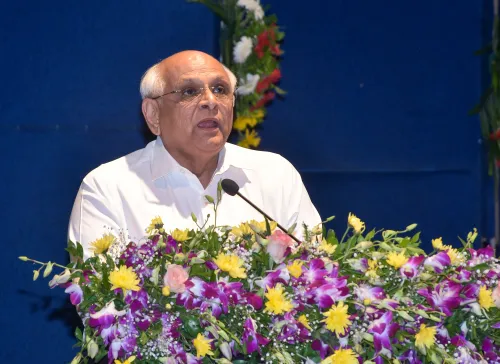
Gujarat CM Patel Boosts Collector Powers for Faster Land Grants

Synopsis
Chief Minister Bhupendra Patel has raised the financial ceilings for District Collectors and District Development Officers in Gujarat to approve land grants across industrial, cooperative, and rural categories — pushing decision-making to the district level to cut approval delays.
Key Takeaways
District Collectors can now approve land allocations for state boards and corporations up to ₹1 crore , raised from ₹15 lakh .
Central government public-purpose land grants up to 1 hectare get a new ceiling of ₹50 lakh , up from ₹15 lakh .
Cooperative housing society allocations rise from ₹6 lakh to ₹50 lakh at the Collector level.
District Development Officers can now approve village residential plots up to ₹1 lakh , up from ₹20,000 .
The reform is designed to eliminate state-level referrals for mid-value land grants and shorten administrative timelines.
Categories covered include infrastructure, industry, cooperative godowns, milk cooperatives, rural grids, and government employee housing.
A single bureaucratic bottleneck — the ceiling on what a district official can approve — has long slowed Gujarat's land allocation pipeline. Chief Minister Bhupendra Patel has now dismantled that ceiling in a sweeping revision announced on Tuesday, 28 July 2026, dramatically raising the financial authority of District Collectors and District Development Officers (DDOs) across the state so that land grants for infrastructure, industry, cooperative housing, and rural development can be cleared locally — without a file ever travelling to Gandhinagar.
What the new ceilings mean, category by category
The revisions are granular and significant. For allocations to state government boards and corporations covering up to 2 hectares, the District Collector's financial limit jumps from ₹15 lakh to ₹1 crore — a nearly seven-fold increase. For central government departments seeking land for public purposes up to 1 hectare, the ceiling rises from ₹15 lakh to ₹50 lakh.
Individual government employees seeking residential plots see their limit climb from ₹1 lakh to ₹20 lakh. Cooperative housing societies gain a ceiling hike from ₹6 lakh to ₹50 lakh. Commercial allocations via auction move from ₹1 lakh to ₹5 lakh, while cooperative godowns and allied institutions go from ₹3 lakh to ₹15 lakh.
At the village level, DDOs also get a meaningful upgrade. For individual residential plots in village settlements (gamathal), the limit rises from ₹20,000 to ₹1 lakh. Cooperative housing societies in rural areas see their ceiling move from ₹1.5 lakh to ₹7.5 lakh. Allocations for milk cooperatives, cooperative godowns, and rural grid purposes also go from ₹20,000 to ₹1 lakh.
The logic: local records, local decisions, shorter queues
The Chief Minister's Office framed the decision explicitly around 'Ease of Doing Business' and administrative simplification. The argument is practical: District Collectors and DDOs already hold the land records and know the ground conditions. Forcing every mid-value allocation up the chain to the state level added time without adding information.
With decisions now resolvable at the district level, applicant institutions and departments can also follow up locally — a small change that compresses the feedback loop considerably. For industrial developers and cooperative societies in particular, faster land clearance is often the rate-limiting step before construction can begin.
Gujarat's long-running decentralisation playbook
This move fits a pattern Gujarat has pursued for years: pairing its pro-investment pitch with administrative reforms that reduce friction at the point of delivery. Raising financial authority thresholds for district officials — rather than adding new schemes — is a structural fix. It does not require new infrastructure or new staff; it simply trusts existing officials with bigger decisions.
The test, as always, will be in implementation. Whether land allocation timelines for the listed categories actually compress will become visible at district offices in the months ahead. The thresholds are now set; the clock starts now.
Point of View
Not a headline scheme — and that makes it more durable. Gujarat has consistently used administrative decentralisation as a force-multiplier for its investment-friendly image, and this revision extends that logic to land allocation, the most friction-prone step in project clearance. The move also signals confidence in district-level bureaucracy at a time when states across India are experimenting with single-window systems. Whether it delivers measurable acceleration will depend on training, accountability, and whether state-level habit of centralisation quietly reasserts itself.
NationPress
28 Jul 2026
Frequently Asked Questions
What has Gujarat CM Bhupendra Patel changed about land allocation powers?
CM Patel has significantly raised the financial authority of District Collectors and District Development Officers to approve government land grants across multiple categories, so that allocations can be cleared at the district level without state-level referral.
What is the new financial limit for District Collectors for land allocation to state boards in Gujarat?
District Collectors can now approve land allocations to state government boards and corporations up to ₹1 crore for plots up to 2 hectares, raised from the earlier limit of ₹15 lakh .
How does this decision help cooperative housing societies in Gujarat?
The financial ceiling for cooperative housing society land allocations at the Collector level has been raised from ₹6 lakh to ₹50 lakh , allowing faster local approvals without escalation to the state government.
What are the new DDO powers for village plot allocation in Gujarat?
District Development Officers can now approve individual residential village plots up to ₹1 lakh (from ₹20,000), cooperative housing society plots up to ₹7.5 lakh (from ₹1.5 lakh), and milk cooperative or rural grid allocations up to ₹1 lakh (from ₹20,000).
Why is Gujarat decentralising land grant decisions to district level?
The rationale is that District Collectors and DDOs already hold local land records and ground-level information. Routing mid-value decisions through the state added delay without adding value. Local approval also makes follow-up easier for applicant institutions.