CM Bhupendra Patel Marks 23 Years of Gujarat's School Enrollment Drive
Synopsis
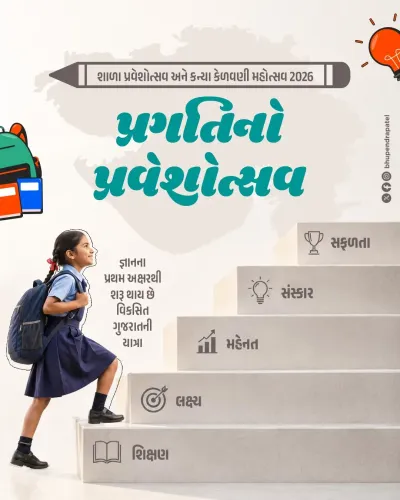
The Chief Minister's Office of Gujarat shared a special article by CM Bhupendra Patel on 24 June 2026, celebrating 23 years of the Shala Praveshotsav and Kanya Kelavani Mahotsav — the school enrollment drives originally launched by Narendra Modi to make education a mass societal movement in Gujarat.
Key Takeaways
The Chief Minister's Office of Gujarat posted on 24 June 2026 marking 23 years of the Shala Praveshotsav and Kanya Kelavani Mahotsav programs.
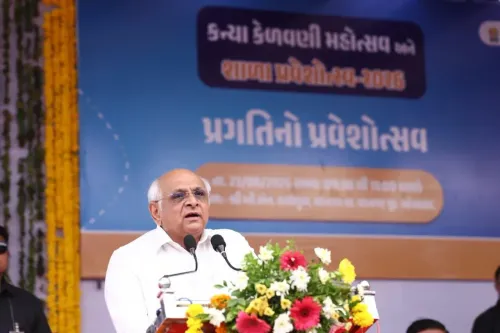
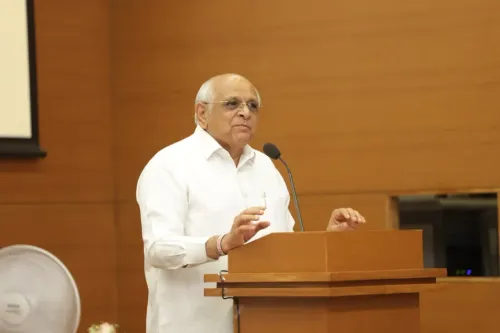
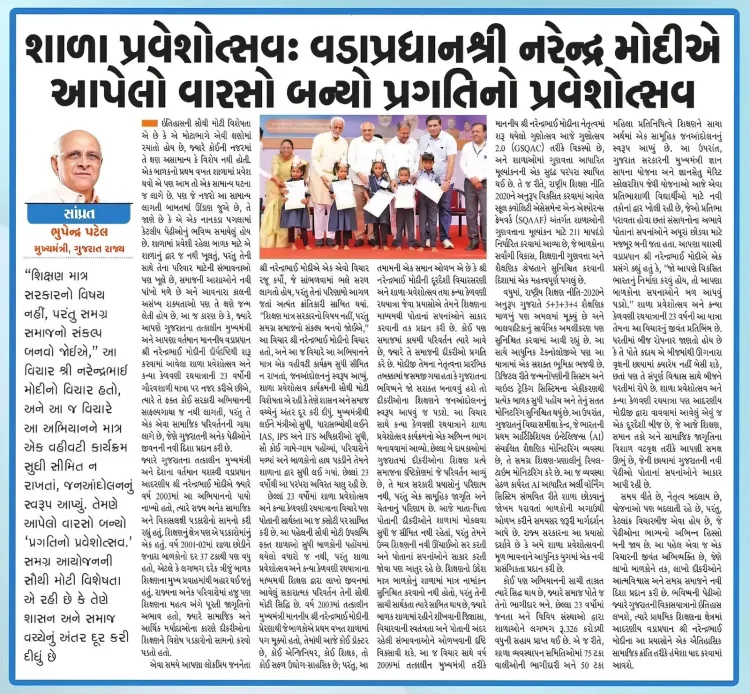
Chief Minister Bhupendra Patel authored a special article on Gujarat's education journey tied to the #ShalaPraveshostav2026 campaign.
The initiative was originally launched by Narendra Modi during his tenure as Gujarat's Chief Minister ( 2001–2014 ).
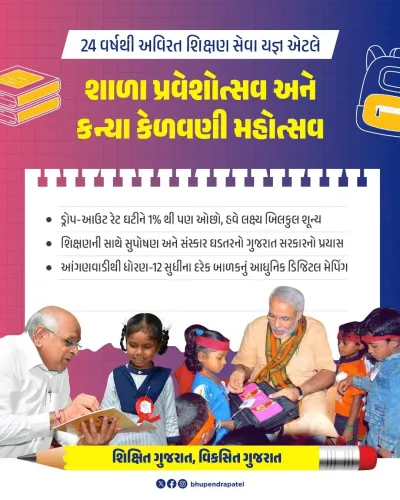
Shala Praveshotsav focuses on boosting school admissions and reducing dropouts; Kanya Kelavani Mahotsav specifically targets girl-child enrollment.
The Gujarat model frames education as a societal responsibility, predating national frameworks like the Sarva Shiksha Abhiyan .
Enrollment outcomes and participation data from the 2026 edition across Gujarat districts are awaited.
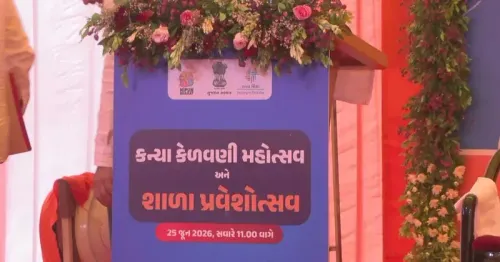
The Chief Minister's Office of Gujarat on Wednesday, 24 June 2026 shared a special article by Chief Minister Bhupendra Patel marking 23 years of the state's landmark education initiative, Shala Praveshotsav and Kanya Kelavani Mahotsav, originally launched by then-Chief Minister Narendra Modi in the early 2000s to transform school enrollment into a mass movement across Gujarat.
Context
The post, shared under the hashtag #ShalaPraveshostav2026, quotes a guiding principle: 'Shikshan maatra sarkarno vishay nahi, parantu samagra samajno sankalp banavo joie' ('Education must not remain merely a government concern, but must become the resolve of all of society'). Chief Minister Bhupendra Patel's article reflects on how the twin drives have shaped Gujarat's development trajectory alongside brightening the futures of its children.
The initiative was conceived during Narendra Modi's tenure as Gujarat's Chief Minister, a period spanning 2001 to 2014, with the explicit aim of treating education as a jan andolan — a people's movement — rather than a top-down administrative exercise.
Policy Backdrop
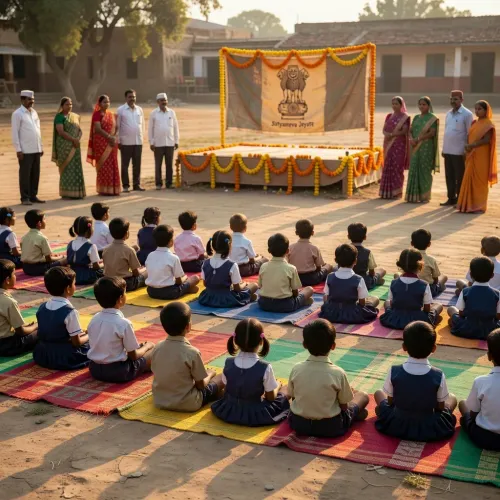
Shala Praveshotsav is an annual school enrollment drive designed to increase admissions and reduce dropout rates across Gujarat. It runs alongside Kanya Kelavani Mahotsav, a festival specifically promoting the enrollment and education of girl children, making community participation central to both campaigns.
The Gujarat model predates and in many ways parallels later national frameworks, including the Sarva Shiksha Abhiyan and the emphasis on universal access embedded in the National Education Policy. By anchoring enrollment drives in community ownership rather than bureaucratic mandate, the state pioneered an approach that has since influenced broader education policy thinking in India.
Stakeholders and Impact
The primary beneficiaries of these programs are school-age children across Gujarat, with a particular focus on girl students through the Kanya Kelavani component. The campaigns mobilise elected representatives, teachers, parents, and civil society alongside government machinery, embodying the 'societal resolve' framing articulated in the post.
Over 23 years, the sustained nature of these drives has made them a defining feature of Gujarat's education governance, with successive administrations continuing the tradition as a marker of state commitment to universal schooling. The current edition, Shala Praveshotsav 2026, carries forward that legacy under Chief Minister Bhupendra Patel's government.
What's Next
Attention will now turn to participation metrics and enrollment outcomes from the 2026 edition of Shala Praveshotsav across Gujarat's districts. Any announcements on scaling the community-driven model or integrating it with newer national education frameworks will be closely watched by policymakers and education administrators.
As Gujarat marks this milestone, the broader question is whether the state's two-decade experience of treating education as a societal compact can inform similar drives in other states still grappling with enrollment gaps and girl-child dropout rates.
Point of View
The ruling dispensation positions the program not merely as a scheme but as a civilisational commitment, insulating it from electoral-cycle disruptions. This narrative also serves a dual purpose: it reinforces Modi's developmental record in Gujarat while simultaneously crediting Patel's government with sustaining and extending that legacy. The 23-year milestone is a potent symbol in an era when policy discontinuity is a common criticism of Indian governance.
NationPress
22 Sept 2026
Frequently Asked Questions
What is Shala Praveshotsav in Gujarat?
Shala Praveshotsav is an annual school enrollment drive in Gujarat launched in the early 2000s by then-Chief Minister Narendra Modi to increase school admissions and reduce dropout rates by treating enrollment as a community-wide movement.
What is Kanya Kelavani Mahotsav?
Kanya Kelavani Mahotsav is a Gujarat government initiative run alongside Shala Praveshotsav that specifically promotes the enrollment and education of girl children, mobilising community participation to keep girls in school.
Who started Shala Praveshotsav and Kanya Kelavani Mahotsav?
Both programs were started by Narendra Modi during his tenure as Chief Minister of Gujarat, which lasted from 2001 to 2014, as part of his effort to make education a mass people's movement.
What did CM Bhupendra Patel write about Gujarat education?
Chief Minister Bhupendra Patel authored a special article shared on 24 June 2026 reflecting on 23 years of Gujarat's educational transformation through Shala Praveshotsav and Kanya Kelavani Mahotsav, emphasising that education must be a resolve of all of society, not just the government.
When is Shala Praveshotsav 2026?
The 2026 edition of Shala Praveshotsav was being highlighted by the Chief Minister's Office of Gujarat as of 24 June 2026; specific district-level dates and enrollment outcomes for the 2026 edition are yet to be officially announced.