Gujarat CM Patel Signs MoU With Meta for WhatsApp Governance
Synopsis
The Gujarat government under CM Bhupendra Patel has signed an MoU with Meta Platforms in Gandhinagar to deliver around 20 citizen services — including income, caste and EWS certificates, ration card updates, and grievance redressal — through a single WhatsApp number in English and Gujarati, advancing the state's digital governance push.
Key Takeaways
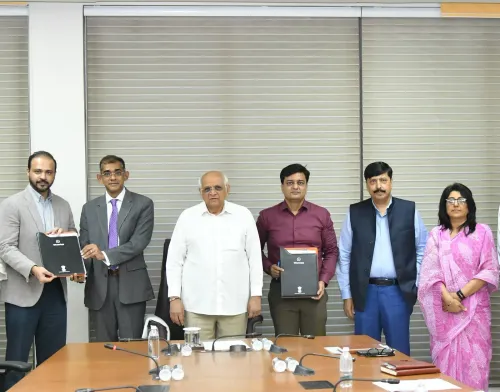
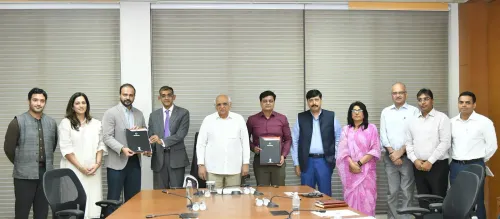
The Gujarat government and Meta Platforms signed an MoU in Gandhinagar on 25 May 2026 in the presence of CM Bhupendra Patel .
Approximately 20 government services will be accessible via a single WhatsApp number in English and Gujarati .
Services include income, caste and EWS certificates , ration card updates, revenue records, official affidavits, and grievance redressal.
Citizens will no longer need to visit multiple web portals or stand in queues at government offices for these services.
Real-time status tracking for submitted requests will be strengthened under the agreement.
The state government plans to add more services to the platform in phases in the coming months.
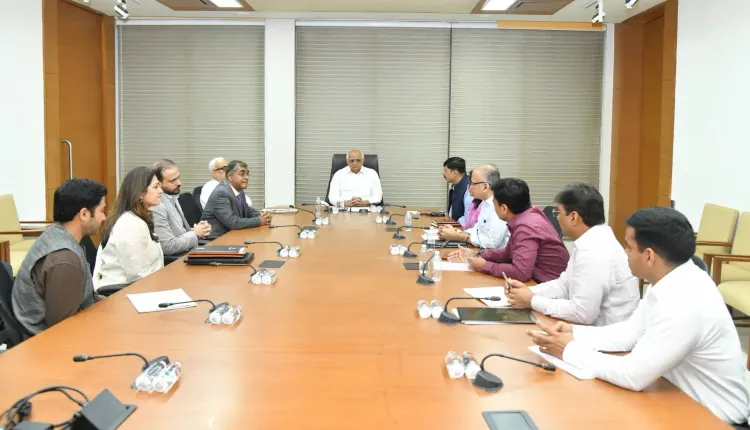
The Chief Minister's Office of Gujarat announced on Monday, 25 May 2026 that the Gujarat government, under Chief Minister Bhupendra Patel, has signed a landmark Memorandum of Understanding (MoU) with Meta Platforms in Gandhinagar to deliver government services directly through WhatsApp, marking a significant step in the state's digital governance agenda.
Context
The MoU was signed in the presence of Chief Minister Bhupendra Patel and will enable citizens to access approximately 20 government services through a single WhatsApp number in both English and Gujarati. Services covered include income, caste and EWS certificates, ration card updates, revenue records, official affidavits, and grievance redressal, all accessible from home without visiting a government office.
The CMO framed the initiative around Prime Minister Narendra Modi's guiding concept of 'Nagrik Devo Bhava:' ('The citizen is like God'), describing the MoU as translating that philosophy into practice — from 'One-Day Governance' to 'WhatsApp Governance.'
Policy Backdrop
The agreement is rooted in India's Digital India programme, launched in 2015, which set a national agenda for shifting routine government interactions to online and mobile platforms. Gujarat's partnership with Meta Platforms — the US technology company that owns WhatsApp — extends that mandate to a messaging platform used by hundreds of millions of Indians.
Several Indian states have previously piloted WhatsApp-based grievance redressal tools, but the Gujarat–Meta MoU is positioned as a broader, structured integration covering a wide basket of citizen services under one number. The approach avoids creating new physical infrastructure by leveraging an existing, widely adopted platform.
Stakeholders and Impact
Rural and urban citizens across Gujarat stand to benefit most directly. The MoU specifically addresses last-mile delivery — the persistent challenge of reaching citizens who lack reliable internet access to navigate multiple web portals or the time to queue at government offices.
Certificate applicants for income, caste, and Economically Weaker Section (EWS) categories are among the primary beneficiaries, as these documents are frequently required for education admissions, government jobs, and welfare schemes. The MoU also promises real-time status tracking for submitted requests, strengthening accountability in service delivery.
For Meta Platforms, the agreement deepens WhatsApp's role as a public-service infrastructure layer in India, one of its largest markets, building on earlier commercial and civic use-case expansions for the platform.
What's Next
The Gujarat government has stated its intent to add more services to the WhatsApp-based platform in phases in the coming months. The initial rollout of approximately 20 services is expected to serve as a proof-of-concept before the basket is expanded.
Observers will watch for the publication of adoption metrics and user feedback once the platform goes live, as these will determine whether the model can be scaled further or replicated by other states. The phased approach signals that the government is treating this as an evolving platform rather than a one-time deployment.
Point of View
Bypassing the adoption friction that has slowed standalone government app rollouts. By anchoring the initiative in PM Modi's 'Nagrik Devo Bhava:' framing, the Bhupendra Patel government is simultaneously advancing a local governance milestone and reinforcing its alignment with the Centre's Digital India narrative ahead of a period of heightened political visibility. The partnership also signals a maturing relationship between Indian state governments and global tech platforms, where the latter provide infrastructure in exchange for scale and legitimacy in a critical market. The real test will be last-mile uptake — whether citizens in low-connectivity rural Gujarat actually use the channel or whether the MoU remains an urban-facing showcase.
NationPress
21 Sept 2026
Frequently Asked Questions
What services will be available on Gujarat's WhatsApp governance platform?
Around 20 government services will be available, including income certificates, caste certificates, EWS certificates, ration card updates, revenue records, official affidavits, and grievance redressal, all accessible through a single WhatsApp number in English and Gujarati.
Who signed the MoU between Gujarat and Meta Platforms?
The MoU was signed between the Gujarat government and Meta Platforms in Gandhinagar in the presence of Chief Minister Bhupendra Patel on 25 May 2026 .
What is 'WhatsApp Governance' in Gujarat?
'WhatsApp Governance' refers to Gujarat's initiative to deliver government services directly through a single WhatsApp number, so citizens can apply for certificates, update ration cards, access revenue records, and file grievances without visiting offices or navigating multiple web portals.
What is 'Nagrik Devo Bhava:' and how does it relate to this MoU?
'Nagrik Devo Bhava:' ('The citizen is like God') is a concept promoted by Prime Minister Narendra Modi for citizen-first, responsive administration. The Gujarat government has cited this philosophy as the guiding principle behind the WhatsApp governance MoU with Meta Platforms.
Will more services be added to Gujarat's WhatsApp platform in the future?
Yes. The Gujarat government has stated that it plans to add more services to the WhatsApp-based platform in phases in the coming months, treating the current basket of around 20 services as an initial rollout.