Gujarat Launches STI Policy 2026–31, Paving Way for Semiconductor Industry Growth
Synopsis
Gujarat's new STI Policy 2026–31 heralds a transformative era for the semiconductor industry, aiming to elevate the state as India's tech hub. Discover how this initiative, unveiled at the Gujarat SemiConnect Conference, promises to reshape the economic landscape and enhance global positioning.
Key Takeaways
Gujarat's STI Policy 2026–31 aims to bolster the semiconductor industry.
Transformational conference attended by key government and industry figures.
Dholera to evolve into India’s Semicon City .
Commitment to sustainability and green growth .
Focus on developing a skilled workforce for the tech sector.
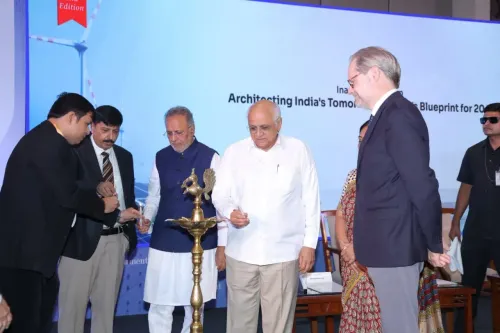
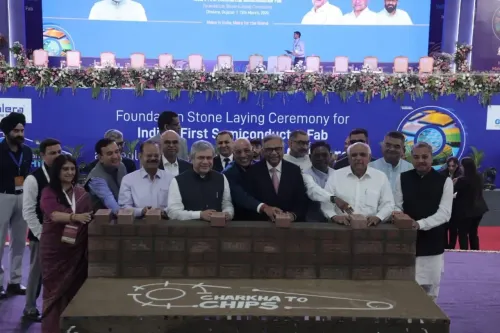
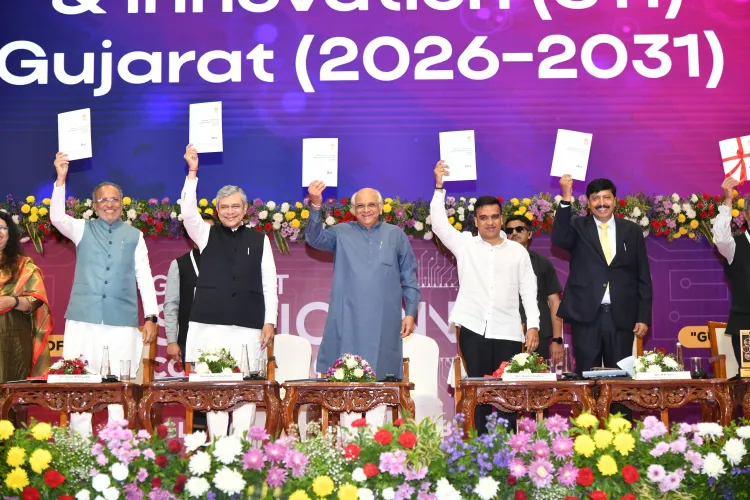
Gandhinagar, March 1 (NationPress) The government of Gujarat has officially presented its Science, Technology, and Innovation (STI) Policy for the years 2026–31 as Chief Minister Bhupendra Patel inaugurated the Gujarat SemiConnect Conference-2026 in Gandhinagar, detailing the state's ambitious agenda to enhance the realms of semiconductor manufacturing, design, and research.
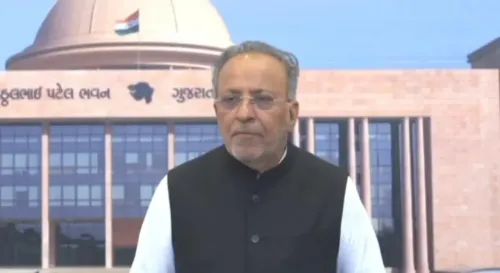
The event, hosted by the Gujarat Department of Science and Technology under the banner "Gujarat: India's Silicon Gateway," saw attendance from Union Electronics and IT Minister Ashwini Vaishnaw, Deputy Chief Minister Harsh Sanghavi, State Science and Technology Minister Arjun Modhwadia, along with key officials and representatives from various domestic and international semiconductor firms.
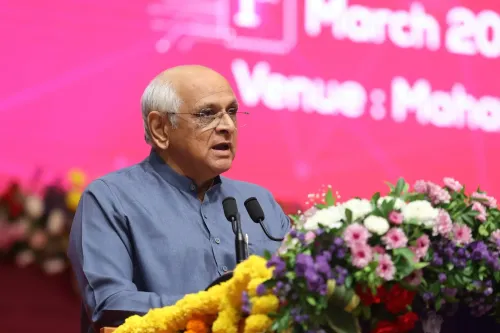
During his speech, Chief Minister Patel emphasized that this conference represents a pivotal moment in Gujarat's economic evolution.
"This gathering marks a significant transition for Gujarat, evolving from the nation’s growth engine to a tech powerhouse," he stated.
"With assured policy stability, transparency, and a favorable business environment, Gujarat is rapidly becoming a leader in semiconductor and chip production," the Chief Minister added.
Referencing national ambitions such as "Viksit Bharat @ 2047" and "Aatmanirbhar Bharat," Chief Minister Patel affirmed Gujarat's dedication to realizing Prime Minister Narendra Modi's vision through "a journey from chip to champion."
He also noted, "Under Prime Minister Modi's guidance, India is solidifying its position in the hardware domain, fostering the belief that India is ready, dependable, and capable of delivering results."
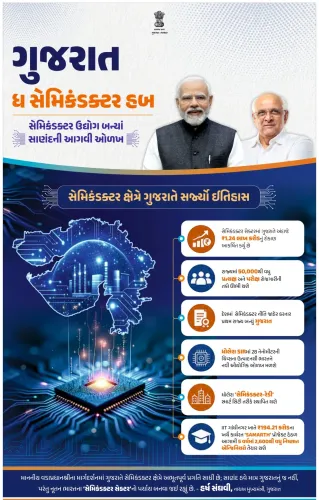
Chief Minister Patel remarked that the Dholera Special Investment Region (DSIR) is evolving beyond mere plans to become the nation's Semicon City.
He highlighted that robust infrastructure, plug-and-play setups, and advanced logistics systems are being established in Dholera and Sanand to cater to the future needs of the semiconductor industry.
"We are laying down the necessary infrastructure and logistics alongside a young, skilled workforce," he explained, mentioning the establishment of a nano-fabrication laboratory at IIT Gandhinagar aimed at fostering advanced research and training.
He also pointed out that amid global concerns regarding carbon emissions and taxes, Gujarat, as a power-surplus state with a strong renewable energy foundation, is prioritizing sustainable growth.
On Saturday, Union Minister Vaishnaw celebrated a milestone in India's semiconductor journey with Prime Minister Modi inaugurating Micron's first plant in Sanand.
"With Micron's plant now operational, India has carved out a unique position on the global semiconductor map," he stated.
Looking ahead, he announced, "We will kick off Semicon 2.0 with the goal of transforming India into not just a manufacturing hub but a global center for design, machinery, and talent."
Reflecting on the program's inception, Union Minister Vaishnaw recalled, "When the initial semiconductor presentation was made in 2021, the Prime Minister dedicated three hours to review every detail, exceeding the planned 45 minutes. This highlights the seriousness of this initiative."
He affirmed that under Semicon 2.0, India aims to nurture deep-tech start-ups, aspiring to cultivate companies akin to Qualcomm, Broadcom, and Nvidia domestically.
"India will not only produce semiconductor chips but will also manufacture chip-making machinery, materials, and develop testing ecosystems with a long-term vision in mind," he added.
On the topic of workforce development, Union Minister Vaishnaw mentioned, "A global shortfall of two million semiconductor professionals is anticipated, and India will play a crucial role in bridging this gap."
He noted that the target of training 85,000 engineers within a decade was achieved in just four years.
"Students from 35 universities are currently engaged in the design of real chips. We plan to extend this network to 500 universities, allowing more youth across states to partake in this high-tech sector," Union Minister Vaishnaw stated.
He also addressed the infrastructure and financial commitments, indicating that $250 billion has been pledged at the infrastructure level, complemented by $17 billion in funding for deep-tech ventures.
Tax incentives have been guaranteed until 2047 to ensure policy stability, the Union Minister confirmed.
"With surplus energy and clean resources, Gujarat holds a significant opportunity to develop data centers, contributing to India's aspiration of becoming a global data hub," he added.
Deputy Chief Minister Sanghavi remarked that Gujarat has become the preferred destination for investors nationwide.
"Gujarat assures the highest returns on investment in the country," he stated, further adding, "It provides not only investment prospects but also a secure future."
While providing economic statistics, the Deputy Chief Minister mentioned, "Despite representing only five percent of the nation's population and covering six percent of its geographical area, Gujarat contributes over 18 percent to India's manufacturing output, more than 8 percent to GDP, over 30 percent to exports, and more than 40 percent to total cargo handling."
He emphasized that the state's longstanding political and policy stability is a key asset, and the government is proactive in addressing investor concerns.
State Minister Modhwadia remarked that the Covid-19 pandemic has revealed weaknesses in semiconductor supply chains.
"When supply chains were interrupted, industries worldwide faced challenges because semiconductors are essential components. Viewing this as a challenge, India has committed to becoming a semiconductor hub," he added.
Concerning the Micron Assembly, Test, and Packaging plant in Sanand, the Minister stated, "This is a significant achievement, but considerable progress lies ahead."
Point of View
The unveiling of the STI Policy 2026–31 by Gujarat signifies a strategic move towards establishing the state as a major player in the semiconductor sector. The emphasis on infrastructure, skill development, and sustainability reflects a forward-thinking approach that aligns with India's broader ambitions in technology and manufacturing.
NationPress
17 Oct 2026
Frequently Asked Questions
What is the purpose of Gujarat's STI Policy 2026–31?
The STI Policy 2026–31 aims to enhance semiconductor manufacturing, design, and research in Gujarat, transforming the state into a tech hub.
Who inaugurated the Gujarat SemiConnect Conference?
The conference was inaugurated by Chief Minister Bhupendra Patel.
What is the significance of the Dholera Special Investment Region?
Dholera is being developed into India's Semicon City, equipped with the necessary infrastructure for the semiconductor industry.
How does Gujarat plan to support workforce development in the semiconductor sector?
Gujarat aims to train a skilled workforce through partnerships with universities and the establishment of training programs.
What are the projected economic contributions of Gujarat?
Gujarat contributes significantly to India's manufacturing output, GDP, and exports, making it a vital economic player.