Did Gujarat's wetlands host over 8.33 lakh migratory birds in 2024–25?
Click to start listening
Synopsis
Gujarat's wetlands have emerged as a thriving sanctuary for migratory birds, with over 8.33 lakh recorded in 2024–25. This impressive figure highlights the state's commitment to conservation and its role as a vital stopover for various avian species on their long migrations. Discover the ongoing efforts that make Gujarat a birdwatcher's paradise.
Key Takeaways
- Gujarat recorded over 8.33 lakh migratory birds in 2024–25.
- The Khijadiya Bird Sanctuary alone had 3.09 lakh birds from 334 species.
- Nal Sarovar and Thol combined saw over 4.67 lakh birds.
- Gujarat's conservation efforts have a rich history dating back to Modi's tenure.
- The state has undertaken initiatives like the ‘Karuna Abhiyan’ for wildlife rescue.
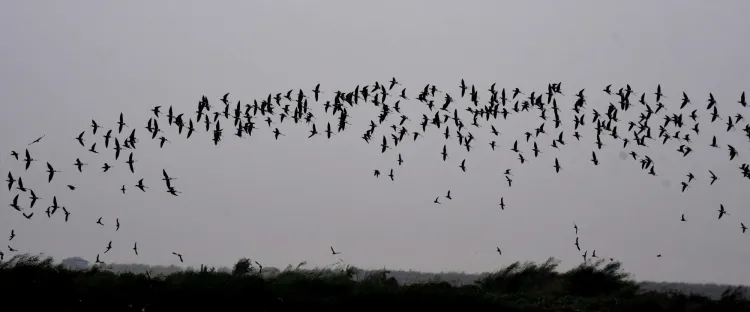
Gandhinagar, Jan 4 (NationPress) Gujarat's wetlands welcomed over 8.33 lakh migratory birds during the 2024–25 season, further solidifying its status as one of India's most secure and favored locations for birdwatchers.
Official statistics reveal that the Khijadiya Bird Sanctuary alone attracted more than 3.09 lakh birds across 334 species last year.
In addition, the joint tally at Nal Sarovar Bird Sanctuary and Thol Bird Sanctuary surpassed 4.67 lakh birds, with the Wadhwana Wetland housing over 54,000 birds.
The Kutch region accounted for 2,564 migratory birds in 2025, highlighting its increasing significance along international migratory routes. Among the nearly 9,000 bird species worldwide, around 1,200 species are found in India, which includes more than 400 migratory species. These birds undertake extensive journeys from Siberia, Eastern Europe, North Asia, and Central Asia, selecting Gujarat’s wetlands as temporary havens.
Officials attribute the consistent growth in migratory bird populations to Gujarat's enduring conservation policies.
Wildlife protection efforts initiated during Prime Minister Modi's time as Gujarat's Chief Minister have been continually supported under Chief Minister Bhupendra Patel, alongside effective enforcement, habitat preservation, and community involvement.
Led by Forest and Environment Minister Arjun Modhwadia and Minister of State Pravin Mali, the Forest Department and wildlife organizations have engaged in ongoing conservation and habitat management activities. At Khijadiya, notable species like flamingos, pelicans, painted storks, ibises, spoonbills, ducks, geese, eagles, kites, kingfishers, and herons were prominently observed.
According to estimates from 2023, Gujarat is also home to over 2.85 lakh peafowl, the national bird of India.
Established as a sanctuary in 1969 and recognized as a Ramsar Site in 2012, Nal Sarovar spans 120.82 sq km and is situated on the Central Asian Flyway, attracting 329 recorded bird species, including migratory birds that stop briefly during their extensive travels.
Thol Bird Sanctuary continues to host a diverse array of waterbirds, such as pelicans, ducks, geese, cranes, ibises, storks, raptors, and waders, while Wadhwana Wetland has reported sightings of migratory species like bar-headed geese, northern pintails, common teal, glossy ibises, and the rare black-necked stork. Meanwhile, Kutch has gained renewed attention through the Passage Migrant Count, India's premier citizen-science initiative launched in 2022.
From September 19–21, the largest edition of the survey was conducted across 10,000 sq km of Kutch, involving over 200 birders from 17 states surveying deserts, grasslands, thorn forests, and coastal areas. More than 600 eBird checklists documented over 250 bird species, underscoring the area’s role as a crucial refueling stop for birds crossing the Arabian Sea.
Remarkably, the survey included sightings of 1,577 European Rollers, 313 Spotted Flycatchers, and 379 Blue-cheeked Bee-eaters, among various other migratory species. In addition to habitat conservation, Gujarat has prioritized wildlife rescue and awareness. Since 2017, the state has executed the annual ‘Karuna Abhiyan’ during Uttarayan, aimed at rescuing birds harmed by kite strings. During Uttarayan 2025 alone, over 17,000 injured birds were rescued and treated.
The state also recognizes National Bird Day on January 5, fostering citizen awareness and community-led conservation efforts.
With ongoing protection, scientific supervision, and public engagement, Gujarat continues to enhance its reputation as a “paradise for birdlife”, providing a secure seasonal refuge for migratory birds from around the globe.
Point of View
I emphasize that Gujarat's remarkable achievement in attracting over 8.33 lakh migratory birds is a testament to its effective conservation strategies. This success story not only enhances the state's ecological integrity but also boosts tourism and public awareness about the importance of protecting our avian friends.
NationPress
05/01/2026
Frequently Asked Questions
What factors contribute to Gujarat's status as a bird sanctuary?
Gujarat's extensive wetlands, robust conservation policies, habitat protection, and community involvement significantly contribute to its reputation as a premier bird sanctuary.
How many species of birds are found in Gujarat?
Gujarat is home to over 400 migratory species and attracts approximately 329 recorded bird species in sanctuaries like Nal Sarovar.
What initiatives are in place for wildlife rescue in Gujarat?
The annual ‘Karuna Abhiyan’ is a key initiative in Gujarat aimed at rescuing birds injured during kite flying events.
What role does the Kutch region play in migratory patterns?
The Kutch region serves as a crucial stopover on international flyways, hosting thousands of migratory birds each season.
What is the significance of National Bird Day in Gujarat?
National Bird Day, observed on January 5, promotes awareness and encourages community participation in bird conservation efforts.