What Happens After Maduro's Arrest? US Faces Uncertainty Over Venezuela's Political Transition
Synopsis
With Nicolás Maduro's arrest, Venezuela faces a pivotal moment. As U.S. officials navigate the complexities of leadership and legitimacy, the future of Venezuela's governance remains uncertain. Will the U.S. find a path forward amidst political turmoil? Discover the implications of this significant event and what it means for the region.
Key Takeaways
Maduro's arrest creates a power vacuum.
U.S. officials recognize the need for engagement.
Delcy Rodríguez steps into a leadership role.
Legitimacy of leadership remains a contested issue.
The role of military forces in governance is crucial.
Washington, Jan 5 (NationPress) The apprehension of Nicolás Maduro has eliminated Venezuela’s most prominent power figure, yet officials in the United States recognize significant ambiguity regarding who will take control of the nation and how a political transition may transpire.
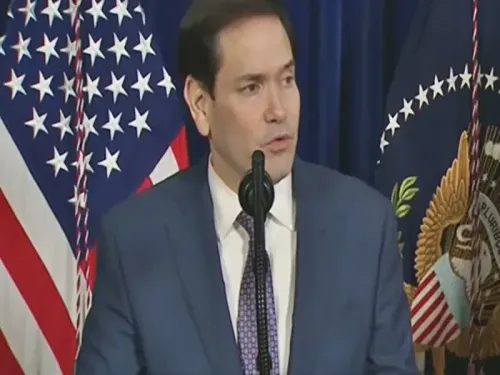
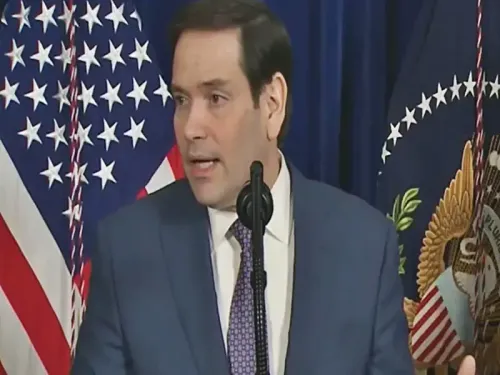
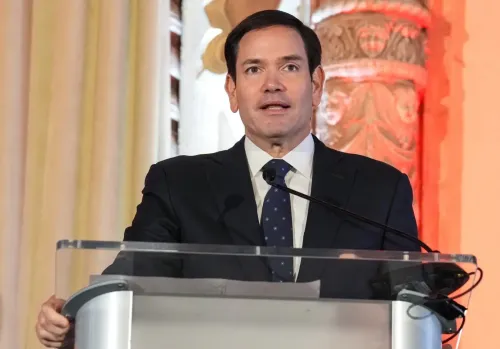
Secretary of State Marco Rubio stated that the U.S. does not acknowledge Maduro or any of his successors as valid leaders but must confront what he termed the immediate realities on the ground.
“We must engage with the individuals who possess the firearms,” Rubio remarked during an interview on NBC’s Meet the Press, alluding to the Venezuelan security forces and institutions that remain fully operational.
Rubio confirmed in discussions with ABC News and CBS News that he has communicated with Vice President Delcy Rodríguez, who has stepped into a leadership role following Maduro’s detention. He refrained from elaborating on any promises she may have made.
“What counts is their actions,” Rubio conveyed to CBS News’ Face the Nation. “We will evaluate everything based on their behavior.”
Rubio emphasized that engagement does not imply recognition. On ABC’s This Week, he noted that the United States has frequently had to interact with authorities it does not recognize to achieve limited goals.
“That’s distinct from acknowledging their legitimacy,” Rubio stated on ABC News.
The issue of legitimacy dominated discussions on Sunday. Analysts featured on CNN pointed out that Rodríguez has been sanctioned by both the United States and the European Union and played a crucial role in Maduro’s administration.
Journalist David Sanger from The New York Times indicated on CNN’s widely viewed Sunday talk show GPS with Fareed Zakaria that the Biden administration seems to be opting for pragmatism over democratic symbolism, engaging with whomever can ensure immediate compliance.
Concurrently, some experts referenced opposition leaders María Corina Machado and Edmundo González, who claimed victory in the contentious 2024 election. So far, she has remained outside the transition process.
Rubio expressed admiration for the opposition but remarked that immediate elections are unrealistic after extensive authoritarian governance. “Everyone desires an election tomorrow,” he remarked to ABC News. “That’s ridiculous.”
“These processes require time,” Rubio stated on CBS News. “There’s a procedure.”
Military analysts cautioned that Venezuela’s armed forces remain strong and unified. Former U.S. Southern Command chief Admiral James Stavridis commented on CNN that Washington now faces challenging decisions.
“You can either collaborate with existing structures, or you risk chaos,” Stavridis warned, adding that a gradual transition might be the only feasible path forward.
Rubio claimed that the United States will persist in applying pressure using oil sanctions and maritime enforcement while observing the behavior of Venezuela’s interim leadership.
“We possess multiple levers of influence,” Rubio indicated on NBC News, highlighting the ongoing oil blockade.
At this juncture, Maduro is in U.S. custody and facing prosecution. However, as officials and analysts recognized on Sunday, the removal of a single leader has not resolved the more profound question of governance.
“What follows next,” Stavridis stated on CNN, “is the most challenging aspect.”
Point of View
My perspective is rooted in the belief that political transitions require a careful balance of engagement and principles. While the U.S. must navigate the complexities of Venezuelan politics, we remain committed to supporting democratic ideals and the voices of the Venezuelan people in their quest for a stable and just governance.
NationPress
1 Oct 2026
Frequently Asked Questions
What is the current political situation in Venezuela?
Following Nicolás Maduro's arrest, there is significant uncertainty regarding who will lead Venezuela and how a political transition will unfold.
How does the U.S. government view Maduro's successors?
The U.S. does not recognize Maduro or his successors as legitimate leaders but acknowledges the need to engage with existing power structures.
Who is Delcy Rodríguez?
Delcy Rodríguez is the Vice President of Venezuela and has taken on a leadership role following Maduro's arrest.
What are the implications of the U.S. sanctions on Venezuela?
The U.S. sanctions aim to exert pressure on the Venezuelan government while impacting its economy, especially the oil sector.
What might happen next in Venezuela?
The future of Venezuela's governance is uncertain, with discussions focusing on the need for gradual political transitions and potential elections.