Is the Hadi murder an orchestrated attempt to incite chaos in Bangladesh?
Click to start listening
Synopsis
Tensions in Bangladesh soar after the murder of Sharif Osman Hadi, a key figure in last year's student uprising. The incident is viewed as a potential internal hit, igniting violence against pro-India supporters. The unfolding chaos raises concerns about election delays and a rise in anti-India sentiments, posing significant implications for regional stability.
Key Takeaways
- Hadi's assassination has triggered widespread violence in Bangladesh.
- There are fears of election delays due to the chaos.
- Efforts are being made to incite anti-India sentiments.
- The situation appears to be orchestrated for political gain.
- Radical elements are exploiting the unrest for their agenda.
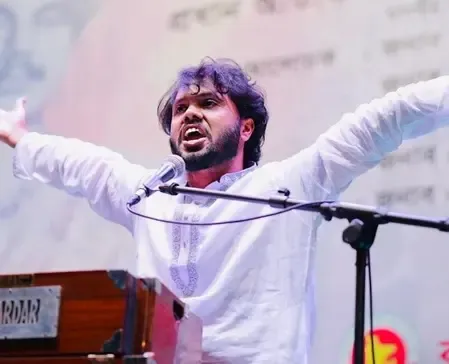
New Delhi, Dec 19 (NationPress) Tension is escalating in Bangladesh following the assassination of Sharif Osman Hadi, a prominent figure in last year's student uprising. Although details regarding the perpetrators remain scarce, Indian intelligence agencies suspect this to be an internal assassination.
The murder has sparked significant unrest in Dhaka, with violence directed at pro-India individuals, impartial media, Hindus, and supporters of the Awami League, as well as their property.
A closer examination of the unfolding events suggests a deliberate orchestration aimed at achieving two primary goals.
Firstly, there appears to be a concerted effort to postpone the elections. Secondly, there is a blatant attempt to instigate anti-India sentiments.
Current opinion polls indicate that the Jamaat-e-Islami is gaining ground against the Bangladesh Nationalist Party (BNP). Experts assert that if elections proceed fairly, the BNP could emerge victorious.
This outcome is undesirable for both the ISI-affiliated Jamaat and interim government leader Mohammad Yunus.
In the aftermath of the student uprising that led to the ousting of the Sheikh Hasina government, the National Citizens Party (NCP) was established, comprising students from the uprising. They now find themselves with little chance in the upcoming elections.
Yunus fully supports the NCP, and he too seeks a delay in the elections to allow his favored party time to solidify its position.
Officials have noted that the narrative being cultivated suggests that conducting elections in Bangladesh is unsafe. This aligns with the ISI's agenda, allowing them to interfere in the country for an extended period.
Everything that has transpired in Bangladesh recently appears to be meticulously orchestrated, according to officials.
Each incident is being politicized, resulting in violence erupting at the slightest provocation.
It is crucial to observe how anti-India sentiments are being fueled by these violent occurrences.
Hadi was known for his overtly anti-India stance, and there are efforts in Bangladesh to portray his murder as the work of pro-India factions. This narrative could provoke widespread anger, making it easier for radicals to incite violence across the nation, officials caution.
In Chattogram, incidents of stone throwing were reported at the Deputy High Commission's office and residence. Videos circulating on social media depict radical and militant activities.
In Dhaka, a radical faction attempted to march towards the Indian High Commission, breaking through barricades, chanting anti-India slogans, and issuing threats. They were, however, contained by law enforcement.
Agency officials believe there is a calculated effort to internalize the situation, portraying India as the source of public discontent.
It has also become evident that the management of the violence appears institutional, as law enforcement agencies showed inaction in various areas.
Instability in the neighboring country poses a significant threat to internal security. Furthermore, New Delhi will have considerable countermeasures to implement as Bangladesh attempts to construct a misleading narrative aimed at provoking anti-India sentiments, officials conclude.
Point of View
It is crucial to observe the unfolding events in Bangladesh with a critical lens. The murder of Hadi, amidst allegations of orchestrated violence, underscores the delicate balance of power and the potential for heightened anti-India sentiments. Our commitment is to provide an unbiased perspective while ensuring that the voices of the affected citizens are heard.
NationPress
19/12/2025
Frequently Asked Questions
What sparked the recent violence in Bangladesh?
The violence was triggered by the assassination of Sharif Osman Hadi, a significant figure in the student uprising. This event has led to unrest targeting various groups, including pro-India supporters.
What are the implications for upcoming elections?
There are concerns that the ongoing chaos may lead to delays in the elections, which could benefit certain political factions while undermining democratic processes in Bangladesh.
How is anti-India sentiment being stoked?
The narrative surrounding Hadi's murder is being manipulated to portray pro-India elements as responsible, potentially inciting public anger and violence against Indian interests.
What role do Indian agencies play in this situation?
Indian intelligence agencies are monitoring the situation closely and suspect that the murder may have internal motivations aimed at destabilizing the region.
How can the situation impact India-Bangladesh relations?
The growing unrest and anti-India sentiments could strain diplomatic relations and complicate security dynamics between the two nations.