Haryana CMO Backs FPO Mission 2026 to Boost Farmer Incomes
Synopsis
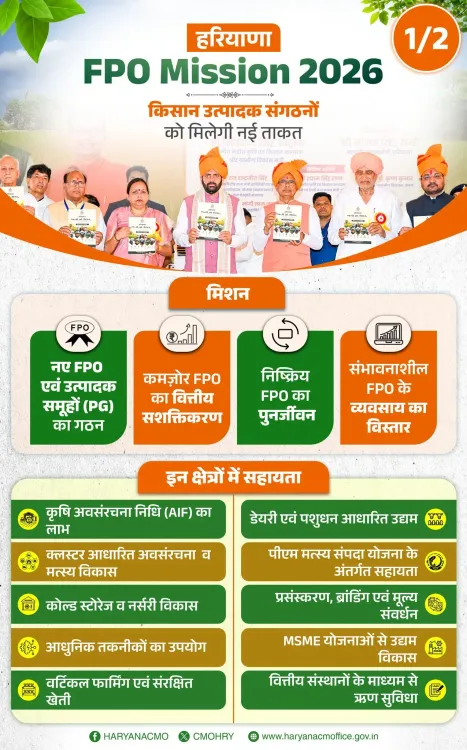
The Chief Minister's Office of Haryana on 3 July 2026 highlighted FPO Mission 2026, a programme to organise farmers into producer collectives and connect them to better markets, fair prices, and new commercial opportunities — building on India's national FPO policy framework to raise rural incomes across the state.
Key Takeaways
The Chief Minister's Office of Haryana promoted Haryana FPO Mission 2026 on 3 July 2026 , framing it as a major agricultural reform initiative.
The mission aims to empower Farmer Producer Organisations (FPOs) to give farmers access to better markets, fair prices, and new business opportunities.
The programme builds on the Government of India's 2020 central scheme to promote 10,000 FPOs with an outlay of ₹6,865 crore .
Primary beneficiaries are small and marginal farmers in Haryana , a state whose economy is anchored in wheat, rice, and horticulture.
Key institutions expected to support implementation include NABARD and the Small Farmers' Agribusiness Consortium (SFAC) .
Budget allocations, new FPO registration targets, and agency partnerships are the immediate milestones to watch in 2026 .
The Chief Minister's Office of Haryana on Friday, 3 July 2026 promoted Haryana FPO Mission 2026, describing the programme as a significant initiative to organise farmers, connect their produce to better markets, fair prices, and new commercial opportunities.
The official post, shared from the CMO Haryana account, stated in Hindi: 'हरियाणा FPO Mission 2026 किसानों को संगठित कर उनकी उपज को बेहतर बाज़ार, उचित मूल्य और नई व्यावसायिक संभावनाओं से जोड़ने की एक महत्वपूर्ण पहल।' — translated: 'Haryana FPO Mission 2026 is an important initiative to organise farmers and connect their produce to better markets, fair prices, and new commercial possibilities.' The post further described the mission as 'an important step towards making agriculture more profitable and increasing farmers' incomes by empowering Farmer Producer Organisations (FPOs).'
Context
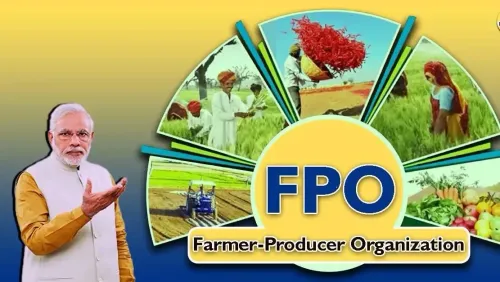
Farmer Producer Organisations (FPOs) are registered collectives that aggregate smallholder produce, strengthen bargaining power, and improve access to inputs, credit, and markets. Haryana, a northern Indian state where wheat, rice, and horticulture are central to the rural economy, has positioned FPOs as a key vehicle for raising farm incomes and reducing dependence on intermediaries. The state's push aligns with a well-established national policy direction. India first issued guidelines for FPO promotion in 2013, and the approach gained significant scale when the Government of India launched a central sector scheme in 2020 to form and promote 10,000 FPOs with a total outlay of ₹6,865 crore. Haryana's mission continues this pattern of adapting the central framework to local crops and market conditions.Policy Backdrop
The central FPO scheme of 2020 tasked implementing agencies — including NABARD and the Small Farmers' Agribusiness Consortium (SFAC) — with hand-holding newly registered collectives through a five-year support cycle covering cluster-based business organisations, equity grants, and credit guarantees. States that built on this architecture have reported improved realisation for perishables and commodities alike. Haryana FPO Mission 2026 follows this centre-state coordination model, aiming to empower FPOs as commercial entities rather than passive aggregators. By giving collectives access to better market linkages and business development support, the mission targets the chronic problem of fragmented smallholder holdings that suppress negotiating leverage and post-harvest value retention.Stakeholders and Impact
The primary beneficiaries are small and marginal farmers across Haryana who currently sell individually and absorb the cost of fragmentation. FPO membership allows them to pool volumes, standardise quality, and negotiate collectively — outcomes that translate directly into higher net income per acre. Beyond the farm gate, the mission is expected to stimulate ancillary activity in storage, grading, processing, and logistics — sectors that generate rural non-farm employment. Institutions such as NABARD and SFAC are the natural partners for credit facilitation and technical support during the rollout phase, and their engagement will be a key indicator of programme depth.What's Next
Policy watchers will track state budget allocations earmarked for the mission, targets for the number of new FPOs to be registered or strengthened, and formal partnership agreements with national implementing agencies. The 2026 timeline implies the current year is critical for operationalising the framework, making announcements on funding and institutional tie-ups the immediate milestones to watch. If Haryana succeeds in building a dense, well-capitalised FPO network, it could serve as a replicable model for other agriculturally intensive states seeking to move smallholders up the value chain without large direct subsidy outlays.Point of View
The CMO is aligning with a broader national shift away from price-support dependence toward market-integration as the primary income lever for farmers. The timing — mid-2026 — suggests the government is entering an active implementation and visibility phase, likely ahead of budget or partnership announcements. Whether the mission translates rhetoric into measurable income gains for smallholders will depend heavily on how quickly institutional credit and market linkages are operationalised on the ground.
NationPress
1 Oct 2026
Frequently Asked Questions
What is Haryana FPO Mission 2026?
Haryana FPO Mission 2026 is a state government programme to organise farmers into Farmer Producer Organisations (FPOs), connecting their produce to better markets, fair prices, and new commercial opportunities with the goal of increasing agricultural incomes.
What is a Farmer Producer Organisation (FPO)?
An FPO is a registered collective of farmers that pools produce to improve bargaining power and gain better access to inputs, credit, and markets — helping smallholders earn more than they could selling individually.
How does Haryana FPO Mission 2026 relate to the central government's FPO scheme?
It builds on the Government of India's 2020 central sector scheme that aimed to form and promote 10,000 FPOs with an outlay of ₹6,865 crore. Haryana's mission adapts this national framework to the state's specific crops and market conditions.
Who benefits from Haryana FPO Mission 2026?
Small and marginal farmers across Haryana are the primary beneficiaries, gaining collective market access and negotiating leverage. The mission is also expected to generate rural employment in storage, grading, processing, and logistics.
Which agencies will support the implementation of Haryana's FPO Mission?
NABARD and the Small Farmers' Agribusiness Consortium (SFAC) are the key national institutions expected to provide credit facilitation and technical support during the rollout phase of the mission.